
El aumento en los precios empieza a consolidarse

El Ministerio de Fomento acaba de publicar el índice de precios para el primer trimestre de 2016 con buenas noticias para todos nosotros salvo, quizás, para los compradores, ya que el aumento en los precios para Marbella y Estepona parece estar, poco a poco, consolidándose. Con base interanual y por primera vez desde 2008, se ven aumentos en el índice de precios de un 4% para Marbella y Estepona.

Variacion de precio por trimestre en Marbella y Benahavis 2016

He comentado en numerosas ocasiones sobre esta cuestión, y la última, el pasado enero, cuando todavía el crecimiento no estaba claro sobretodo viendo las sensaciones en la calle. Aunque el mercado sigue aún lento, parece que la tendencia al alza de los precios ya está aquí. Si se observa, el gráfico adjunto, se ve que en todas las localidades alrededor de Marbella, excepto por Fuengirola, los precios parecen haber empezado a subir. Para verlo aún mejor, he recopilado en el gráfico que se encuentra debajo, año por año, el incremento del índice de precio en las mismas localidades en los últimos tres años y podemos ver claramente la diferencia: en 2013 hubo un descenso medio aproximado del 10%, un mínimo descenso en 2014 como año de transición y aumentos en 2015. Todavía es un aumento moderado de un 4% pero lo importante es el cambio en la tendencia. Algunos analistas ya predijeron el mismo aumento para 2016 y parece ser cierto. Espero que la inestabilidad política en España y las elecciones no afectarán este renacer.

Variacion interanual de precios en Marbella y Benahavis entre 2013 y 2016

The increase in the housing prices starts to consolidate

The Ministry of Housing just released the data of the housing price index for the first quarter of 2016 with good news for all of us, except maybe for the buyers, as the increase in the housing prices for Marbella and Estepona seems to be, yet slow, consolidated. On a yearly basis, and for the first year since the 2008 crash, we are seeing increases in the index price of about 4% for both Marbella and Estepona.

price-index-marbella-benahavis-winter-2016

I have been talking about this issue and, even, when I wrote in January about the price index I still had some concerns about the recovery because I was still feeling, at street level, that the market was still slow, but seems that we are definitively getting out. Taking a close look to the chart we will see that in all the municipalities around Marbella, except maybe for Fuengirola, the prices seemed to have reached the bottom and are starting to increase. 

price-variation-marbella-benahavis-winter-2016

To get a closer view, I produced a chart with the year-to-year increases in the price index in the same municipalities in the last three years and we can see clearly the difference: in 2013 an average of 10% decreases, minimum decreases in 2014 as the transition year and increases in 2015. We are talking about a still moderate 4% increase but the important fact is the change in the tendency. Some analysts already predicted the same increases for 2016 and seems to be right. I hope that the political instability in Spain and the brexit vote will not affect this recovery. 

What is being sold in Malaga Province

I have always considered that it is important for us to know exactly what is being sold in the area we work at. In this line, the data of the percentage of units sold per price has always attracted my attention because most of the sales in the province of Malaga are properties under 150.000 €, 60% of the total units closed, and in the area I work at, Marbella and Benahavís, that is a product that hardly exists.

transaction-per-price-range-marbella-benahavis-costa-del-sol

On the chart attached, it can be seen the percentage of units sold on different price ranges and how it changes with time. There are two important conclusions we can extract from this chart: the first is that 60% of the units were sold under 150.000 € and that between 85% and 90% of the units were sold below 300.000 € and , the second , is that the tendency shows that in 2015 there were more properties being sold on the higher ranges, on properties on top of 750.000 €, where the percentage doubled in the last three years. Why is that important to Marbella and Benahavís, because, as it can be seen on the charts below, only 3,7 % of the properties below 150.000 € in the province of Malaga are in Marbella and Benahavís and, on the other side, 64,7% of the properties of top of 750.000 € are here. Therefore, and as conclusion, this change of tendency in the market for higher end properties will affect more positively to Marbella and Benahavís than to the rest of the municipalities of the province of Malaga as we are seeing on the positive evolution of the transactions of these two councils.

properties-for-sale-malaga-province-percentage-150000
properties-for-sale-malaga-province-percentage-300000
properties-for-sale-malaga-province-percentage-1000000

¿Qué se está vendiendo en la provincia de Málaga?

Siempre he considerado importante saber exactamente que se vende en la zona que trabajamos. Así, los datos porcentuales de las unidades vendidas por precio siempre han llamado mi atención ya que la mayoría de las ventas en la provincia de Málaga son propiedades inferiores a 150.000 euros, 60% del total de las unidades vendidas, y donde trabajo, Marbella y Benahavís, es un producto que raramente existe.

Malaga, Marbella and Benahavis - porcentaje de ventas por precio

En el gráfico adjunto, podemos ver el porcentaje de las unidades vendidas según los diferentes rangos de precios y cómo va cambiando según el tiempo. Hay dos importantes conclusiones que podemos apreciar: la primera es que el 60% de las unidades vendidas son por debajo de 150.000 € y entre el 85% y 90% de las unidades vendidas por debajo de 300.000 € y, la segunda, la tendencia muestra que en 2015 había más propiedades vendidas en los rangos superiores, en propiedades de 750.000 €, donde el porcentaje se dobla en los últimos tres años. Es importante para Marbella y Benahavís porque, como podemos ver en el gráfico, solo el 3.7% de las propiedades por debajo de 150.000 € en la provincia de Málaga están en Marbella y Benahavís, y, por otro lado, el 64.7% de las propiedades de más de 750.000 € están aquí. Por lo tanto, y como conclusión, este cambio de tendencia en el Mercado para las propiedades de más nivel afectará  más positivamente a Marbella y Benahavís que a los demás municipios de la provincia de Málaga como estamos viendo en la positiva evolución de las transacciones de estos dos ayuntamientos.

Malaga, Marbella and Benahavis - porcentaje de propiedades vendidas 150.000
Malaga, Marbella and Benahavis - porcentaje de propiedades vendidas 450.000
 
Malaga, Marbella and Benahavis - porcentaje de propiedades vendidas 750.000
 

El Mercado mantiene su tendencia positiva

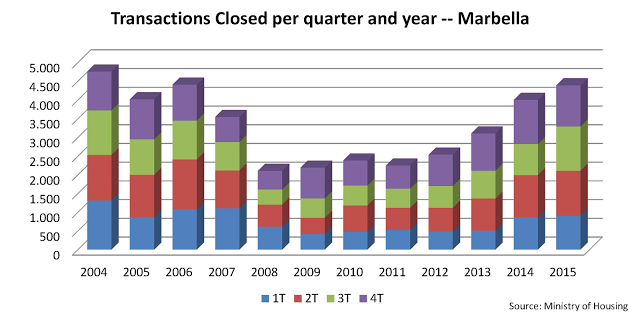
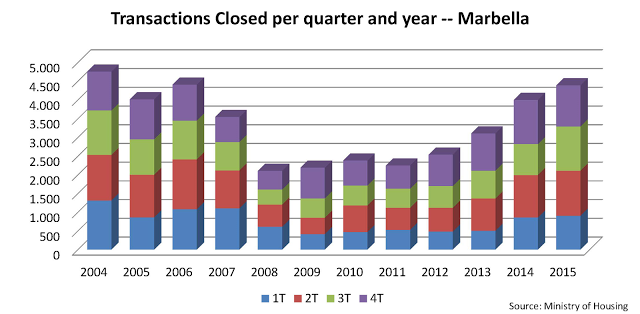
Los datos publicados recientemente por el Ministerio de Fomento para Marbella han confirmado la tendencia general del 2015, el número de operaciones por año ha recuperado los niveles pre-crisis. Como se ve en el gráfico, la tendencia al alza de los últimos años continuó en 2015 con nuevas subidas en el numero de unidades vendidas. 

Aunque no estamos todavía en un mercado de compradores, si los números siguen subiendo de esta forma, podríamos ver el cambio en este 2016 o en 2017. 

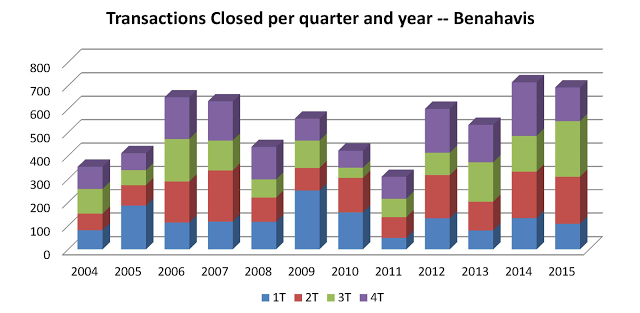
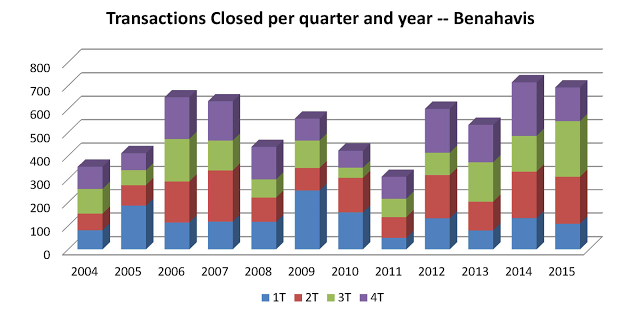
Por contra, en Benahavís, aunque los resultados del año también fueron bastante buenos, los datos han confirmado lo que yo ya sentí en la calle, en el cuarto trimestre no se notaba tanta actividad. De hecho, ha sido el peor cuarto trimestre desde 2011. No tengo una explicación clara para esto salvo las subidas y bajadas normales del mercado o las incertidumbres en la economía europea pero ya veremos con los datos del primer trimestre si fue solo un dato coyuntural o si tenemos que preocuparnos de nuevo porque el mercado no acaba de consolidarse. 

Esta información del primer trimestre que se publicará a principios de Junio nos dará una idea sobre si los problemas con el Plan General de Marbella, la inestabilidad política del país o los últimos atentados terroristas están afectando al mercado. El tiempo lo dirá pero los comentarios que estoy recibiendo de mis clientes norte europeos son neutros en el sentido que no les están preocupando especialmente las negatividades que acabo de mencionar.

The Market keeps on with its positive tendency

The data recently released by the Ministry of Housing for Marbella confirmed the general tendency of 2015, the number of operations per year has recovered its pre-crisis values. As can be seen on the chart, the upward tendency observed in the last years has continued in 2015 with new increases in the number of units sold. 


Although we are not yet in a buyers market, if the numbers keep on going up this way, we may see the change in 2016 or 2017. 

On the other hand, in Benahavis, although the results for the year 2015 were quite good, the numbers confirmed what I had already perceived at street level, the fourth quarter was not that thrilling. In fact, it has been the worst fourth quarter since 2011. I do not have a clear reason for that except for the usual up and downs of the market or the uncertainties of the European economy but we will see on the first quarter of 2016 if it is just a temporary situation or if we have to worry again because the market will take some more time to be consolidated. 


Furthermore, I think that that information for the first quarter of 2016 to be released at the beginning of June will give us a clear insight about how the problems we are having with the planning permission of Marbella, the political instability in Spain or the recent terrorist attacks in Europe may affect the market. Time will tell but the comments I am receiving from my north European clients are, in a way, neutral in the sense that they are not perceiving the negativities I just mentioned.

Marbella, ¿Están los precios realmente subiendo?

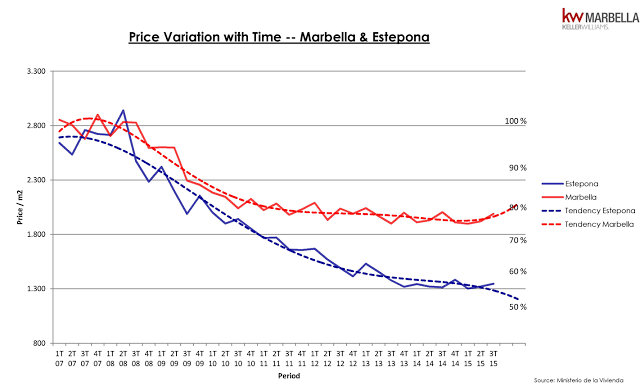
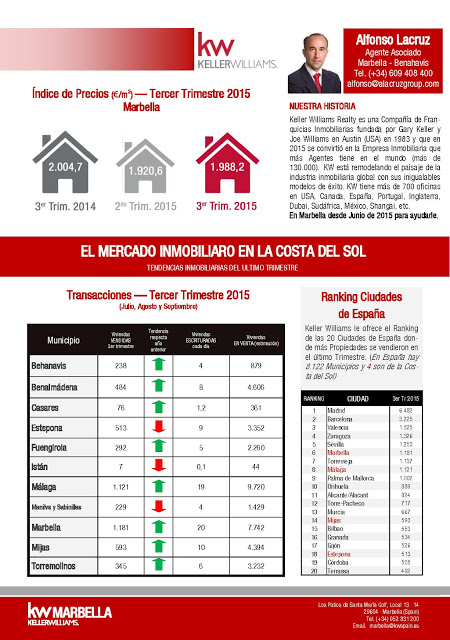
En el último mes de diciembre el Ministerio de Fomento publicó el índice de precios para el tercer trimestre del 2015 mostrando en Marbella dos trimestres consecutivos de subida. Los incrementos son leves pero al menos es un cambio en la tendencia de los precios. Sin embargo, los precios siguen siendo más bajos que el año anterior.


Vimos la misma situación en 2014 y la tendencia nunca llego a materializarse pero este año se podría estar ante el punto de inflexión. Muchos analistas ya han previsto que 2016 va a ser el año de la consolidación, estabilización y normalización del Mercado inmobiliario en España con potenciales incrementos entre 4 y 6%, algunos van hasta 10% del aumento. La mejora de los números del paro, la reducción de los tipos de las hipotecas, la continua recuperación de la economía en general, que esperamos no quede afectada por la inestabilidad política, y los bajos precios son los propulsores del aumento de la demanda, especialmente de la demanda española, fuertemente mermada en los últimos años, y, como consecuencia, de los precios.


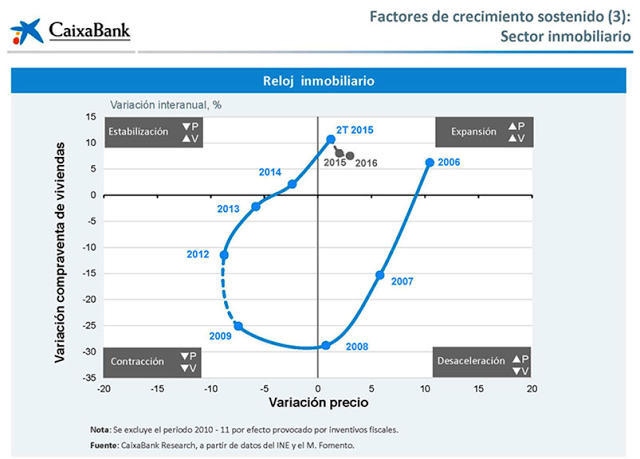
Si miramos el cuadro adjunto, CaixaBank esta ya anticipando la vuelta al optimismo en el Mercado que se vio en el 2005 y 2006, es decir, aumento en precios y ventas. 

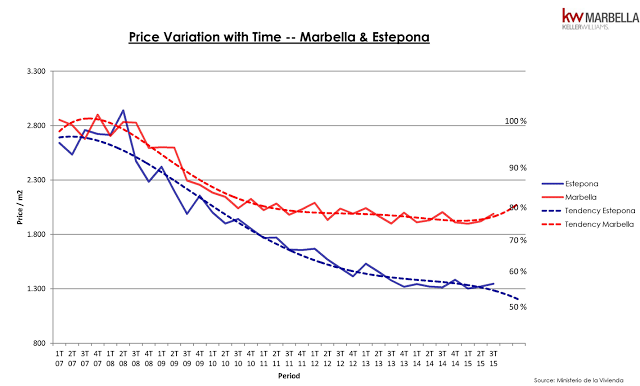
Finalmente, un pequeño comentario de Estepona donde los precios siguen bajando. Marbella tiene más fama y renombre que Estepona por lo que la demanda es mas alta y ayuda a frenar la bajada de precios aunque creo que también vamos a ver en Estepona la estabilización comentada arriba.

Are the Prices in Marbella already going up?

In the last month of December, the price index for the third quarter of year 2015 was published by the Ministry of Housing showing, in Marbella, two consecutive quarters of increases. The increases are not great but at least it is a change in the tendency as shown in the tendency line of the prices. However, the prices are still a little bit lower than one year before. 


We saw the same scenario in 2014 and the tendency never materialized but this could be the year of the inflexion point. A number of analyst have already predicted that 2016 is going to be the year of the consolidation, stabilization and normalization of the real estate market in Spain with potential increases between 4 and 6% with some analysts going as high as 10% increases. The improvement on the unemployment numbers, the reduction on the mortgage rates, the continuous recovery of the economy in general, that we hope will not be affected by the political instability, and the reduced prices are the catalysts of the increase of the demand, specially the Spanish one, highly reduced in the last years, and, as a consequence, of the prices. 


If we take a look to the chart besides, CaixaBank is already predicting a return to the positive market of 2005 and 2006, i.e. increase in sales and increase in prices. 

Finally, a little comment on Estepona where the prices are still going down. Marbella has a better name than Estepona and the higher demand helped to stop the fall in prices. We should also see in Estepona the stabilization in prices commented above.

La sentencia del Tribunal Supremo anulando el PGOU de 2010 de Marbella. Las razones.

Tengo que decir que la noticia que apareció el día 7 de Noviembre sobre la anulación por parte del Tribunal Supremo el PGOU (Plan General de Ordenación Urbana) de Marbella del año 2010 fueron una bomba para mi y, no solo para los que nos dedicamos al negocio inmobiliario, sino también para toda la población de Marbella. Las 16.500 propiedades que el Plan de 2010 había, de alguna forma, legalizado, estaban de nuevo fuera de ordenación.

Aunque no es sencillo, voy a intentar resumir las razones por las que el Tribunal Supremo ha anulado el Plan de 2010:

Legalización de las propiedades que estaban fuera de ordenación (ilegales)

El Tribunal Supremo establece que los redactores del Plan no tienen potestad para legalizar lo que fue ilegalmente cons-truido.

Suelo Urbano no Consolidado

En la misma línea del punto anterior, los técnicos redactores del Plan no pueden alterar o desfigurar el concepto de Suelo Urbano Consolidado.

El sistema de Compensación para la legalización de propiedades fuera de ordenación

El Tribunal Supremo vuelve a establecer que no resulta jurídicamente posible la exigencia de nuevas prestaciones o com-pensaciones con el objeto de alterar la ordenación y que además han sido establecidas por el propio planificador o redactor del Plan.

Estudio Medioambiental

Esta razón es un poco más técnica y habla de que no se cumplió una normativa europea sobre evaluación medioambiental ya que el Plan no identifica ni contempla posibles alternativas a la solución que finalmente se adopto.

Informe de Sostenibilidad Económica

De nuevo, es una razón técnica, al no haberse incorporado al Plan el requerido Informe de Sostenibilidad Económica.

Como resumen, y dejando aparte las dos últimas razones técnicas, el Tribunal Supremo viene a decir que los redactores del Plan no tienen la potestad para legalizar lo que fue ilegalmente construido. Y, como comentario final, diré que he estado unas cuantas veces en la oficina de Urbanismo del Ayuntamiento de Marbella y me consta que están trabajando duro para buscar una salida a la situación que esta sentencia ha creado aunque no va a ser fácil por todas las implicaciones legales que conlleva.

La competencia en el mercado de las propiedades de lujo

Este mes voy a analizar la competencia en la venta de propiedades de lujo. Es difícil, por no decir imposible, aplicar los comentarios de este artículo a todo el mercado de lujo puesto que hay algunas propiedades ciertamente especiales o localizaciones, como estar en primera línea de playa en Marbella Club, a las cuales no se pueden aplicar estas generalidades.


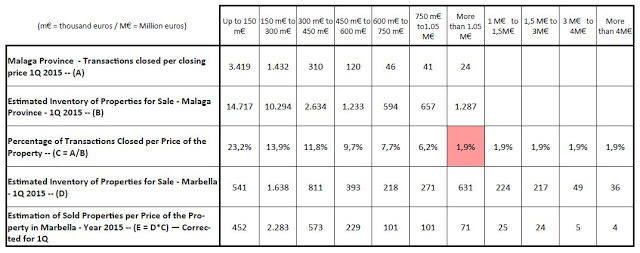
Estoy escribiendo este articulo porque últimamente estoy hablando con propietarios de este tipo de producto que me han contacta-do para vender casas espectaculares y siempre comento que la complicación de vender estas propiedades es la competencia exis-tente en este segmento del mercado. Para poder entender lo que quiero decir, he incluido un cuadro en el cual se aprecia, según el precio de venta, el número estimado de propiedades en venta, el número de ventas y el porcentaje de propiedades que se venden. Aquí es donde podemos ver que en propiedades de más de un millón de euros, el porcentaje de propiedades vendidas frente a las que están en el mercado es del 1.86% al trimestre, lo cual es muy bajo. Solo se van a vender las que tienen la mejor relación calidad-precio. Si hay 150 propiedades en venta en un determinado rango, solo 11 se venderán en un año. Entre estas 150, habrá 10 o 12 propiedades en las que el precio se reduce debido a un divorcio o separación, a problemas financieros, a alguna defunción, o, sim-plemente, a que el propietario está cansado de esperar a que llegue un comprador. Estas propiedades son las que se venden de entre las 150 que están en el mercado. Es duro de asumir pero he visto recientemente muchas casas espectaculares que no se ven-den por esta razón o, dicho de otra forma, porque el precio es demasiado alto teniendo en cuenta el número de propiedades con las que tiene que competir. La cuestión es la siguiente: ¿vale la pena esperar a que el mercado se recupere, teniendo en cuenta que Standard & Poors ha anticipado subidas de precio del 2.5% en 2016 y del 4% en 2017, o, es mejor vender ahora, obtener un 5 o 6% invirtiendo ese capital en una cartera de riesgo moderado y a la vez quitarse los costes de mantenimiento de esa propiedad?

The Sentence of the Supreme Court of Spain annuling Marbella’s 2010 PGOU. The reasons.

I have to say that the news that appeared on November 7th regarding the annulling of the Marbella’s 2010 PGOU (General Plan-ning Permission) were a shock to me and to not only the people in the business of real estate but also to all inhabitants in Marbel-la. The 16.500 homes that the previous 2010 Plan had, in different ways, legalized are again out of plan.

Although it is not easy, I will try to summarize the reasons given by the Supreme Court of Spain at its sentence:

Legalization of the out of Plan properties

The Supreme Court ruled that the Architect and the Technicians that completed the PGOU do not have enough powers to decide about the out of Plan constructions and how to make them fully legal.

Unconsolidated Urban Land

It is again about the same concept as before. The Technicians can not change the concept of what is a Unconsolidated Ur-ban Land.

The Compensation system to legalize out of Plan properties

The compensation system established to alter the property law was rejected as can not depend on the provisions drawn by the planner. It is again going back to the same principle, the technicians that produced the Plan can not alter the status of illegally constructed properties.

Environmental Report

The Plan does not comply with European requirements on environmental evaluation as it does not evaluate alternatives to what the Plan actually proposes.

Report about the Economic Sustainability

A Report on the Economic Sustainability of the Plan has to be included in the Plan and was not prepared nor incorporated.

In summary, and leaving apart the two last technical reasons, what the Supreme Court sentenced is that the Planner is not em-powered to legalized what was illegally constructed. As a final comment, I would say that I have been a number of times in the last weeks at the Planning Office of the Townhall and they are working extremely hard to find a way out to the situation created although it is not going to be an easy one as there are many legal implications.

The competition on the market of the luxury properties

This month I am going to analyze the selling of luxury properties. It is difficult, not to say, impossible to apply the comments on this article to the generality of the luxury market since, there are some niches where the generalities can not be applied like special properties for any reason o really top locations like first line beach Marbella Club.


I am writing this article because I have been asked many times lately to sell spectacular villas and I have always commented that the complication of selling those properties is the competition on that segment of the market. To be able to understand what I mean, I have included a chart where, as a function of the selling price, it can been seen the estimated number of properties for sale, the number of sales and the percentage of sales per range. Here is where one can see that on properties on top of two million euros that percentage of sold properties versus the ones in the market is only 1,86 % a quarter that is extremely low. Only the ones with the best price vs quality relation will sell. If there are 150 properties for sale in a particular price range, only 11 will sell in one year. Among those 150 there will always be 10 to 12 properties that reduce its price affected by a divorce or separation, any kind of finan-cial problem, the deceased of someone, or, simply, that the owner is tired of having the property in the market for a number of years waiting for a buyer. Those are the ones that will sell among the 150 in the market. It is tough to assume but I have seen a number of spectacular houses recently that do not sell for this specific reason or simply put, the price is not too high considering the number of properties that specific house has to compete with. The question is the following: is it worth to wait for the market to recover, taking into account that Standard & Poors has anticipated increases of 2,5 % in 2016 and 4% in 2017, and reach the estab-lished asking price in a number of years or is it better to get your equity now and benefit from what that wealth can produce as an investment with a moderate risk portfolio, around 5 to 6 %, plus all the amounts saved on maintenance costs for that property?