



Resale prices are still rising in Marbella and Benahavís, but the pace is falling fast. What the latest Land Registry data means for the price of your home.
Foreign buyers in Marbella and Benahavís 2026: the British lose ground, the Dutch close in
Double-click to edit...
The Journal · October 2026
Foreign buyers in Marbella and Benahavís 2026: the British lose ground, the Dutch close in
Foreign demand is at a record, but the mix of nationalities has changed a great deal in ten years. Who is buying on the Costa del Sol in 2026, and why that diversity makes the market more stable.

Alfonso LacruzMarket analyst · 25+ years on the Costa del Sol
FOREIGN BUYERS IN THREE FIGURES
13Dutch vs BritishPurchases separating the Netherlands from the United Kingdom in Spain in Q2 2026.
37%MálagaShare of home purchases made by foreign buyers in Q2 2026, the highest in the series.
12.1%Top nationalityThe largest share of any country among foreign buyers: Swedes in Benahavís.
IN THIS ARTICLE
THE JOURNAL AS A PDF
October 2026 edition, in full
The original charts, the issue's second article and the properties of the month, in three pages.
Open the PDFEvery few months someone asks me if foreign buyers are drying up. The Land Registry says no. They are as active as ever, but the passports have changed a great deal. This is my reading of the charts.
United Kingdom: still first, but losing ground
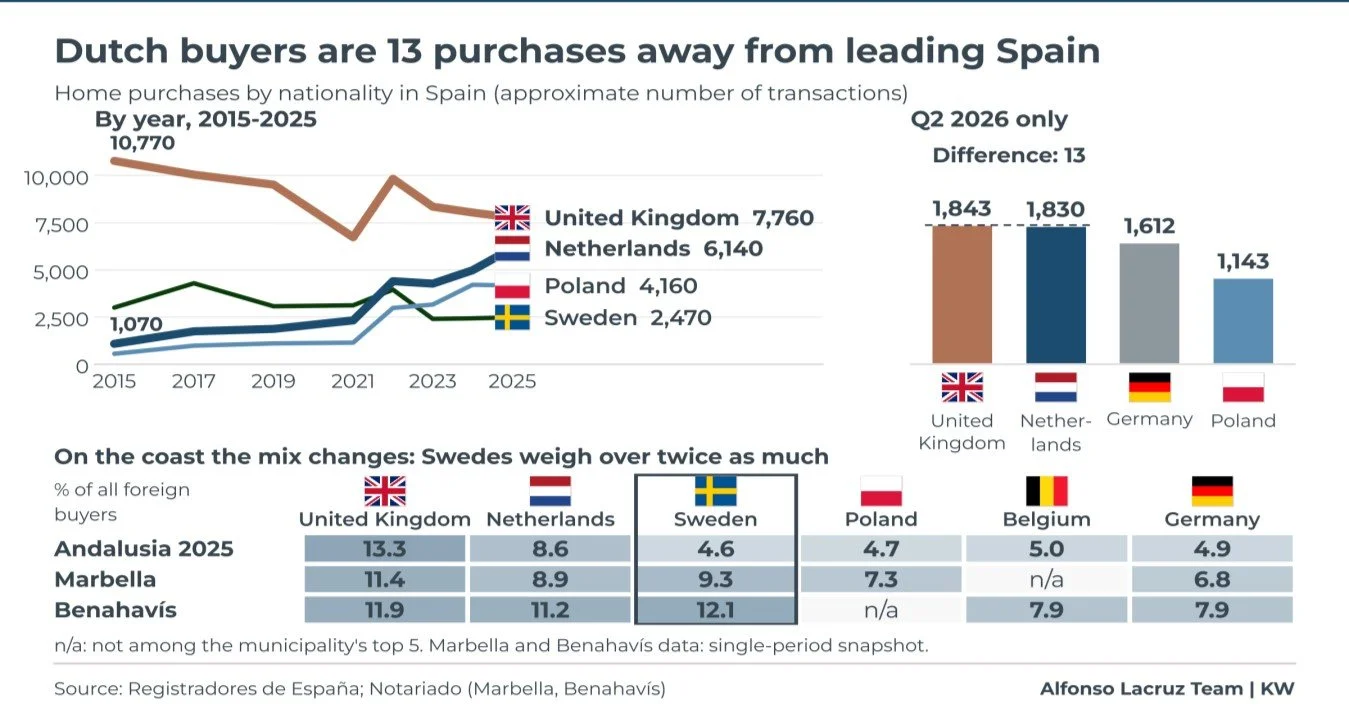
The British bought around 10,770 homes in Spain in 2015 and 7,760 in 2025. Brexit, the 90-day rule and a weaker pound explain most of it.
Netherlands: the leader in waiting
Dutch purchases went from 1,070 to 6,140 in the same period. In the second quarter of 2026 they finished just 13 transactions behind the British.
Sweden: what a currency can do
When the krona hit record lows in 2023, Swedish purchases fell sharply and have not recovered. On our coast they still matter: 12.1% of foreign buyers in Benahavís and 9.3% in Marbella, twice their weight in Andalusia.
Poland: from newcomer to regular
Polish purchases nearly quadrupled between 2019 and 2024 and held steady in 2025, with a clear taste for new builds.
Germany and Belgium: two different paths
The Germans hold a steady third place. The Belgians, another new-build nationality, fell 16% in the first half of 2026, yet remain 7.9% of foreign buyers in Benahavís.
Foreign demand: at a record
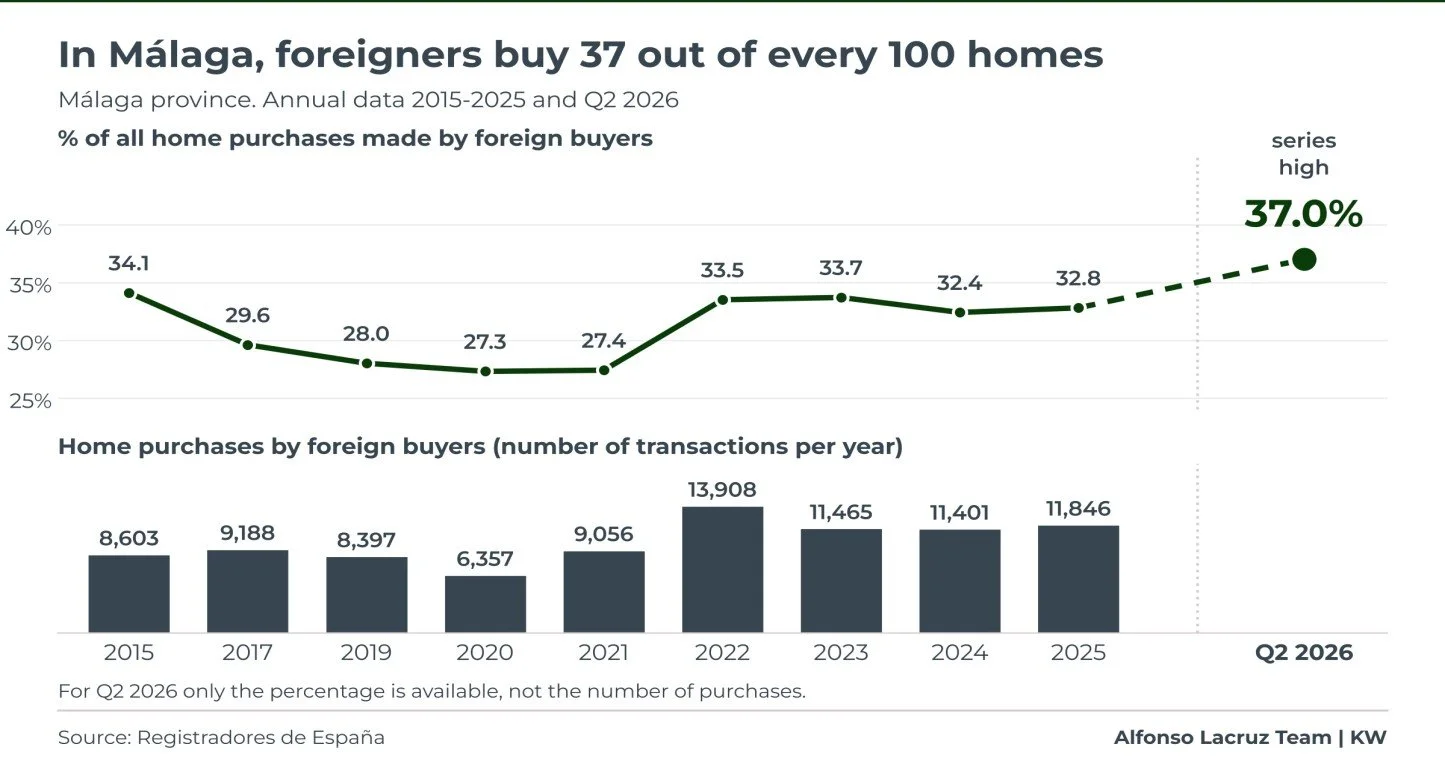
In the second quarter of 2026, foreigners made 16% of all home purchases in Spain and 37 out of every 100 in Málaga. The buyer who has slowed down is the Spanish one, facing a Euribor a full point higher than a year ago. What that slowdown means for prices is the subject of the other article in this Journal.
For me, after 25 years, honesty starts with admitting that selling a home well is hard, and that is why it is worth doing it with someone who does it every day.
Alfonso Lacruz, The Real Estate Journal, October 2026.
In summary, a market that does not depend on one nationality
In summary, I read this mix as good news. In Marbella and Benahavís no single country exceeds 12% of foreign buyers, and around half come from outside the top five. A market that does not depend on one nationality is a more stable market: when one group slows down, another takes its place. That is exactly what the last ten years show.
Methodology. Spain-wide figures are approximate numbers of purchases by nationality. Shares in Marbella and Benahavís are the percentage of each nationality among foreign buyers in a single period, so they show a snapshot rather than a trend. Benahavís figures are indicative given the low number of sales.
Frequently asked questions
Which nationality buys the most homes in Spain?
The British, with about 7,760 purchases in 2025. The Dutch are close behind with 6,140, and in the second quarter of 2026 they were just 13 transactions short of the British.
How important are Swedish buyers in Marbella and Benahavís?
Very. Swedes make up 12.1% of foreign buyers in Benahavís and 9.3% in Marbella, about twice their weight in Andalusia as a whole, even though their purchases fell sharply after the krona hit record lows in 2023.
Are foreign buyers still active on the Costa del Sol?
Yes. In the second quarter of 2026 foreigners made 16% of all home purchases in Spain and 37 out of every 100 in the province of Málaga, the highest share in the series.

About the author
Alfonso Lacruz
Naval engineer and market analyst. Over 25 years advising owners in Marbella and Benahavís. Publishes a monthly market analysis with Land Registry data.
MASTERMINDWITH GARY KELLER200+GOOGLE REVIEWS · 5.0MREAAWARD 2022KWLUXURY
The figures are indicative and every property is different: for a specific number, ask for a valuation of your home.
Sources: Land Registry (Registradores de España); Notaries (Notariado) for Marbella and Benahavís. Last updated: 29 October 2026.
Keep reading
Thinking of selling your home on the Costa del Sol?
Start by knowing where your home stands in today’s market.
Arras contract: what the seller should know before signing it
Resident or Non-Resident: How What You Pay Changes When You Sell a House in Spain
Almost one in five homes sold in Marbella now tops €1 million. Above €4 million, just 1.5%
Luxury property market in Marbella and Benahavís: Q1 2026 data
Luxury market in Marbella and Benahavís 2026: fewer sales, higher prices and 4 years to sell
The Costa del Sol market is down 30%: what it means for the price of your home in 2026
What Taxes Do You Pay When Selling a Property in Marbella and Benahavís? (2026)

The Costa del Sol market has fallen 30%: what it means for your home's price in 2026

Buy a renovated home or one to renovate in Marbella and Benahavís? Which is better?

New-build prices on the Costa del Sol in 2025: bubble or healthy market?

New-build prices on the Costa del Sol 2025: bubble or healthy market?
Marbella and Costa del Sol property market, Q4 2025: sell, buy or invest?
Why are prices rising in Marbella, Benahavís and Estepona if fewer homes are selling?

Why are prices rising in Marbella, Benahavís and Estepona if fewer homes are selling?
What Happens When You Overprice a Property? How to Lose Value Even When the Market Rises
MARKET STABILITY? ESTEPONA RISES WHILE MARBELLA, BENAHAVÍS, AND MIJAS SALES FALL
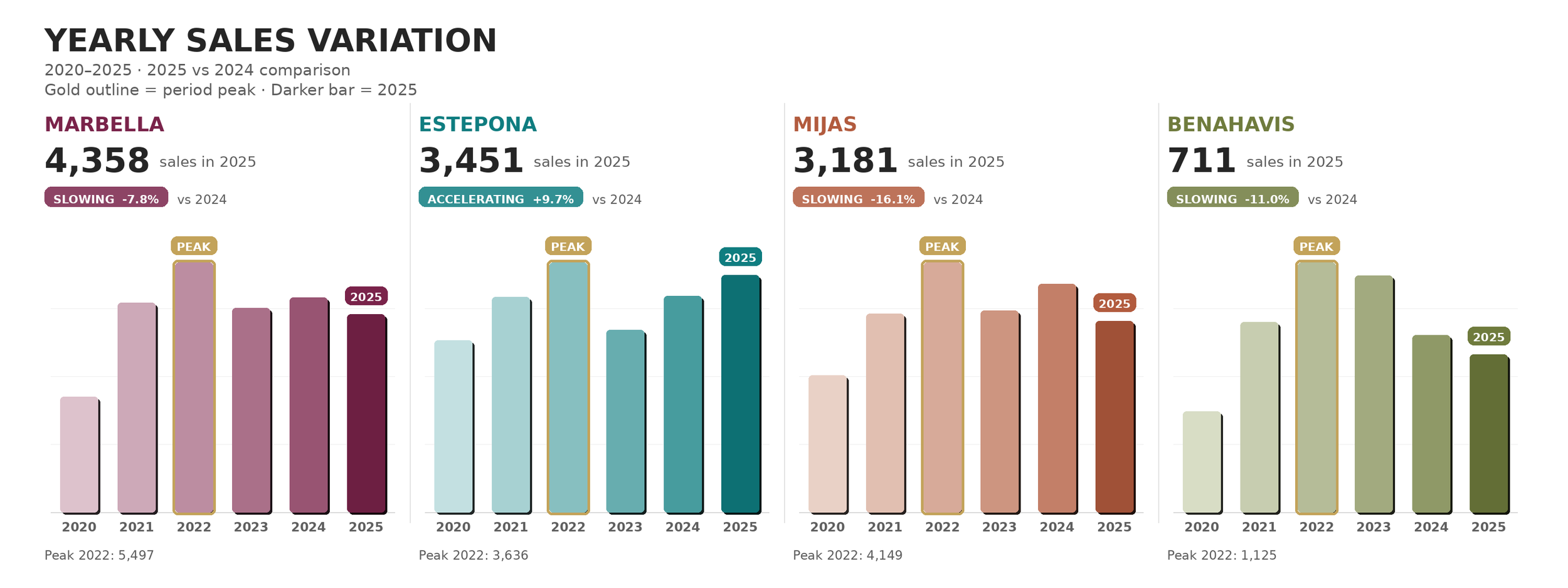
The latest sales figures from the fourth quarter of 2025 recently published confirm the Costa del Sol property market is changing pace. The exceptional momentum of recent years is easing, but this should not be mistaken for weak-ness. Instead, we are seeing a gradual return to a more balanced market where buyers remain ac-tive but are highly selective.
1. Marbella and Benahavís are slowing, while Estepona advances. The four municipalities are no longer moving together. Marbella recorded a 7.8% drop in homes sold compared with 2024, while Benahavís fell by 11.0% and Mijas by 16.1%. Estepona, however, moved the other way, rising 9.7%. This proves there is no single Costa del Sol market anymore; micro-local dynamics dictate performance.
2. Affordability is only half the story as product mix is key. If price point alone dictated the market, the numbers would look diferent. Mijas, the most accessible area at an average €360,043, saw the sharpest drop. Estepona, averaging €414,976, surged. Why?Estepona is heavily buoyed by a wave of new-build completions from past contracts ï¬nally hitting the Notary. Mijas, conversely, is behaving like a traditional resale market feeling a natural cooling. In higher-end markets like Marbella €734,425) and Benahavís (€939,770), buyers are simply taking more time, carefully comparing luxury resales against a few shiny new-build alternatives.
3. The market still looks strong in historical terms. Despite the recent slowdown, all four municipalities remain well above their 20-year average for sales. The boom years created an unusually high benchmark. Today’s activity repre-sents a healthier, more sustainable rhythm rather than a worrying contraction.
In this complex environment, strategy matters. For homeowners in Marbella and Benahavís, success depends more than ever on expert pricing, strong positioning, and deep market insight. It is the pre-cise difference between merely sitting on the market and success-fully getting sold.
Stability? Why Estepona is rising while sales fall in Marbella, Benahavís and Mijas
MARBELLA AND BENAHAVIS BETWEEN 500K€ AND 2M€: WHAT KIND OF LIFE CAN YOU HAVE HERE?
As we live every day in this real estate world, we talk a lot about market statistics and prices, but for most of our clients the real question is much simpler: What kind of life can I have here with my budget?
In these ranges, when you know the area and are clear about what you want, the answer is not same for any budget and the article explains what kind of life each level from 500 k€ to 2 M€ euros allows on the Costa.
At the lower range of this bracket, around 500 k€ to 800 k€, buyers are usually choosing between a good apartment or townhouse in a well located community and a more basic villa that may need updating. You can be close to services, in a pleasant urbanization, perhaps with a shared pool and some sea or garden views. Daily life is convenient: schools, supermarkets, sports and restaurants are all within a short drive. What you may compromise on is plot size, absolute privacy or the “wow” view.

As you move towards 1 M€ and even a little higher, the conversation changes. In many areas you can find a solid detached villa with its own garden and pool, often with better orientation, more light and clearer views. The difference is not only in meters, but in how the property feels when you arrive: more space around you, more flexible layouts, room for guests and family to visit comfortably. For many buyers in this range, that is when the property begins to feel like a long-term home rather than just a holiday base.
Between 1,5 M€ and 2 M€, quality and micro-location become more visible. You are closer to the better streets within a given area, with easier access, quieter surroundings and more established neighbors. You may not be in the most famous gated communities, but you are often one or two steps below them in price, with a similar sense of calm and security.
The point is that the same budget can buy very differ-ent lives, depending on where you focus: closer to the beach or in the hills, more square meters or a better street, something ready to live in or a home with poten-tial. The most useful first step is not to chase the largest house on paper, but to be honest about how you want to live day to day. Once that is clear, it becomes much easier to see which areas and which homes truly match your life not just your budget.
Not every location is for everyone but we have many locations and lives to choose from and that is the beauty of our Costa del Sol.