
Journal on the Real Estate Market on the Costa del Sol - July 2026
Journal on the Real Estate Market on the Costa del Sol - June 2026
WHAT TAXES DO YOU PAY WHEN SELLING A PROPERTY IN MARBELLA & BENAHAVÍS? (2026)
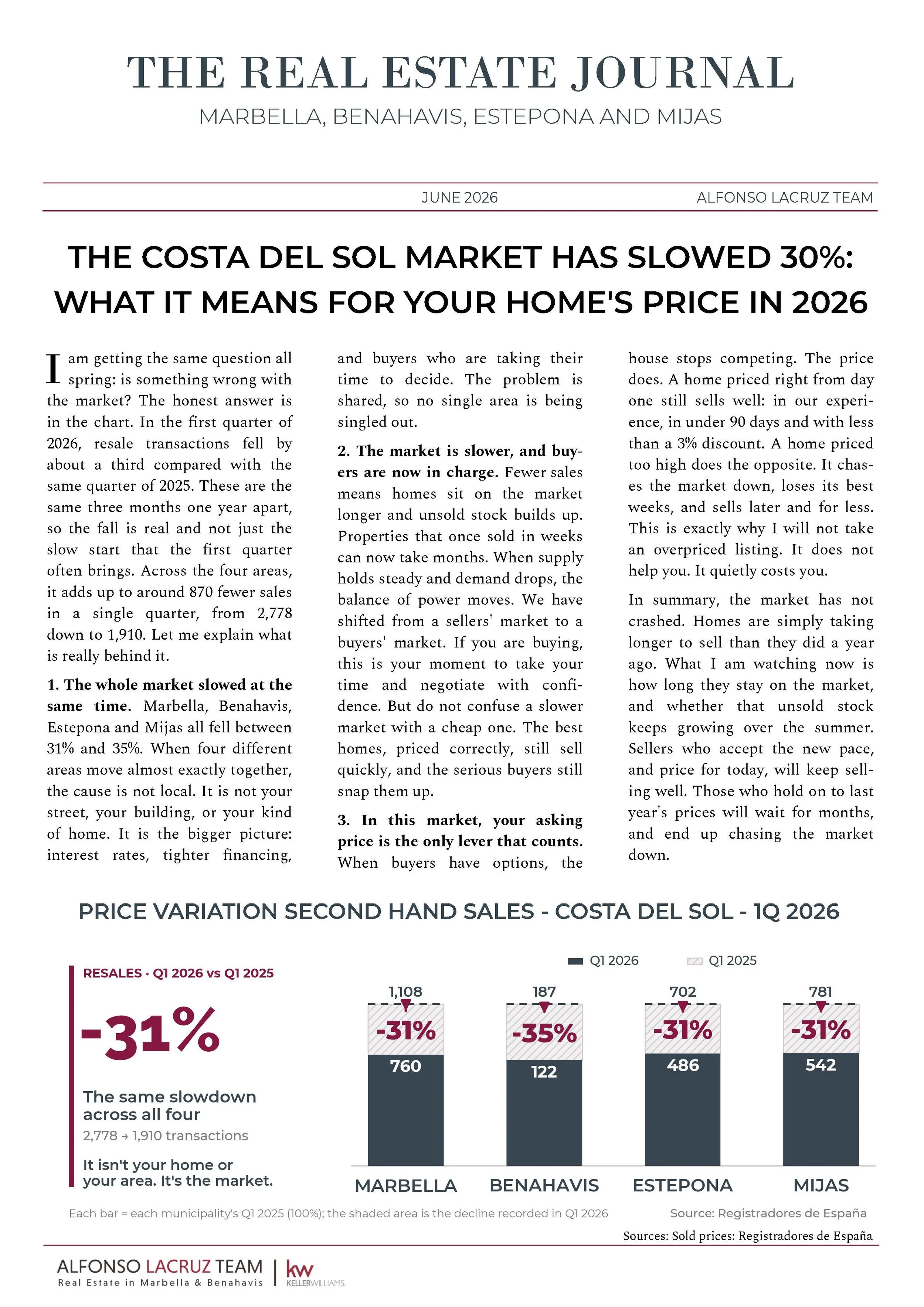
There are two main taxes when you sell in Spain: the Capital Gain Tax, paid to the national tax office on your profit, and the Plusvalia, paid to your Town Hall on the increase in the value of the land. These are the general rules for individuals; particular cases vary.
CAPITAL GAIN TAX
1. How is the taxable gain calculated?
Patrimonial Gain = Value Transferred - Acquisition Value
Value Transferred is the price you sell for, minus the costs of the sale: agency fees with their VAT, the Plusvalia, and the cancellation of the mortgage if there was one.
Acquisition Value is the price you originally paid, plus the costs of that purchase: notary and land registry fees, and the Transfer Tax, or the VAT and Stamp Duty if it was a new build. You may also add any extension or substantial improvement, provided you hold the invoices. Ordinary repairs do not count, and without an invoice nothing counts.
2. When is it paid?
Residents, within their income tax return (IRPF), in June of the year following the sale. Non-residents, within four months of closing.
3. What are the rates in 2026?
For residents it is progressive and flat for non-residents (see attached table). The buyer must also withhold 3% of the price at the Notary as an advance on that tax. If the final bill is lower, the difference is refunded, normally within six to twelve months.
PLUSVALIA TAX
4. Who pays it, and when?
The seller, unless agreed otherwise, within 30 working days of the deed. There are two ways to calculate it and you may use whichever gives the lower result.
Direct estimation. Based on your real gain, applying the proportion the land represents within the cadastral value. Sell for less than you paid and the tax is zero, although you must still declare it.
Objective system. Cadastral value of the land x coefficient x municipal rate. The coefficient depends on the years of ownership; the rate is capped at 30%.
Worth knowing this year: the coefficients were raised in January 2026, but Parliament repealed the decree on 27 January and the previous ones apply again.
In short: what you take home depends not only on your asking price but also on the invoices you kept and the year you bought.
* As each case is different, this article is only a brief note and deductions may also apply, it is highly recommended that you check your own details with your lawyer or tax advisor.
THE COSTA DEL SOL MARKET HAS SLOWED 30%: WHAT IT MEANS FOR YOUR HOME'S PRICE IN 2026
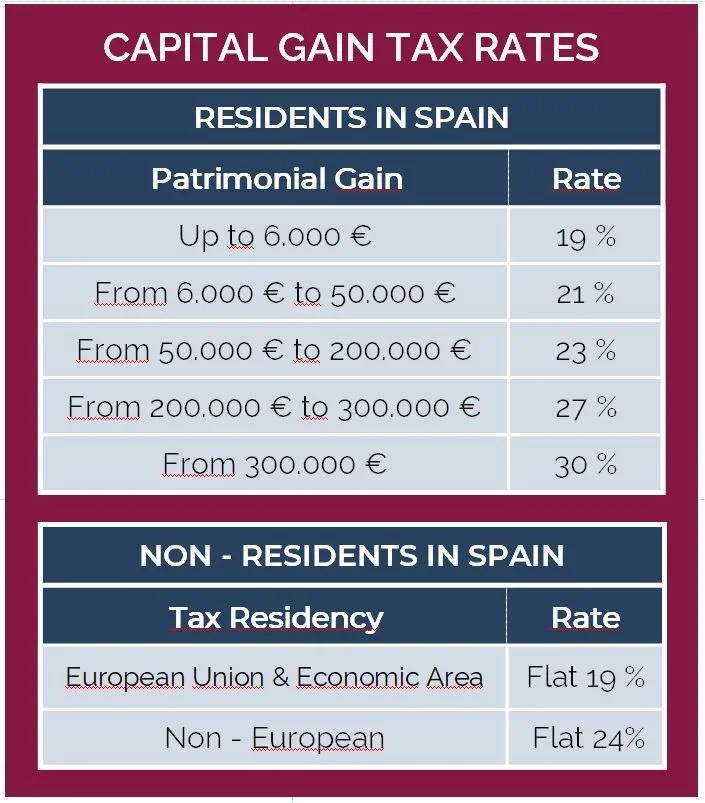
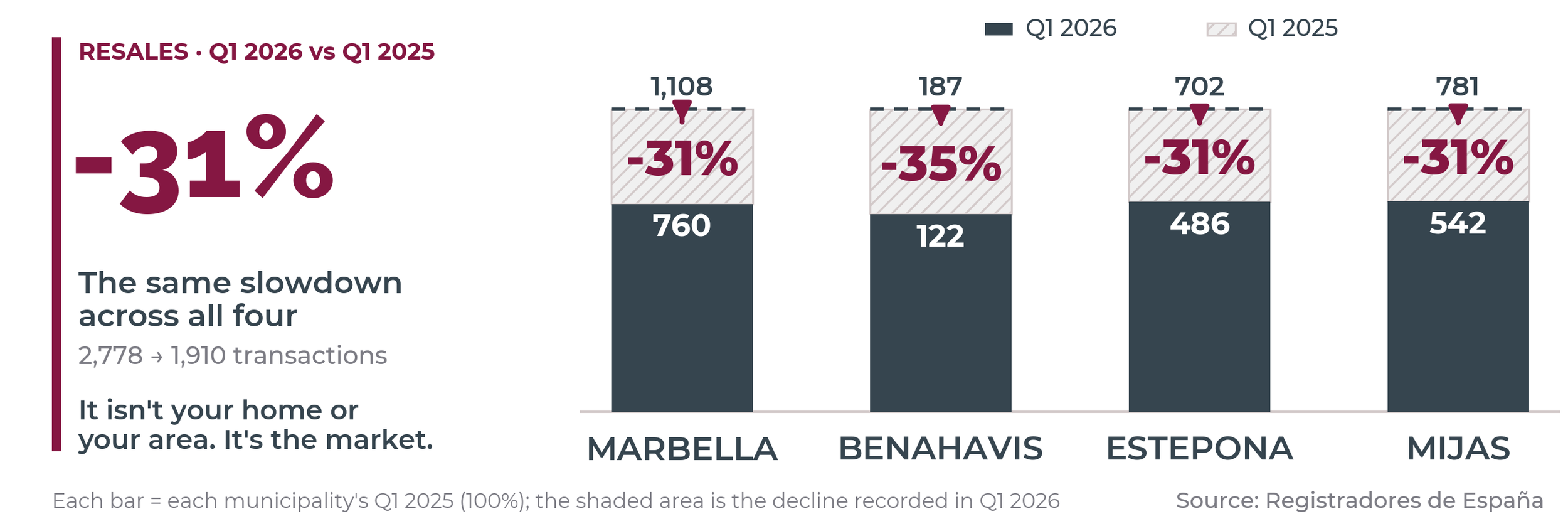
I am getting the same question all spring: is something wrong with the market? The honest answer is in the chart. In the first quarter of 2026, resale transactions fell by about a third compared with the same quarter of 2025. These are the same three months one year apart, so the fall is real and not just the slow start that the first quarter often brings. Across the four areas, it adds up to around 870 fewer sales in a single quarter, from 2,778 down to 1,910. Let me explain what is really behind it.
1. The whole market slowed at the same time. Marbella, Benahavis, Estepona and Mijas all fell between 31% and 35%. When four different areas move almost exactly together, the cause is not local. It is not your street, your building, or your kind of home. It is the bigger picture: interest rates, tighter financing, and buyers who are taking their time to decide. The problem is shared, so no single area is being singled out.
2. The market is slower, and buyers are now in charge. Fewer sales means homes sit on the market longer and unsold stock builds up. Properties that once sold in weeks can now take months. When supply holds steady and demand drops, the balance of power moves. We have shifted from a sellers' market to a buyers' market. If you are buying, this is your moment to take your time and negotiate with confidence. But do not confuse a slower market with a cheap one. The best homes, priced correctly, still sell quickly, and the serious buyers still snap them up.
3. In this market, your asking price is the only lever that counts. When buyers have options, the house stops competing. The price does. A home priced right from day one still sells well: in our experience, in under 90 days and with less than a 3% discount. A home priced too high does the opposite. It chases the market down, loses its best weeks, and sells later and for less. This is exactly why I will not take an overpriced listing. It does not help you. It quietly costs you.
In summary, the market has not crashed. Homes are simply taking longer to sell than they did a year ago. What I am watching now is how long they stay on the market, and whether that unsold stock keeps growing over the summer. Sellers who accept the new pace, and price for today, will keep selling well. Those who hold on to last year's prices will wait for months, and end up chasing the market down.
RENOVATED OR TO RENOVATE IN MARBELLA & BENAHAVIS? WHAT'S WORTH IT IN 2026
It's one of the most common dilemmas I hear from buyers in this price range: pay more for a fully renovated home and move in within weeks, or pay less for one with potential and take on months of building work. There is no single right answer, and having walked both roads with clients, I know each option comes with fine print worth reading before you commit.
1. Peace of mind has a price tag. A move-in-ready home includes something no spreadsheet captures: certainty. You know how it will look, when you'll move in, and exactly what it costs. That certainty has a clear cost: the profit margin of the developer or investor who took on the work before you, along with their time, capital tied up, and the risk that something might have gone wrong. It's a fair premium, the job is done and the result speaks for itself, but it's worth keeping in mind when comparing with an unrenovated alternative.
2. Renovating can pay off… or not. Buying to renovate can be a smart move, but only if the location, the property, and the community all line up. In numbers, a quality full renovation in Marbella or Benahavís typically runs between €1,500 and €2,500 per square metre, and overruns of 15-25% are common when no experienced hand is steering the project. Old pipes show up the moment walls come down, permits drag on, design choices shift mid-build. Add the time cost: months without enjoying the house, often paying rent elsewhere in the meantime. When everything aligns, the savings are real and the home turns out exactly as you wanted; when it doesn't, the opportunity ends up costing as much as the turnkey option, or more.
3. Before you decide, look at what isn't on display. Inspect the roof, plumbing, and walls before falling for the kitchen. Ask for a fixed written quote, not a verbal estimate. And check what the community allows: many gated developments here have their own renovation rules, and not all of them permit the same scope of work. If permits are involved, find out the real timelines at the town hall as they rarely match the calendar you have in mind. Those who know what they want and how hard they're willing to work for it succeed with either path. Those who don't, fail at both.
NEW BUILD PRICES ON THE COSTA DEL SOL 2025: BUBBLE OR HEALTHY MARKET?
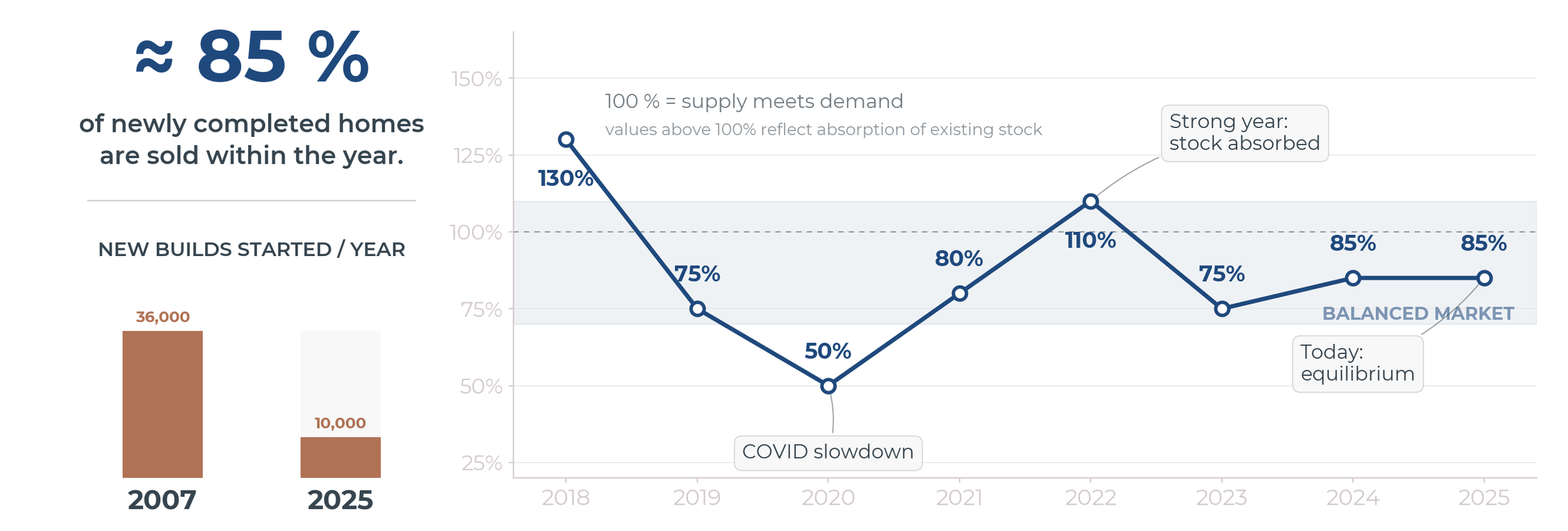
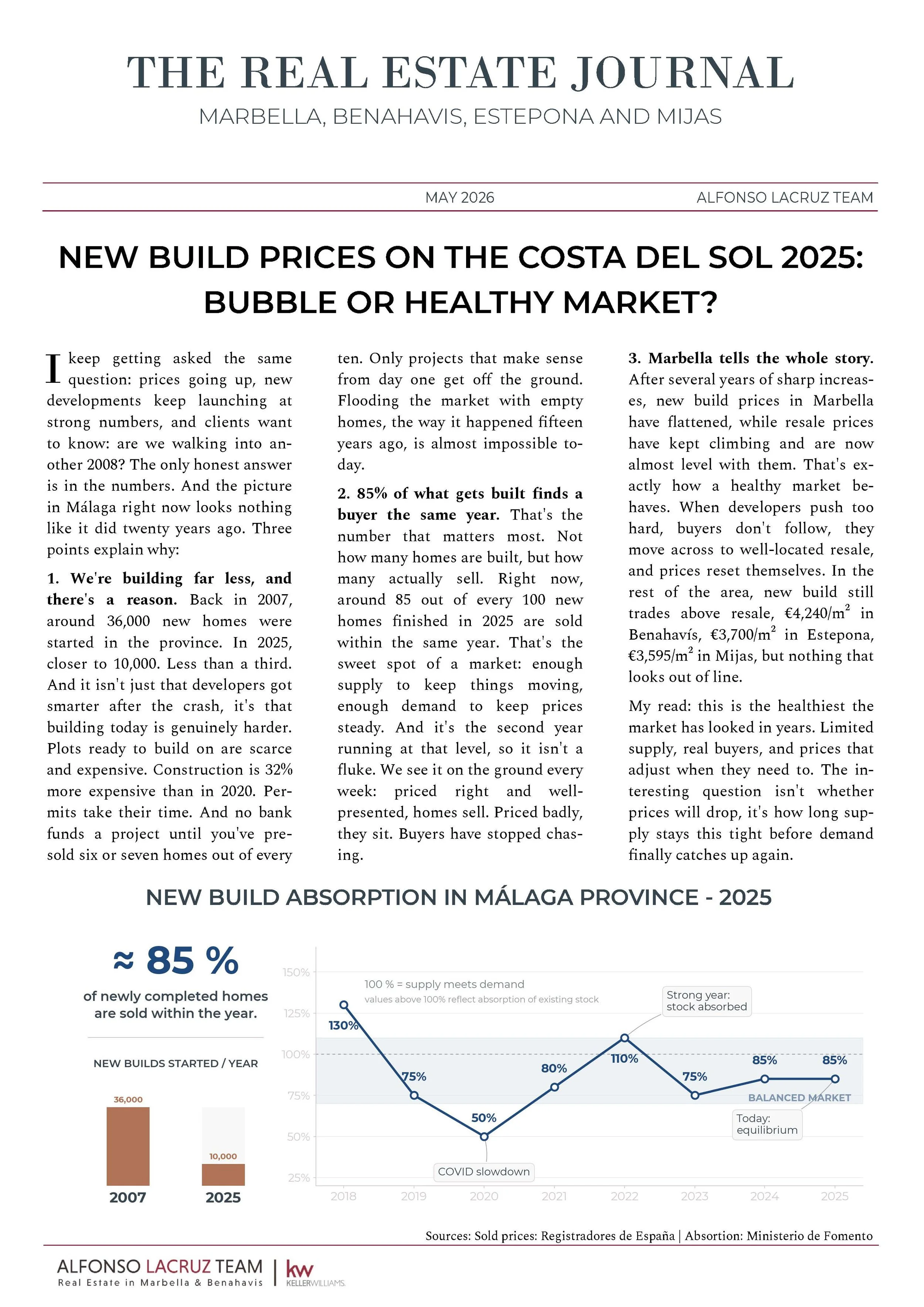
I keep getting asked the same question: prices going up, new developments keep launching at strong numbers, and clients want to know: are we walking into another 2008? The only honest answer is in the numbers. And the picture in Málaga right now looks nothing like it did twenty years ago. Three points explain why:
1. We're building far less, and there's a reason. Back in 2007, around 36,000 new homes were started in the province. In 2025, closer to 10,000. Less than a third. And it isn't just that developers got smarter after the crash, it's that building today is genuinely harder. Plots ready to build on are scarce and expensive. Construction is 32% more expensive than in 2020. Permits take their time. And no bank funds a project until you've presold six or seven homes out of every ten. Only projects that make sense from day one get off the ground. Flooding the market with empty homes, the way it happened fifteen years ago, is almost impossible today.
2. 85% of what gets built finds a buyer the same year. That's the number that matters most. Not how many homes are built, but how many actually sell. Right now, around 85 out of every 100 new homes finished in 2025 are sold within the same year. That's the sweet spot of a market: enough supply to keep things moving, enough demand to keep prices steady. And it's the second year running at that level, so it isn't a
fluke. We see it on the ground every week: priced right and wellpresented, homes sell. Priced badly, they sit. Buyers have stopped chasing.
3. Marbella tells the whole story. After several years of sharp increases, new build prices in Marbella have flattened, while resale prices have kept climbing and are now almost level with them. That's exactly how a healthy market behaves. When developers push too hard, buyers don't follow, they move across to well-located resale, and prices reset themselves. In the rest of the area, new build still trades above resale, €4,240/m² in Benahavís, €3,700/m² in Estepona, €3,595/m² in Mijas, but nothing that looks out of line.
My read: this is the healthiest the market has looked in years. Limited supply, real buyers, and prices that
adjust when they need to. The interesting question isn't whether prices will drop, it's how long supply stays this tight before demand finally catches up again.

Journal on the Real Estate Market on the Costa del Sol - May 2026
SALES FELL, PRICES ROSE: MARBELLA & COSTA DEL SOL Q4 2025. SHOULD YOU BUY, SELL OR INVEST IN 2026?
What the latest data means for sellers, buyers and investors?
Sales fell. Prices rose. In Q4 2025, the Costa del Sol delivered a contradiction that tells a different story to each of the three readers who matter most: the seller thinking of listing, the buyer still hesitating, and the investor de-ciding where to allocate next.
For the Seller. The official figures are encouraging: sold prices climbed across all four municipalities, and the gap between asking and sold prices is narrowing in Marbella, Benahavís and Estepona. That only happens when realistic sellers meet the market and ambitious ones do not. A property that has been listed for many months without movement is not being failed by the market, it is being failed by its asking price.
For the Buyer. The room for meaningful negotiation is shrinking. In Marbella, sold prices rose 3.2% in Q4 alone while asking prices rose only 2.1% so the real market is moving faster than seller expectations. On properties priced sensibly from day one, the ones that actually transact, discounts have become minimal. The correc-tion some buyers were waiting for has not arrived, and the window for waiting productively is narrowing with each quarter. The opportunity now lies in selection: identifying the right property in the right micro-location at a fair price, rather than holding out for a discount the data no longer supports.
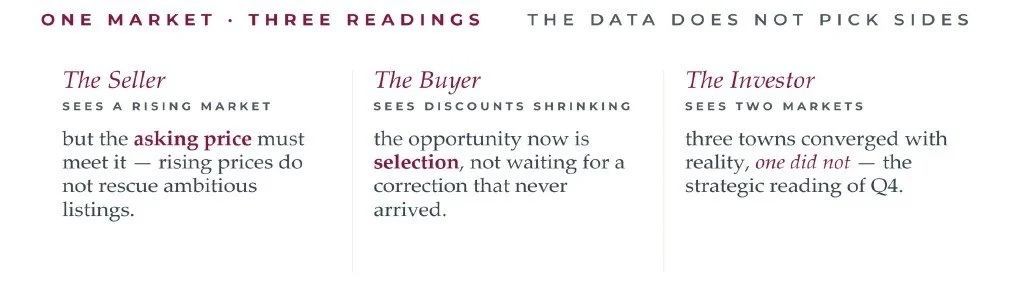
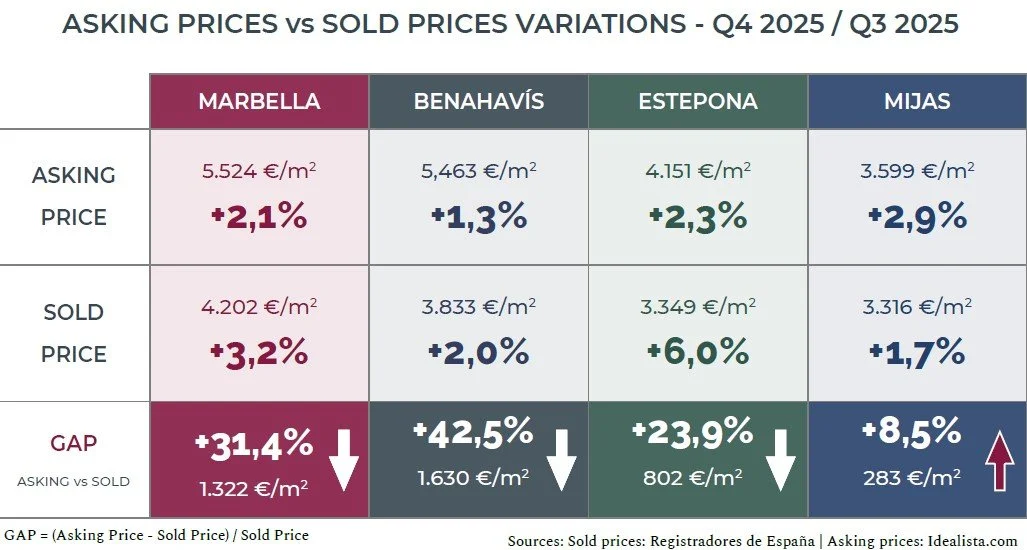
For the Investor. The most useful signal this quarter is the divergence between Mijas and the other three mu-nicipalities. In Marbella, Benahavís and Estepona, the gaps between asking and sold prices stand at 31.4%, 42.5% and 23.9% respectively, all trending downward. These are markets where reality has been absorbed, and disciplined entry is rewarded over speculative timing.
Mijas is the exception: the gap is only 8.5%, but it is widening rather than closing, with asking prices rising fast-er than sold prices. That is not an opportunity, it is a market where sellers have not yet adjusted. The disciplined approach is to watch it closely and enter only with precision, zone by zone, rather than on aggregate numbers.
One market. Three readings. The data does not pick sides, the reader does.
COSTA DEL SOL PROPERTY PRICES Q4 2025: WHY ARE PRICES RISING WHILE SALES ARE FALLING?
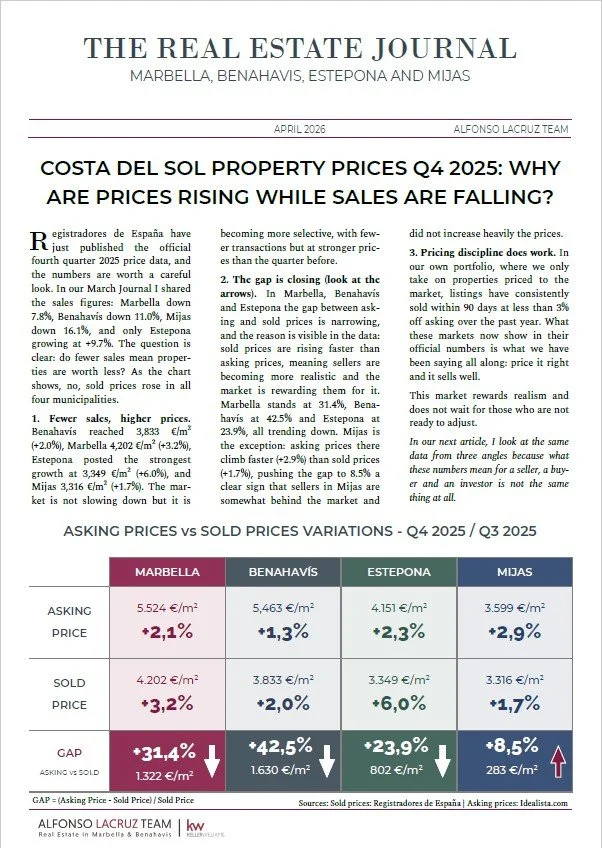
Registradores de España have just published the official fourth quarter 2025 price data, and the numbers are worth a careful look. In our March Journal I shared the sales figures: Marbella down 7.8%, Benahavís down 11.0%, Mijas down 16.1%, and only Estepona growing at +9.7%. The question is clear: do fewer sales mean proper-ties are worth less? As the chart shows, no, sold prices rose in all four municipalities.
1. Fewer sales, higher prices. Benahavís reached 3,833 €/m² (+2.0%), Marbella 4,202 €/m² (+3.2%), Estepona posted the strongest growth at 3,349 €/m² (+6.0%), and Mijas 3,316 €/m² (+1.7%). The market is not slowing down but it is becoming more selective, with fewer transactions but at stronger prices than the quarter before.
2. The gap is closing (look at the arrows). In Marbella, Benahavís and Estepona the gap between ask-ing and sold prices is narrowing, and the reason is visible in the data: sold prices are rising faster than asking prices, meaning sellers are becoming more realistic and the market is rewarding them for it. Marbella stands at 31.4%, Benahavís at 42.5% and Estepona at 23.9%, all trending down. Mijas is the exception: asking prices there climb faster (+2.9%) than sold prices (+1.7%), pushing the gap to 8.5% a clear sign that sellers in Mijas are somewhat behind the market and did not increase heavily the prices.
3. Pricing discipline does work. In our own portfolio, where we only take on properties priced to the market, listings have consistently sold within 90 days at less than 3% off asking over the past year. What these markets now show in their official numbers is what we have been saying all along: price it right and it sells well.
This market rewards realism and does not wait for those who are not ready to adjust.
In our next article, I look at the same data from three angles because what these numbers mean for a seller, a buyer and an investor is not the same thing at all.
Journal on the Real Estate Market on the Costa del Sol - April 2026
WHAT HAPPENS WHEN YOU OVERPRICE A PROPERTY: HOW TO LOSE VALUE EVEN IN A RISING MARKET ?
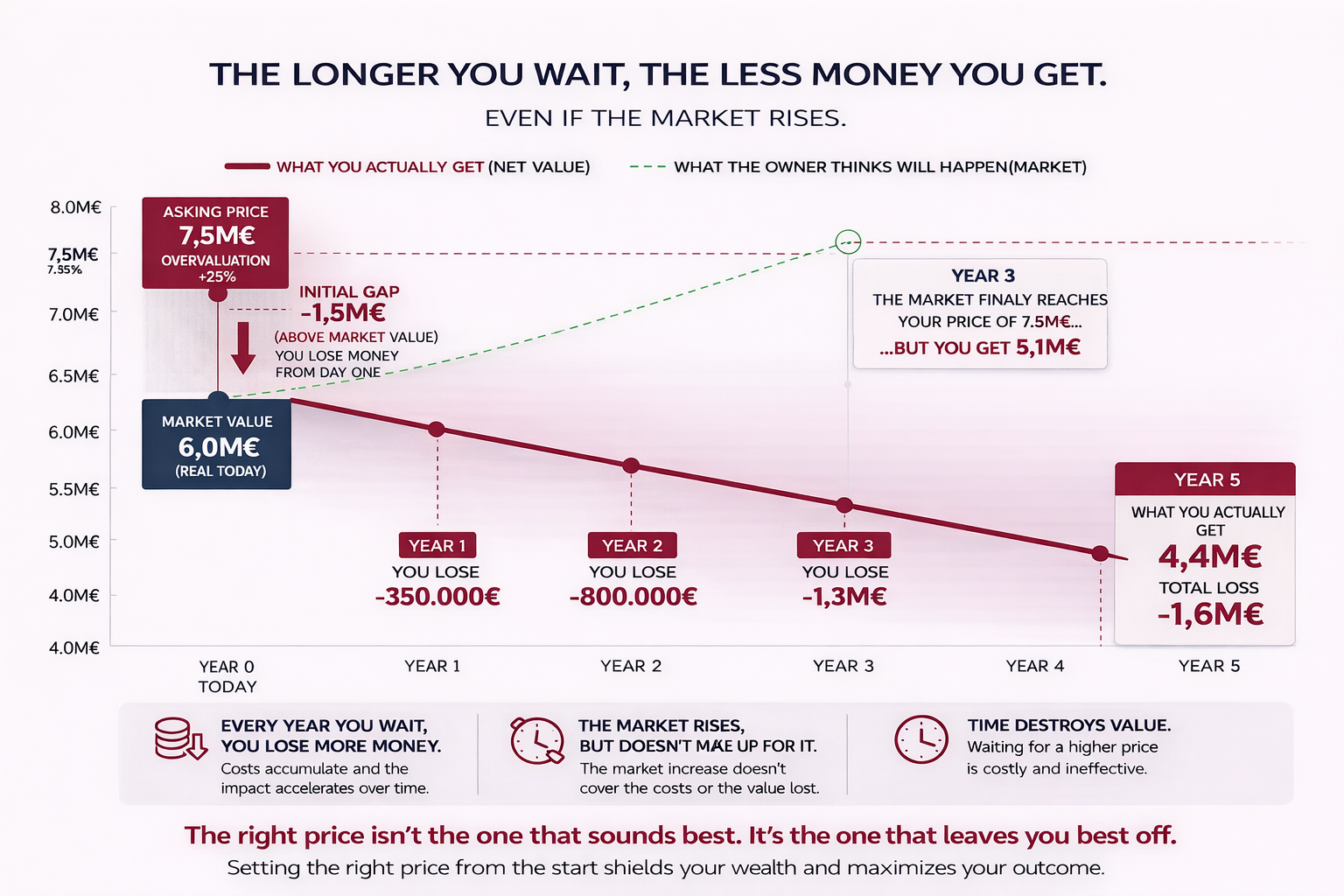
Overpricing a property can reduce what you actually walk away with, even in a rising market. If the property does not generate rental income, waiting is not neutral. In most cases, it quietly works against you. This is especially relevant in markets like Marbella and Benahavís, where many owners assume future price growth will compensate for an ambitious asking price. The reality is different.
Why overpricing a property can cost sellers money?
When a property is launched above its true market val-ue, five factors start working in parallel:
1. Market growth. Yes, prices may increase over time. This is often the reason behind overpricing. But it is on-ly one variable and not the most decisive one.
2.Holding costs. Owning a property comes with ongoing expenses, whether it is sold or not. Community fees, insurance, maintenance and upkeep continue every month. A realistic assumption is around 1.5% per year.
3. Inflation. Even if you achieve a higher price in the future, the real value of that money may be lower. Infla-tion reduces purchasing power over time, often as-sumed at around 2% annually.
4. Opportunity cost. The capital tied up in the property could be working elsewhere. Even a conservative return of 4% per year compounds over time, increasing the cost of waiting.
5. Property ageing. Properties lose relative appeal over time. Design trends evolve, competition improves, and even well-maintained homes can feel outdated. A rea-sonable estimate is around 1% per year.
While the market may rise, these factors ac-cumulate. The result is simple: overpricing does not protect value, it often reduces it. The right asking price is not the highest number a property could reach. It is the price that protects what you actually receive.
MARKET STABILITY? ESTEPONA RISES WHILE MARBELLA, BENAHAVÍS, AND MIJAS SALES FALL
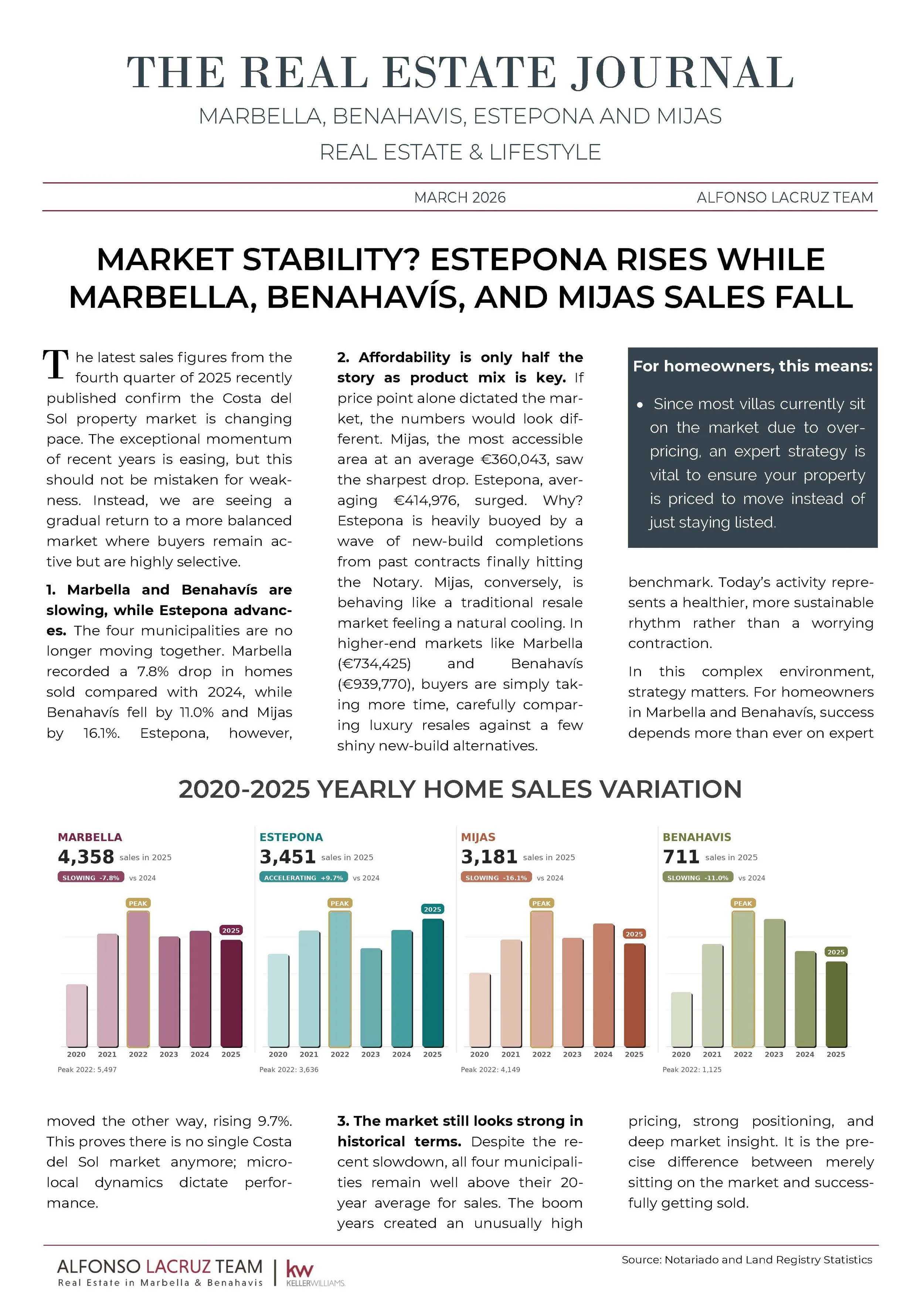
The latest sales figures from the fourth quarter of 2025 recently published confirm the Costa del Sol property market is changing pace. The exceptional momentum of recent years is easing, but this should not be mistaken for weak-ness. Instead, we are seeing a gradual return to a more balanced market where buyers remain ac-tive but are highly selective.
1. Marbella and Benahavís are slowing, while Estepona advances. The four municipalities are no longer moving together. Marbella recorded a 7.8% drop in homes sold compared with 2024, while Benahavís fell by 11.0% and Mijas by 16.1%. Estepona, however, moved the other way, rising 9.7%. This proves there is no single Costa del Sol market anymore; micro-local dynamics dictate performance.
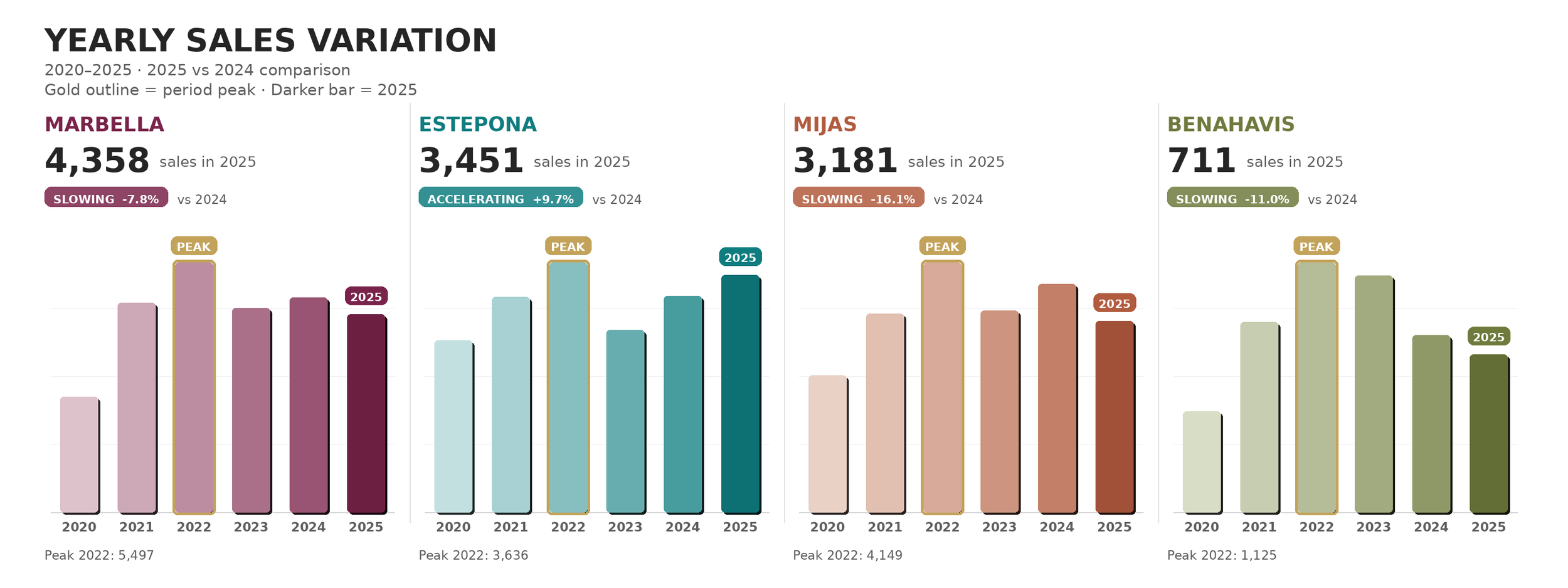
2. Affordability is only half the story as product mix is key. If price point alone dictated the market, the numbers would look diferent. Mijas, the most accessible area at an average €360,043, saw the sharpest drop. Estepona, averaging €414,976, surged. Why?Estepona is heavily buoyed by a wave of new-build completions from past contracts ï¬nally hitting the Notary. Mijas, conversely, is behaving like a traditional resale market feeling a natural cooling. In higher-end markets like Marbella €734,425) and Benahavís (€939,770), buyers are simply taking more time, carefully comparing luxury resales against a few shiny new-build alternatives.
3. The market still looks strong in historical terms. Despite the recent slowdown, all four municipalities remain well above their 20-year average for sales. The boom years created an unusually high benchmark. Today’s activity repre-sents a healthier, more sustainable rhythm rather than a worrying contraction.
In this complex environment, strategy matters. For homeowners in Marbella and Benahavís, success depends more than ever on expert pricing, strong positioning, and deep market insight. It is the pre-cise difference between merely sitting on the market and success-fully getting sold.
Journal on the Real Estate Market on the Costa del Sol - March 2026
MARBELLA AND BENAHAVIS BETWEEN 500K€ AND 2M€: WHAT KIND OF LIFE CAN YOU HAVE HERE?
As we live every day in this real estate world, we talk a lot about market statistics and prices, but for most of our clients the real question is much simpler: What kind of life can I have here with my budget?
In these ranges, when you know the area and are clear about what you want, the answer is not same for any budget and the article explains what kind of life each level from 500 k€ to 2 M€ euros allows on the Costa.
At the lower range of this bracket, around 500 k€ to 800 k€, buyers are usually choosing between a good apartment or townhouse in a well located community and a more basic villa that may need updating. You can be close to services, in a pleasant urbanization, perhaps with a shared pool and some sea or garden views. Daily life is convenient: schools, supermarkets, sports and restaurants are all within a short drive. What you may compromise on is plot size, absolute privacy or the “wow” view.

As you move towards 1 M€ and even a little higher, the conversation changes. In many areas you can find a solid detached villa with its own garden and pool, often with better orientation, more light and clearer views. The difference is not only in meters, but in how the property feels when you arrive: more space around you, more flexible layouts, room for guests and family to visit comfortably. For many buyers in this range, that is when the property begins to feel like a long-term home rather than just a holiday base.
Between 1,5 M€ and 2 M€, quality and micro-location become more visible. You are closer to the better streets within a given area, with easier access, quieter surroundings and more established neighbors. You may not be in the most famous gated communities, but you are often one or two steps below them in price, with a similar sense of calm and security.
The point is that the same budget can buy very differ-ent lives, depending on where you focus: closer to the beach or in the hills, more square meters or a better street, something ready to live in or a home with poten-tial. The most useful first step is not to chase the largest house on paper, but to be honest about how you want to live day to day. Once that is clear, it becomes much easier to see which areas and which homes truly match your life not just your budget.
Not every location is for everyone but we have many locations and lives to choose from and that is the beauty of our Costa del Sol.
THE MARKET REALITY IN MARBELLA & BENAHAVÍS: WHY SOME HOMES SELL AND OTHERS SIT
Double-click to edit...
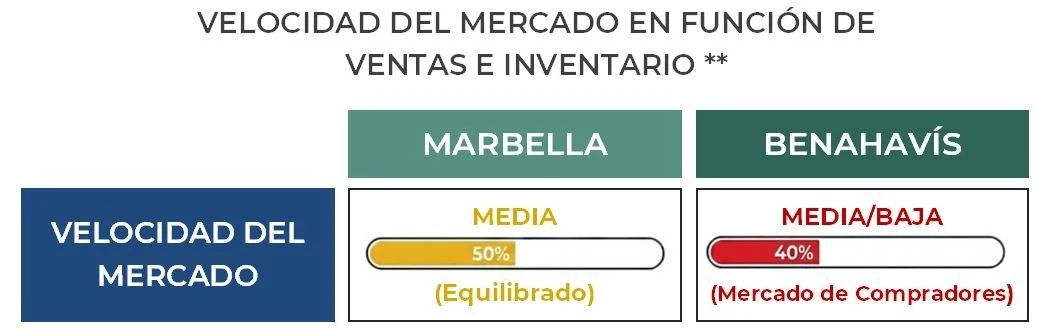
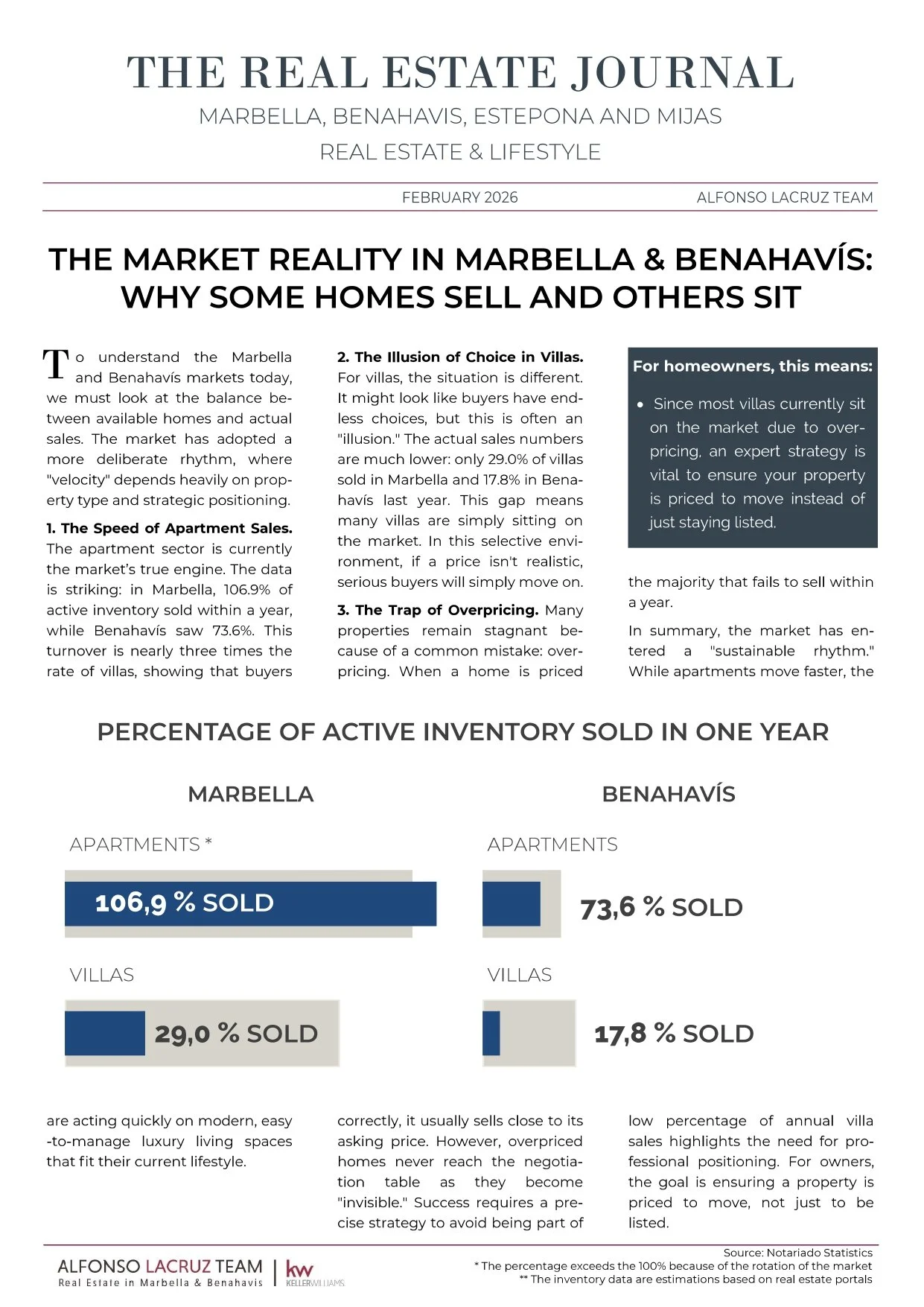
To understand the Marbella and Benahavís markets today, we must look at the balance be-tween available homes and actual sales. The market has adopted a more deliberate rhythm, where "velocity" depends heavily on prop-erty type and strategic positioning.
1. The Speed of Apartment Sales. The apartment sector is currently the market’s true engine. The data is striking: in Marbella, 106.9% of active inventory sold within a year, while Benahavís saw 73.6%. This turnover is nearly three times the rate of villas, showing that buyers are acting quickly on modern, easy -to-manage luxury living spaces that fit their current lifestyle.
2. The Illusion of Choice in Villas. For villas, the situation is different. It might look like buyers have end-less choices, but this is often an "illusion." The actual sales numbers are much lower: only 29.0% of villas sold in Marbella and 17.8% in Benahavís last year. This gap means many villas are simply sitting on the market. In this selective envi-ronment, if a price isn't realistic, serious buyers will simply move on.
3. The Trap of Overpricing. Many properties remain stagnant be-cause of a common mistake: over-pricing. When a home is priced correctly, it usually sells close to its asking price. However, overpriced homes never reach the negotiation table as they become "invisible." Success requires a precise strategy to avoid being part of the majority that fails to sell within a year.
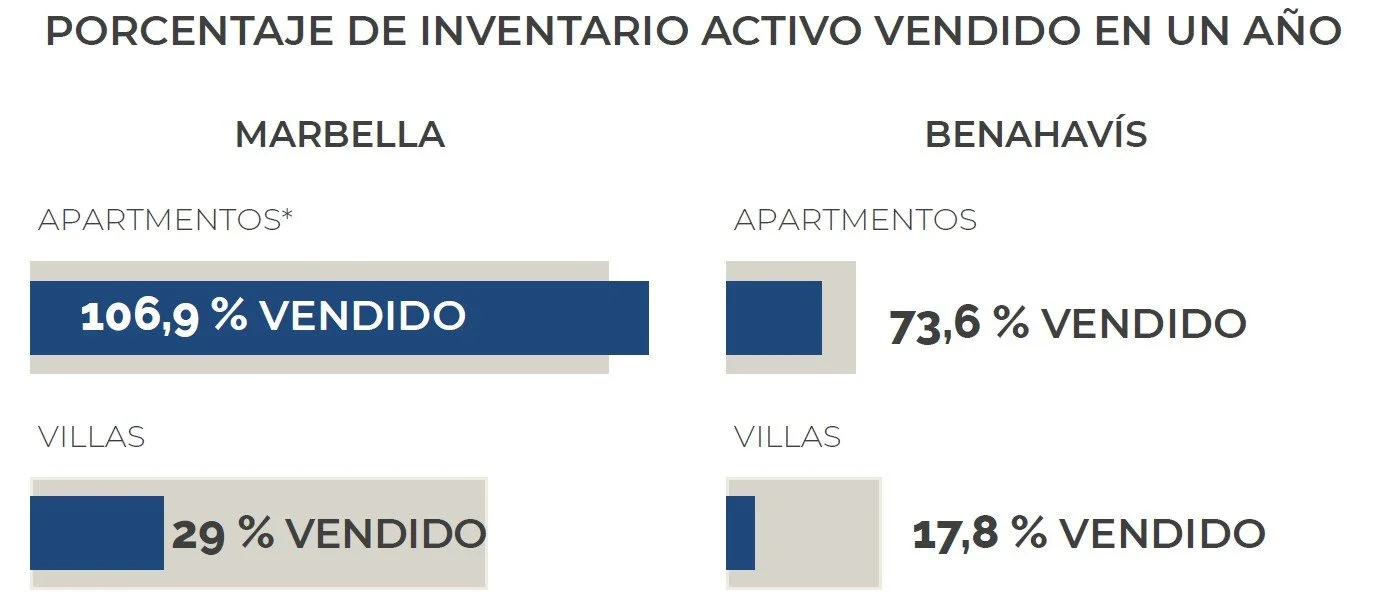
In summary, the market has en-tered a "sustainable rhythm." While apartments move faster, the low percentage of annual villa sales highlights the need for pro-fessional positioning. For owners, the goal is ensuring a property is priced to move, not just to be listed.
Journal on the Real Estate Market on the Costa del Sol - February 2026
Journal on the Real Estate Market on the Costa del Sol - January 2026
WHAT REALLY DETERMINES THE VALUE OF A VILLA IN MARBELLA AND BENAHAVIS ON THE RANGE 5OOK€-2M€
In the 500k€- 2M€‚ bracket, villa values are about more than size alone. Two homes with the same square meters can end up with very different price tags because buyers are not only comparing "what it is", but also "how it lives" and "what it might cost them later". When you break it down, pricing in Marbella and Benahavís usually comes back to four key points: location, the property itself, competition, and the wider market.
Location (and micro-location). "Location, location, location" is true, but here micro-location moves the needle. There is not one Marbella or one Benahavís. Even within Nueva Andalucía, La Campana, Centro Plaza, La Cerquilla and Aloha are all "Nueva Andalucía", yet pricing differs. Access, nearby amenities, the quality of the surrounding homes, and the profile of neighbors ali influence demand. So does "friction": road noise, steep approaches, narrow streets, difficult turning, limited
The Property (quality + livability). Condition and maintenance shape perception immediately. A kitchen is a kitchen, but it is not the same a Gaggenau kitchen as a basic Bosch set-up-sometimes it is not the real cost difference, but the buyer's perception of value. The same applies to windows, bathrooms, insulation, drainage, and overall build quality. Then comes liveability: orientation and natural light, layout, room sizes, privacy, the number of stairs in and out, and how usable the plot really is. Views add value, but the premium is higher when the view corridor is likely to remain.
Competition (your direct rivals). lf there are many similar villas for sale, price pressure increases. This is why we analyze two sets of comparables. "For sale" comparables show who you compete against today: the alternaÂtives buyers will view next, and therefore who you must beat on presentation, features and, if needed, price. "Sold" comparables are the strongest reference for market value beÂcause they show what buyers actually paid once negotiations were finished.
The Market (demand vs supply). When demand is strong, prices rise. When demand is weaker, sellers compete and price becomes the lever. This links to what I explained in my November's Journal about the gap between asking and closing prices: portals show asking, but the market is defined by sold.
In summary: correct pricing is not guesswork. lt requires a professional review of location, property, competition and market grounded in sold evidence, not optimistic listings.
WHERE IS THE MARKET HEADING? THE REALITY OF INVENTORY AND THE PRICE GAP IN COSTA DEL SOL
Double-click to edit...
As we start the new year, the data from the end of 2025 shows us exactly what to expect in 2026. The post-covid activity of the last few years has calmed down. We have entered a more stable environment, which is healthy for both buyers and sellers.
Based on our latest data for Marbella and Benahavis, here are the three trends you need to know:
1. Market Velocity & Balance. The most obvious change is the "Market Velocity" - the speed at which homes sell. Sales have moved to a more nor- mal pace. This is because the Absorption Ratio (the balance between supply and demand) has moved into a "Balanced Market" zone. We are no long- er in a "lopsided sellers market" where sellers hold all the leverage. Buyers are taking more time to decide, and sellers should expect a slightly longer timeline to close a sale.
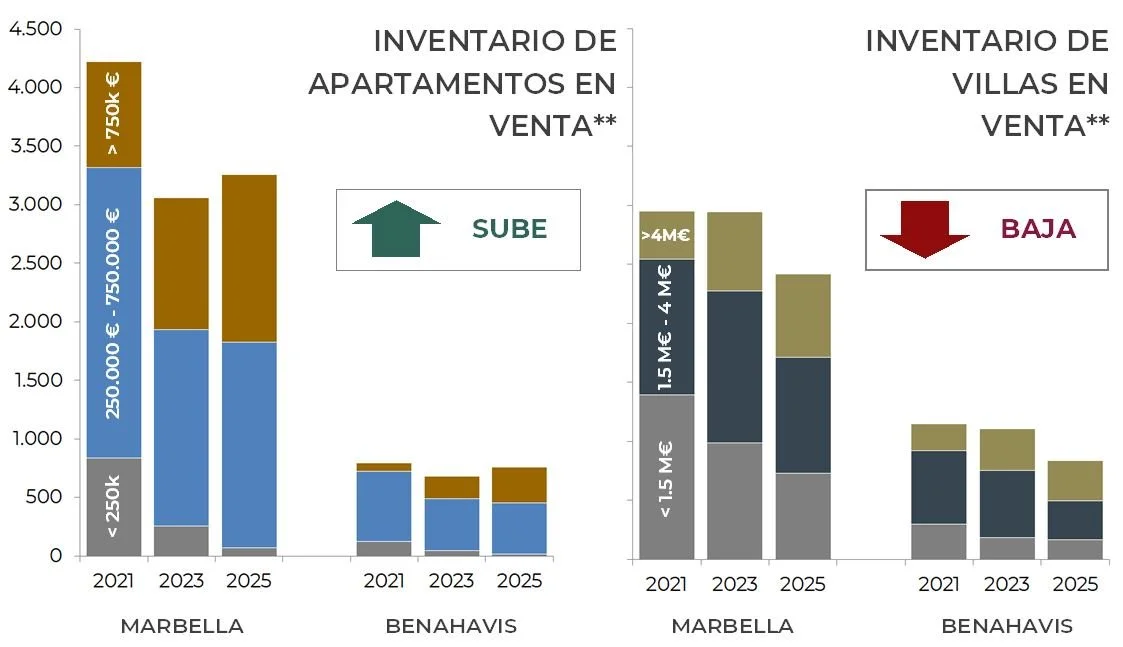
2. The Changing Face of lnventory. The supply of homes is shifting in specific ways. While apartment inventory is generally growing, the market for properties under €250,000 has virtually vanished. In the villa segment, we see a "squeeze" at the bottom: the number of villas for sale is dropping, but almost entirely in the under €1.5M range. Meanwhile, the supply of high-end villas over €4M remains very steady. Scarcity is now a factor of price point, not just property type.
3. Success Requires a Smart Plan. In this balanced environment, simply lísting a home is not enough. Because buyers have more options and less urgency, your property needs a competitive edge. This is where pricing and presentation become vital. To secure a sale, a property must be priced accurately from day one and presented flawessly. Professional staging data- backed pricing are now the only ways to truly stand out. For 2026, success lies in interpreting these shifts correctly. Success belongs to those who adapt to the specific trends of their price range and focus on pro-fessional execution.