MARBELLA Y BENAHAVÍS ENTRE 500.000 € Y 2.000.000 €: ¿QUÉ TIPO DE VIDA PUEDES TENER AQUÍ?

En el día a día hablamos mucho de estadísticas y precios, pero para la mayoría de nuestros clientes la pregunta de fondo es mucho más sencilla: “Con mi presupuesto, ¿qué tipo de vida puedo tener aquí?”

En estos rangos de precio, conociendo bien la zona y teniendo claro lo que se busca, la respuesta no es única: cambia según el presupuesto y en este artículo resumo de forma sencilla qué tipo de vida suele corresponder a cada tramo entre 500 k€ y 2 M€ en la Costa del Sol.

En la parte baja de este rango, entre 500 k€ y 800 k€, los compradores suelen buscar entre un buen piso o adosado bien situados o una villa más básica que quizá necesite alguna mejora. Se puede conseguir estar cerca de servicios, en una buena comunidad con piscina co-mún y, en algunos casos, algo de vistas al mar o al jardín. El día a día es cómodo: colegios, supermercados, y servicios están a pocos minutos en coche. Lo que nor-malmente se sacrifica es tamaño de parcela, privacidad o ese efecto “wow” en las vistas y acabados.

A medida que nos acercamos al entorno de 1 M€ y algo más arriba, la conversación cambia. En muchas zonas ya es posible encontrar una buena villa independiente con su propio jardín y piscina, a menudo con mejor orientación, más luz y vistas más despejadas. La diferencia no está solo en los metros, sino en cómo se siente la casa cuando llegas: más espacio, distribución más cómoda y espacio para que amigos y familia pue-dan disfrutar sin agobios. Para muchos compradores en este tramo es cuando la casa empieza a sentirse co-mo un hogar y no solo como una base de vacaciones.

Entre 1,5 M € y 2 M € la calidad y la micro-localización se notan aún más: mejor calle dentro de cada zona, con accesos más fáciles, entornos más tranquilos y consolidados. Puede que no se este en la ubicación más “top”, pero sí muy cerca en sensaciones, algún escalón por debajo en precio y con un nivel de tranquilidad similar.

Al final, con el mismo presupuesto se pueden vivir vidas muy distintas según dónde se ponga el foco: más cerca de la playa o en el golf, más metros o una mejor calle, algo listo para entrar a vivir o una casa con potencial. El primer paso no es simplemente elegir una casa más grande sobre el papel sino ser sinceros sobre cómo se quiere vivir el día a día. Cuando eso está claro, es mu-cho más fácil ver qué zonas y qué viviendas encajan de verdad con ese estilo de vida y no solo con el presu-puesto.

No todas las ubicaciones son para todo el mundo, pero en nuestra Costa del Sol hay muchas formas de vivirla y ese es, precisamente, su encanto.
¿DÓNDE VA EL MERCADO?: LA REALIDAD DEL INVENTARIO Y LA BRECHA DE PRECIOS EN COSTA DEL SOL

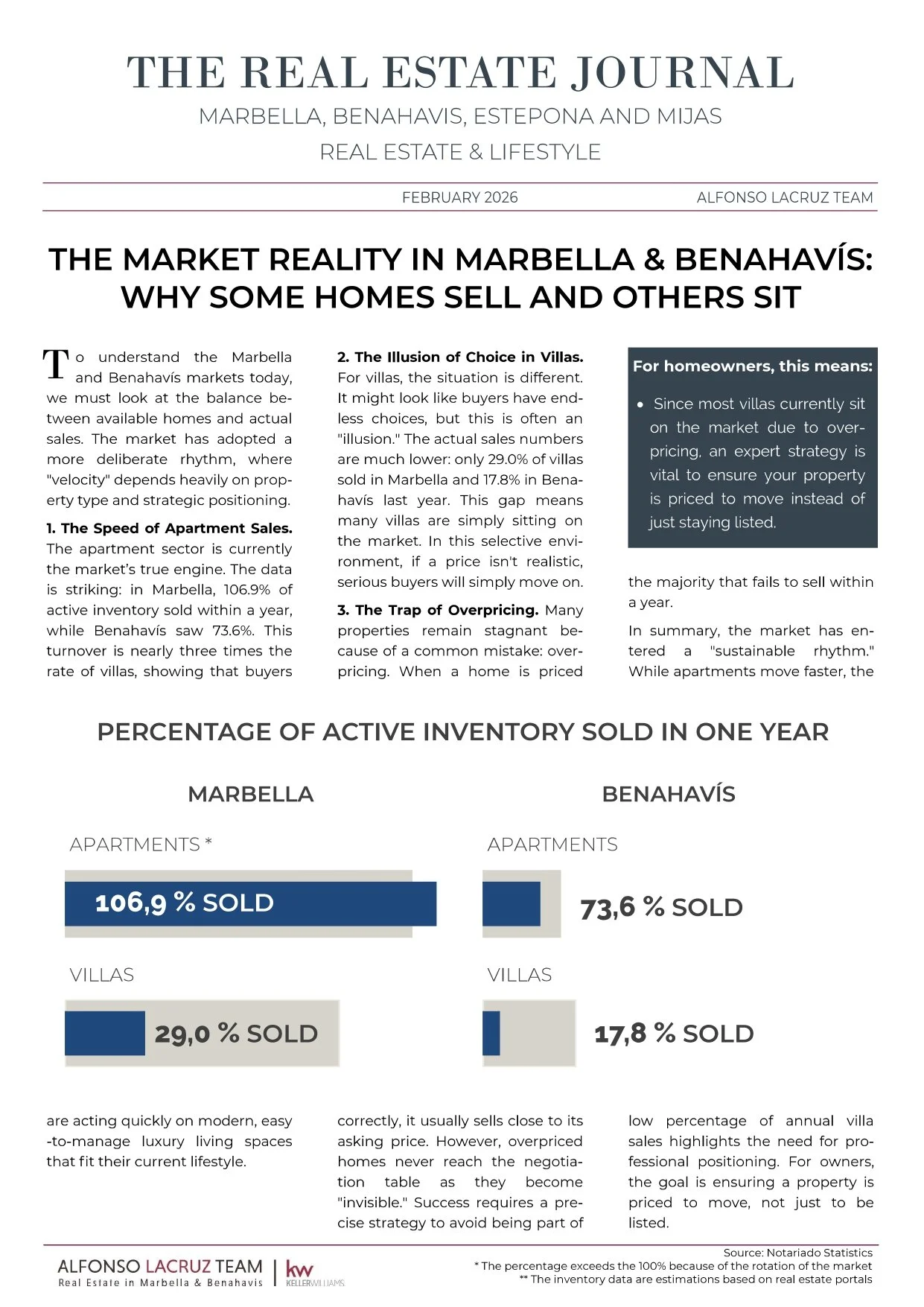
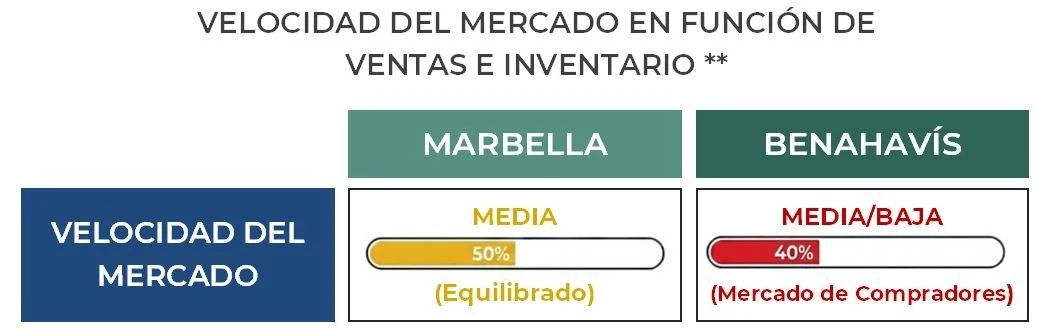
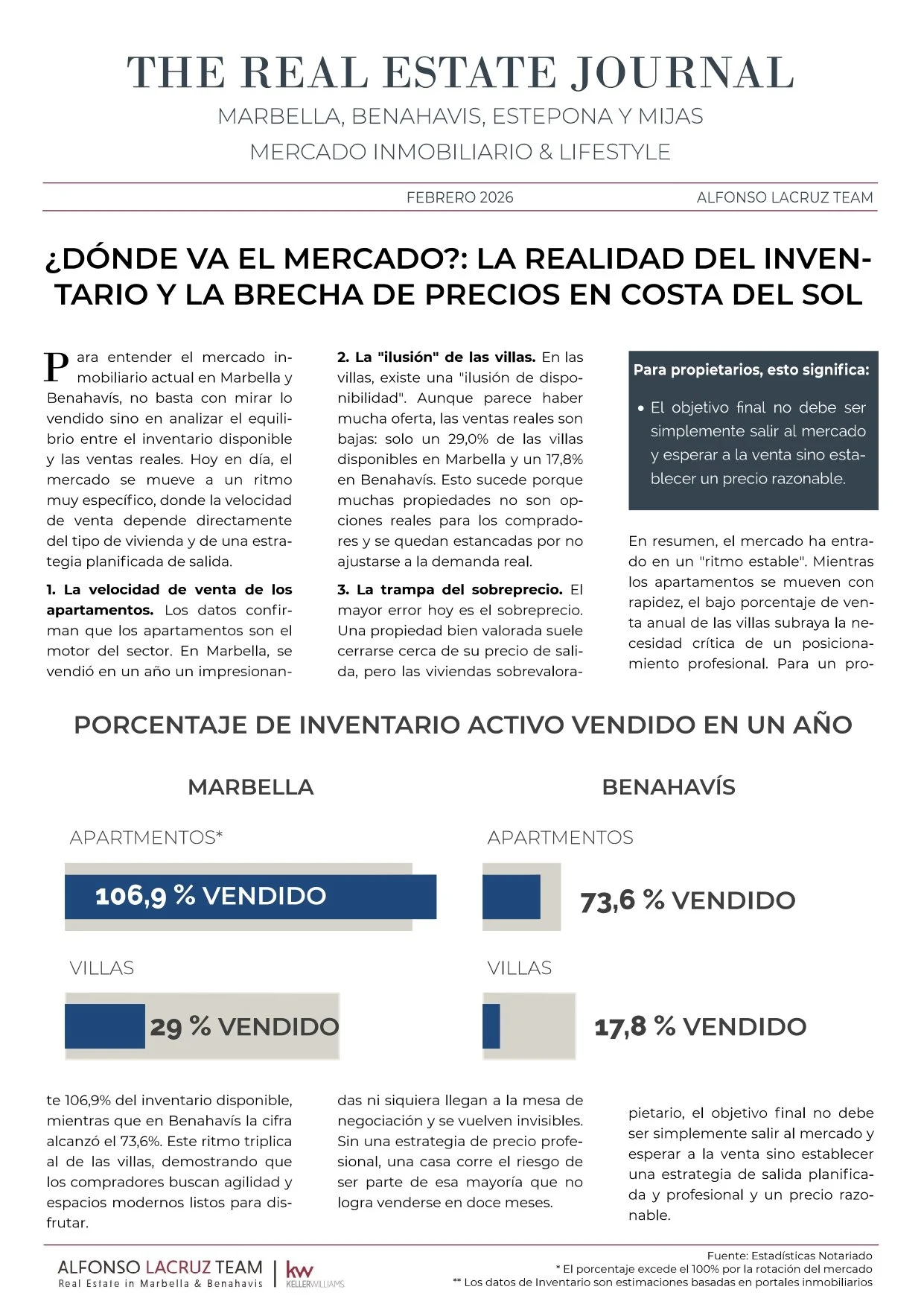
Para entender el mercado in-mobiliario actual en Marbella y Benahavís, no basta con mirar lo vendido sino en analizar el equili-brio entre el inventario disponible y las ventas reales. Hoy en día, el mercado se mueve a un ritmo muy específico, donde la velocidad de venta depende directamente del tipo de vivienda y de una estra-tegia planificada de salida.

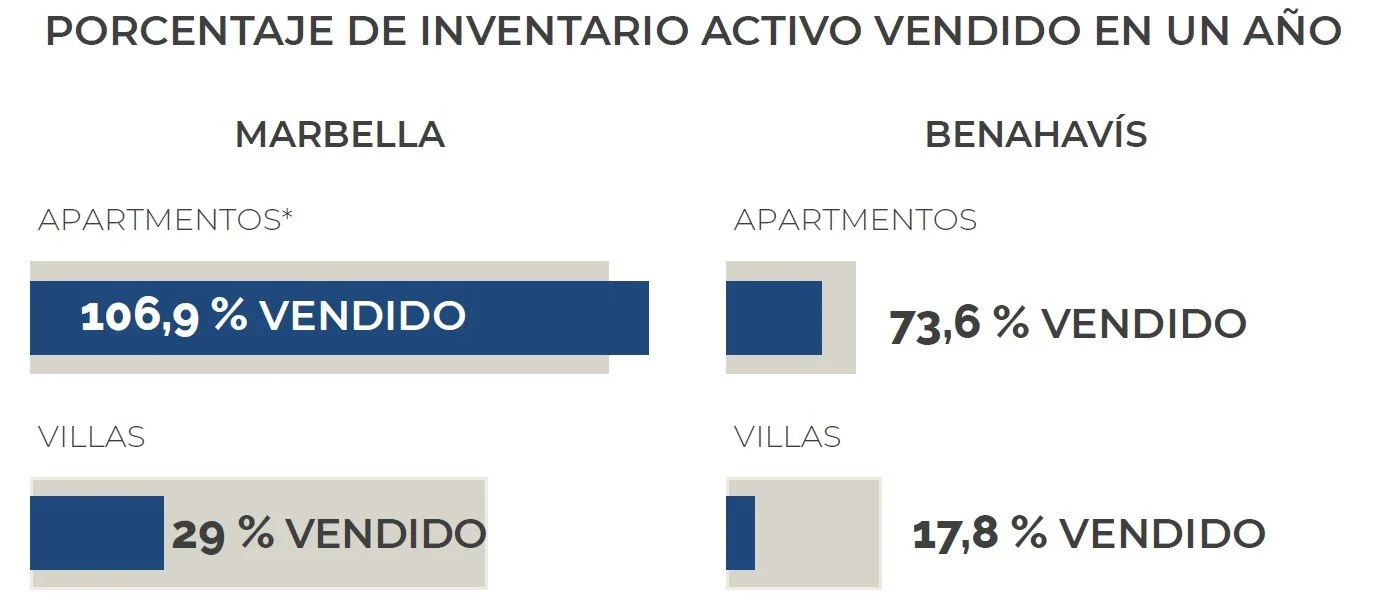
1. La velocidad de venta de los apartamentos. Los datos confir-man que los apartamentos son el motor del sector. En Marbella, se vendió en un año un impresionante 106,9% del inventario disponible, mientras que en Benahavís la cifra alcanzó el 73,6%. Este ritmo triplica al de las villas, demostrando que los compradores buscan agilidad y espacios modernos listos para dis-frutar.

2. La "ilusión" de las villas. En las villas, existe una "ilusión de dispo-nibilidad". Aunque parece haber mucha oferta, las ventas reales son bajas: solo un 29,0% de las villas disponibles en Marbella y un 17,8%en Benahavís. Esto sucede porque muchas propiedades no son op-ciones reales para los comprado-res y se quedan estancadas por no ajustarse a la demanda real.

3. La trampa del sobreprecio. El mayor error hoy es el sobreprecio. Una propiedad bien valorada suele cerrarse cerca de su precio de sali-da, pero las viviendas sobrevaloradas ni siquiera llegan a la mesa de negociación y se vuelven invisibles. Sin una estrategia de precio profe-sional, una casa corre el riesgo de ser parte de esa mayoría que no logra venderse en doce meses.

En resumen, el mercado ha entra-do en un "ritmo estable". Mientras los apartamentos se mueven con rapidez, el bajo porcentaje de ven-ta anual de las villas subraya la ne-cesidad crítica de un posiciona-miento profesional. Para un propietario, el objetivo final no debe ser simplemente salir al mercado y esperar a la venta sino establecer una estrategia de salida planifica-da y profesional y un precio razo-nable.

WHAT REALLY DETERMINES THE VALUE OF A VILLA IN MARBELLA AND BENAHAVIS ON THE RANGE 5OOK€-2M€

In the 500k€- 2M€‚ bracket, villa values are about more than size alone. Two homes with the same square meters can end up with very different price tags because buyers are not only comparing "what it is", but also "how it lives" and "what it might cost them later". When you break it down, pricing in Marbella and Bena­havís usually comes back to four key points: location, the property itself, competition, and the wider market.

  • Location (and micro-location). "Location, location, location" is true, but here micro-location moves the needle. There is not one Marbella or one Benahavís. Even within Nueva Andalucía, La Campana, Centro Pla­za, La Cerquilla and Aloha are all "Nueva Andalucía", yet pricing differs. Access, nearby amenities, the quality of the surrounding homes, and the profile of neighbors ali influence demand. So does "friction": road noise, steep approaches, narrow streets, difficult turning, limited

  • The Property (quality + livability). Condition and maintenance shape perception immediately. A kitchen is a kitchen, but it is not the same a Gaggenau kitchen as a basic Bosch set-up-sometimes it is not the real cost difference, but the buyer's perception of value. The same applies to windows, bathrooms, insulation, drain­age, and overall build quality. Then comes liveability: orientation and natural light, layout, room sizes, privacy, the number of stairs in and out, and how usable the plot really is. Views add value, but the premium is higher when the view corridor is likely to remain.

  • Competition (your direct rivals). lf there are many similar villas for sale, price pressure increases. This is why we analyze two sets of comparables. "For sale" comparables show who you compete against today: the alterna­tives buyers will view next, and therefore who you must beat on presentation, features and, if needed, price. "Sold" comparables are the strongest reference for market value be­cause they show what buyers actually paid once negotiations were finished.

  • The Market (demand vs supply). When demand is strong, prices rise. When demand is weaker, sellers compete and price be­comes the lever. This links to what I ex­plained in my November's Journal about the gap between asking and closing prices: por­tals show asking, but the market is defined by sold.

    In summary: correct pricing is not guesswork. lt re­quires a professional review of location, property, com­petition and market grounded in sold evidence, not optimistic listings.

WHERE IS THE MARKET HEADING? THE REALITY OF INVENTORY AND THE PRICE GAP IN COSTA DEL SOL

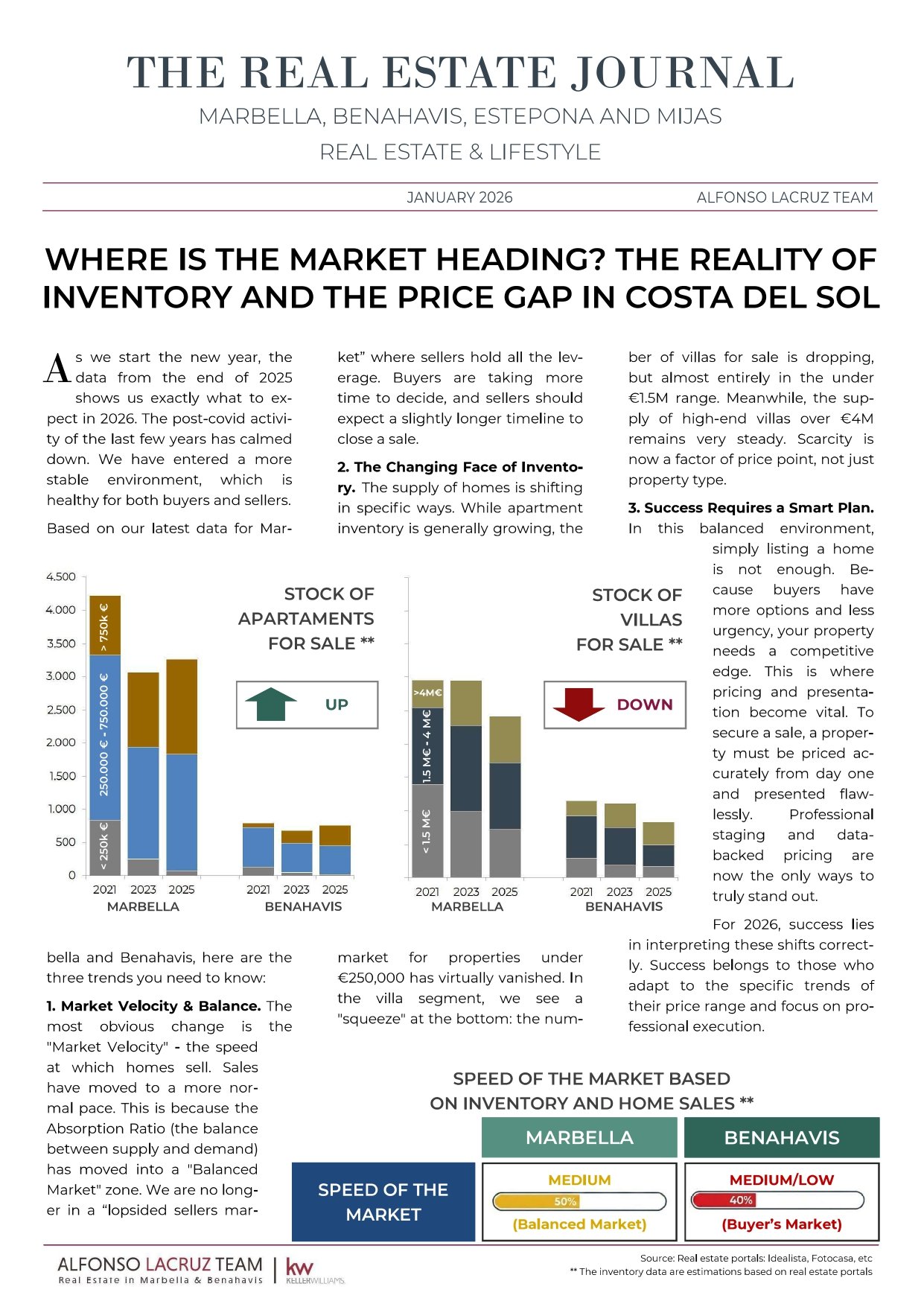
As we start the new year, the data from the end of 2025 shows us exactly what to expect in 2026. The post-covid activi­ty of the last few years has calmed down. We have entered a more stable environment, which is healthy for both buyers and sellers.

Based on our latest data for Marbella and Benahavis, here are the three trends you need to know:

1. Market Velocity & Balance. The most obvious change is the "Market Velocity" - the speed at which homes sell. Sales have moved to a more nor- mal pace. This is because the Absorption Ratio (the balance between supply and demand) has moved into a "Balanced Market" zone. We are no long- er in a "lopsided sellers market" where sellers hold all the lev­erage. Buyers are taking more time to decide, and sellers should expect a slightly longer timeline to close a sale.

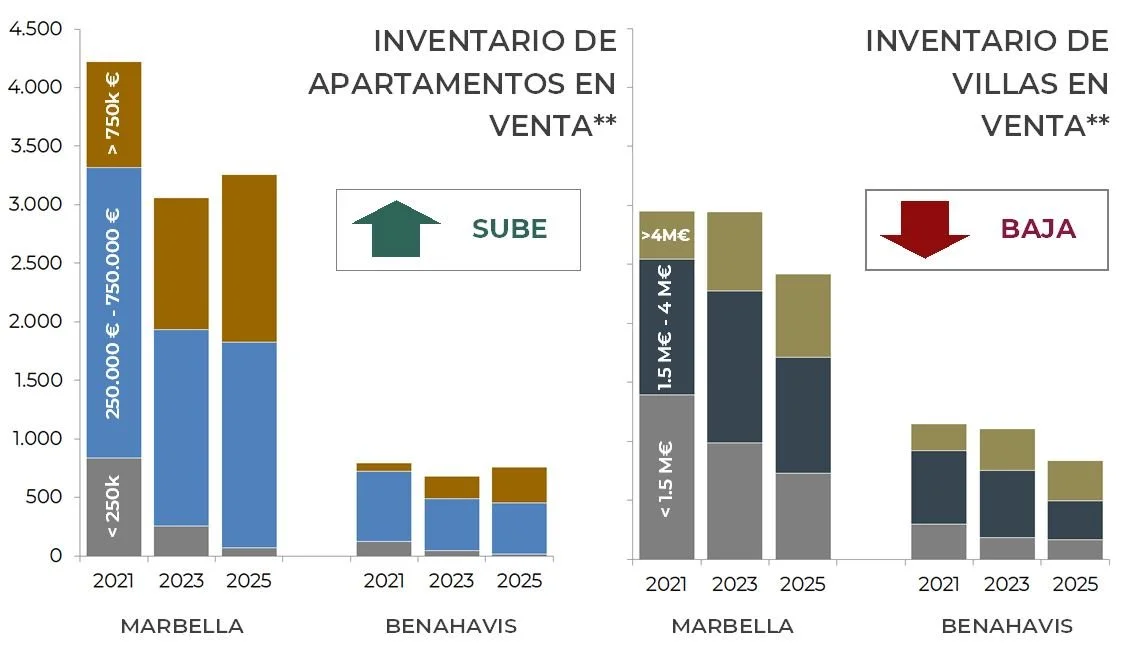
2. The Changing Face of lnvento­ry. The supply of homes is shifting in specific ways. While apartment inventory is generally growing, the market for properties under €250,000 has virtually vanished. In the villa segment, we see a "squeeze" at the bottom: the number of villas for sale is dropping, but almost entirely in the under €1.5M range. Meanwhile, the sup­ply of high-end villas over €4M remains very steady. Scarcity is now a factor of price point, not just property type.

3. Success Requires a Smart Plan. In this balanced environment, simply lísting a home is not enough. Be­cause buyers have more options and less urgency, your property needs a competitive edge. This is where pricing and presenta­tion become vital. To secure a sale, a proper­ty must be priced ac­curately from day one and presented flawessly. Professional staging data- backed pricing are now the only ways to truly stand out. For 2026, success lies in interpreting these shifts correct­ly. Success belongs to those who adapt to the specific trends of their price range and focus on pro-fessional execution.

QUÉ DETERMINA REALMENTE EL VALOR DE UNA VILLA EN MARSELLA Y BENAHAVÍS ENTRE 5OOK€ Y 2.M€

En el rango de entre 500.000 € a 2.000.000 €, el va­lor de una villa no lo dictan solo los metros cuadrados. Dos viviendas similares pueden tener precios muy distintos porque el comprador compara no solo tama-ños sino también "cómo se vive en esa zona y casa" y "qué le puede costar después una casa con esas carac­terísticas". En cualquier caso y en la práctica, el precio de mercado se apoya en cuatro pilares, dos sobre la villa y dos sobre el mercado: ubicación, la propiedad, competencia y mercado.

  • Ubicación (y micro-ubicación). "Ubicación, ubica­ción, ubicación" es cierto, pero aquí la micro-ubicación manda. No hay una sola Marbella ni un solo Benahavís. Incluso dentro de Nueva Andalucía, La Campana, Cen­tro Plaza, La Cerquilla o Aloha se valoran diferente. Pe­san el acceso, los servicios y la calidad del entorno. Tam­bién cuenta la "fricción": el ruido, las pendientes, calles estrechas o poco aparcamiento.

  • La propiedad (calidad y habitabilidad). El estado y el mantenimiento cambian la percepción en segundos. Una cocina es una cocina, pero no es lo mismo una Gaggenau que un conjunto más básico de Bosch: real­mente no es el coste real, sino la percepción de valor del comprador. Lo mismo con ventanas, baños y demás calidades. Independientemente de la calidad están las sensaciones de habitabilidad: orientación y luz, distribución, tamaños de habitaciones, privacidad, las escaleras y la parcela utilizable. Las vistas suman, pero valen más si no se pueden per­der en el futuro.

  • Competencia (tus rivales). Si hay muchas villas similares en venta, aumenta la presión de precio. Por eso analizamos dos compara­bles: i) Los "en venta" nos dicen contra quién compite hoy: qué opciones verá el compra­dor y qué debes superar en presentación, prestaciones y, si hace falta, precio. ii) Los "vendidos" son la referencia más sólida por­que reflejan el precio real tras la negociación.

  • Mercado (oferta y demanda). Cuando la demanda es fuerte, los precios suben; cuan­do es débil, el precio se convierte en palanca. Esto enlaza con mi Journal de Noviembre sobre la brecha entre precio de salida y precio de cierre: los portales muestran la expectativa del vendedor, pero el mercado real lo definen los vendidos.

    En resumen: fijar un precio de mercado requiere anali­zar profesionalmente estos cuatro pilares con datos de ventas cerradas y no solo anuncios online.

¿DÓNDE VA EL MERCADO?: LA REALIDAD DEL INVENTARIO Y LA BRECHA DE PRECIOS EN COSTA DEL SOL

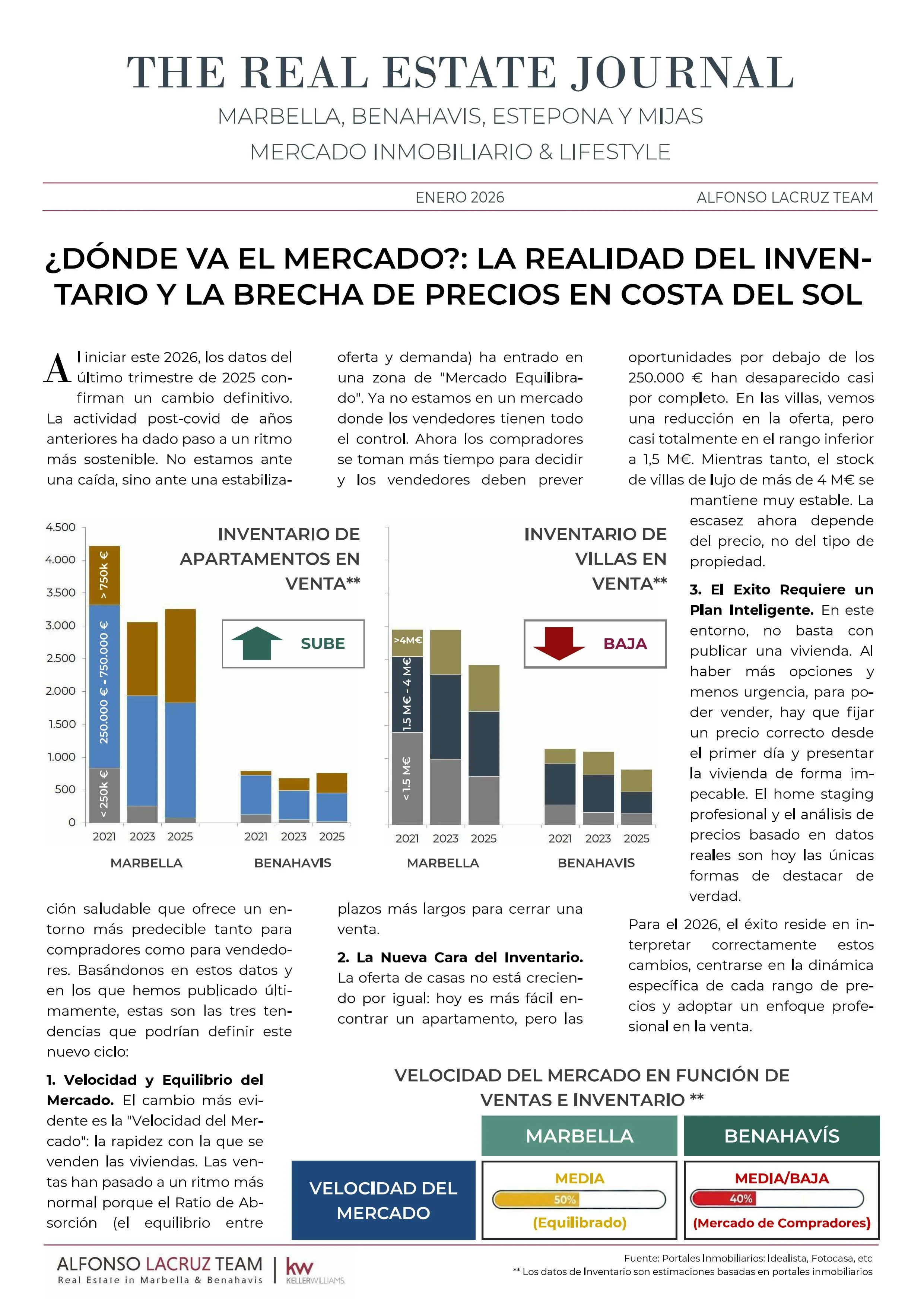
Al iniciar este 2026, los datos del último trimestre de 2025 con­firman un cambio definitivo.La actividad post-covid de años anteriores ha dado paso a un ritmo más sostenible. No estamos ante una caída, sino ante una estabilizaión saludable que ofrece un en­torno más predecible tanto para compradores como para vendedo­res. Basándonos en estos datos y en los que hemos publicado últi­mamente, estas son las tres ten­dencias que podrían definir este nuevo ciclo:

1.Velocidad y Equilibrio del Mercado. El cambio más evi­dente es la "Velocidad del Mer­cado": la rapidez con la que se venden las viviendas. Las ven­tas han pasado a un ritmo más normal porque el Ratio de Ab­sorción (el equilibrio entre oferta y demanda) ha entrado en una zona de "Mercado Equilibra­do". Ya no estamos en un mercado donde los vendedores tienen todo el control. Ahora los compradores se toman más tiempo para decidir y los vendedores deben prever plazos más largos para cerrar una venta.

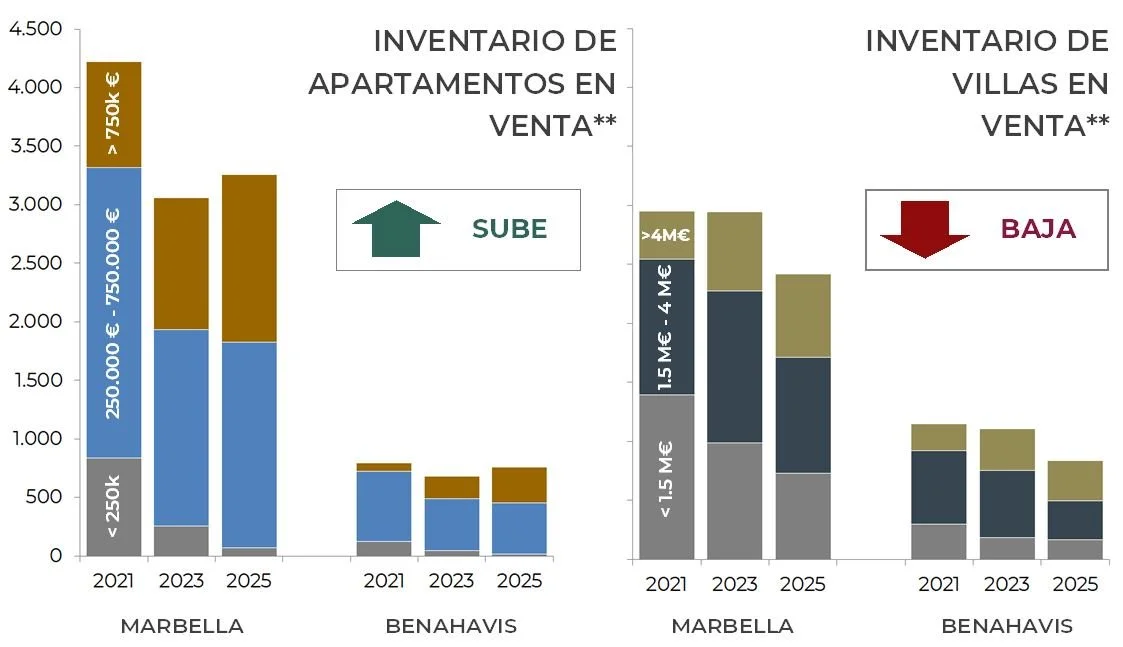
2. La Nueva Cara del Inventario. La oferta de casas no está crecien­do por igual: hoy es más fácil en­contrar un apartamento, pero las oportunidades por debajo de los 250.000 € han desaparecido casi por completo. En las villas, vemos una reducción en la oferta, pero casi totalmente en el rango inferior a 1,5 M€. Mientras tanto, el stock de villas de lujo de más de 4 M€ se mantiene muy estable. La escasez ahora depende del precio, no del tipo de propiedad.

3. El Exito Requiere un Plan Inteligente. En este entorno, no basta con publicar una vivienda. Al haber más opciones y menos urgencia, para po­der vender, hay que fijar un precio correcto desde el primer día y presentar la vivienda de forma imÂpecable. El home staging profesional y el análisis de precios basado en datos reales son hoy las únicas formas de destacar de verdad. Para el 2026, el éxito reside en in­terpretar correctamente estos cambios, centrarse en la dinámica específica de cada rango de pre­cios y adoptar un enfoque profe­sional en la venta.

Why the Costa del Sol shines in winter?: Less rush, more quality of life: the Costa del Sol at its very best

Winter is when the Costa del Sol becomes effortless. The light is softer, the pace slows down, and everything simply flows: longer walks, longer lunches, easier reservations, and a calmer, more liveable rhythm. It´s the season when the destination stops “performing” and starts feeling like real life.

The best way to understand it is to spend a weekend with a clear storyline: culture and tapas to begin, nature and authenticity to reset, and a final touch of quiet, refined luxury, all with Marbella and Benahavís as the natural centre.

A winter weekend that proves the point

DAY 1 - Morning: a cultural anchor in Málaga´s historic centre

Start with an unhurried coffee and a walk through Málaga´s historic centre, when the streets feel lively yet breathable. Keep the “cultural anchor” simple: choose one visit that shapes the morning like Picasso´s Museum or The Alcazaba and Roman Theatre, combining history and architecture. Then let the rest happen naturally between small plazas, elegant fachades, and the hidden corners you only notice when you´re not rushing. Winter is perfect for this: comfortable temperatures, quieter spaces, and beautiful light.

Midday: tapas and hidden gems in the alleyways.

After culture comes one of the south’s greatest pleasures: a tapas lunch in the old town, drifting into those tucked-away places you discover between narrow streets like Uncibay square, Marqués de Larios street or Atarazanas market. Small bars with character, intimate tables, local favourites; this is where Málaga feels most authentic. In winter, the experience is even better: slower service, more space, and the time for a proper sobremesa.

Afternoon: Marbella, at its most enjoyable

Then the mood shifts to Marbella. Winter Marbella is elegance without effort: calmer, more local, and more walkable. The old town feels more personal, the seafront promenade invites a longer stroll, and a late coffee during golden hour becomes the plan. This part of the day highlights a key advantage of the Costa del Sol: you can combine culture, gastronomy and coastal living in one rhythm, without turning your weekend into logistics.

Evening: dinner with atmosphere, not noise

Winter evenings are made for dining well. You can choose for quality and ambience, not for what´s left. Keep it simple: somewhere you can talk, linger, and walk afterwards. In winter, luxury isn´t about excess, it´s about comfort.

DAY 2 - Morning: Benahavís and a mountain viewpoint to reconnect with nature

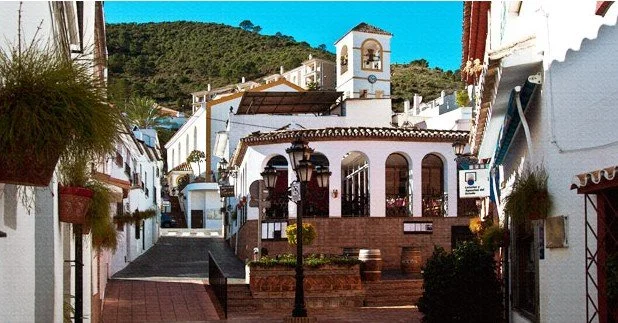
Start day two with the best contrast: Benahavís. Within minutes, the landscape turns greener, the air feels cleaner, and the pace resets. To set the tone, add a simple but powerful plan like Three Pergolas Viewpoint where you can take a short walk, breathe, and enjoy open views. No need for a demanding hike; just nature, silence, and that sense of retreat that explains why so many people want the inland hills without giving up the coast.

Midday: lunch in the village, where gastronomy is the main event

Then comes what Benahavís is known for: lunch in the village. Gastronomy here is undeniably the headline, drawing visitors from all over thanks to its well-regarded restaurants and strong dining culture. Winter makes it even better more relaxed service, more availability, and the kind of meal that becomes an experience rather than a reservation.

Afternoon: Puerto Banús without the crowds - quiet luxury at its best

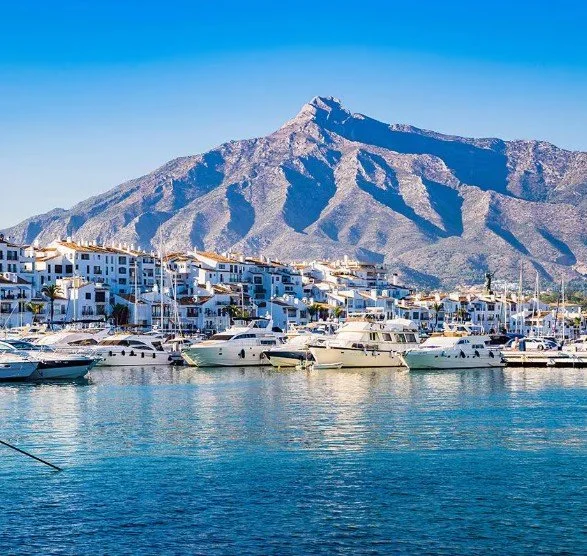
For a magazine-worthy finish, head to Puerto Banús. In winter, luxury and elegance meet  without the high-season bustle: a stroll alongside the yachts, stylish terraces, window-shopping, and a relaxed walk along the seafront promenade, all enjoyed without having to think about noise or crowds. It’s the kind of final chapter that leaves a clear impression: the lifestyle here doesn’t depend on summer; in winter, it often improves.

Evening: a final slow moment-Marbella, softly lit

After Puerto Banús, keep the ending simple and elegant: return towards Marbella for an early evening drink on the promenade, when the light turns golden and the atmosphere feels effortless.

Then choose a dinner that’s about ambience and conversation, warm lighting, good service, no rush. A short walk afterwards, with the sea nearby and the streets quieter than summer, is the perfect full stop to the weekend.

In winter, the luxury is not doing more, it’s doing it better.

After a weekend like this, the conclusion feels natural. The Costa del Sol shines in winter because it offers what people truly want: light, outdoor living, outstanding food, variety, and a more human pace. The coast feels more intimate, the days are calmer, and the experiences that define life here—walks by the sea, long lunches, cultural moments, and time in nature—feel effortless and genuinely enjoyable.

Winter is also when decisions are often made. Without the intensity of peak season, buyers can see the essentials more clearly: how a place lives day to day, how easy it is to move around, and how complete the lifestyle offering really is. The Costa del Sol is not simply a destination—it is a way of living that works year-round, and winter is the proof.

And within that lifestyle map, Marbella and Benahavís become the most complete base for many buyers because they offer the best of both worlds: refined coastal living and high-level services, paired with nature, privacy and a genuine sense of retreat just minutes away. In winter, when life slows down beautifully, Marbella and Benahavís are often where the Costa del Sol feels most complete—and where many people choose to live, invest, and return to year after year.

Off Plan Property Transactions in Spain: Legal Framework, advantages and risks

The purchase of property “off-plan” —that is, acquiring a dwelling that has not yet been built or is still under construction— is a common practice in the Spanish real estate market, particularly in times of urban expansion. It involves entering into a contract of sale with a developer or builder for a property that will be delivered at a future date.

While this type of transaction offers certain advantages to purchasers, it also entails a number of legal and practical risks. The following article examines the essential legal aspects of off-plan purchases under current Spanish law.

The legal regime governing off-plan property sales in Spain is primarily set out in:

  • Law 38/1999, of 5 November, on Building Regulation (Ley de Ordenación de la Edificación – “LOE”).

  • Royal Legislative Decree 1/2007, approving the Consolidated Text of the General Law for the Protection of Consumers and Users.

  • And, generally, the provisions of the Spanish Civil Code, particularly those relating to contractual obligations and termination for breach.

The off-plan developer is subject to several key legal obligations

Guarantee of advance payments: Developers must secure all amounts paid by purchasers before or during construction through either a bank guarantee or an insurance policy (surety bond).

  • This guarantee must ensure the refund of all sums paid on account, plus statutory interest, in the event that construction does not commence or delivery does not take place within the agreed timeframe.

  • The guarantee must be issued individually in favour of each purchaser and expressly referenced in the contract.

It is essential that your legal representative in the off-plan sale ensures this point and that t he guarantee is issued and withdrawn or the insurance policy is duly signed.

Special account requirement: All advance payments received must be deposited into a special, segregated bank account used exclusively to finance construction of the specific project. We   must request a bank certificate for the special account specifying the name  of the developer and the project being developed. This is important because the developer can only use your payments for the development of that specific project. In addition, the bank must authorize each payment and ensure that there is no misappropriation of funds.

Information and transparency duties: The developer must provide detailed and accurate information to the purchaser —including technical specifications, building plans, construction licenses, delivery schedules, and total price— as required by Royal Decree 515/1989.

This is usually done through a document called a DIA (“Documento de informacion Abreviada”).

Advantages of Purchasing Off-Plan

Off-plan acquisitions offer a number of potential benefits:

• More competitive pricing: Buyers usually obtain properties at lower prices than completed units, as they help finance the project from its early stages.

• Customisation options: Purchasers often have the opportunity to choose finishes or make minor modifications during construction.

• Capital appreciation: In a rising market, the property’s value may increase before completion, generating a potential gain.

• Financial planning: Payments are typically made in instalments during construction, allowing better cash-flow management.

Risks and Potential Pitfalls

However, these transactions also entail significant risks, particularly when the statutory guarantees are not properly implemented.

• Delays or construction stoppages: If the developer fails to complete or deliver the project on time, the buyer may face lengthy recovery procedures —especially if no valid guarantee or bond was issued.

• Absence or defect of guarantees: Failure to provide a valid bank guarantee or insurance policy, contrary to Law 20/2015, leaves the purchaser exposed to financial loss.

• Unilateral changes to specifications: Unauthorized modifications to plans or materials may constitute contractual breaches and lead to disputes.

• Developer insolvency: If the developer enters insolvency proceedings, buyers without properly individualised guarantees may rank only as ordinary creditors and risk losing their deposits.

Recommendations for Purchasers

Before signing an off-plan purchase agreement, buyers are strongly advised to:

  1. Verify that a valid building license and approved project exists.

  2. Ensure that an individual guarantee or insurance policy has been issued and remains in force.

  3. Obtain a Land Registry extract (nota simple) to confirm ownership of the land.

  4. Include clear contractual clauses regarding delivery dates and penalties for delay.

  5. Seek independent legal advice from a lawyer specialised in real estate law before making any payment.

Purchasing off-plan property in Spain can be an attractive and legitimate option for acquiring new housing at advantageous conditions. Nevertheless, such transactions demand caution and careful legal due diligence.

Spanish legislation provides robust consumer protection provided that the developer duly complies with its obligations regarding guarantees and transparency. Engaging a lawyer specialized in Spanish real estate law is therefore essential to minimize risk

and ensure that the transaction proceeds securely and in full compliance with applicable law.

At MARBELLA SOLICITORS, we have specialised lawyers in off-plan transactions and who will be delighted to assist you and help you through the entire purchase process, from the reservation to the very end and even beyond, that is: annual tax returns, Spanish Will, etc.

Our Law Office is specialized in property and tax Law, so we are experts in this area of the Spanish Law, with a large experience in conveyancing and purchase/sale transactions. All our lawyers are qualified solicitors, duly registered with the Bar Association. We are based in Costa del Sol with 6 offices along the coast.

SIERRA BLANCA VS. LA ZAGALETA: WHICH LUXURY LIFESTYLE FITS YOU BEST?

When defining true luxury in Marbella and Benahavís, two iconic names domínate the conversation: Sierra

Blanca and La Zagaleta. The question isn't which is "best," but rather which aligns with your lifestyle. They offer fun­damentally different experiences: one is connected and urban, the other secluded and prívate.

Sierra Blanca: The "Urban" Choice. Sierra Blanca sits on the northern side of Marbella's Golden Mile. lts primary appeal is proximity. Residents are minutes away from international schools, Puerto Banús, and the city's business and social hubs. lt offers a prestigious, quiet neighborhood feel with mature gardens and sea views, but remains deeply connected to the daily rhythm of Marbella.

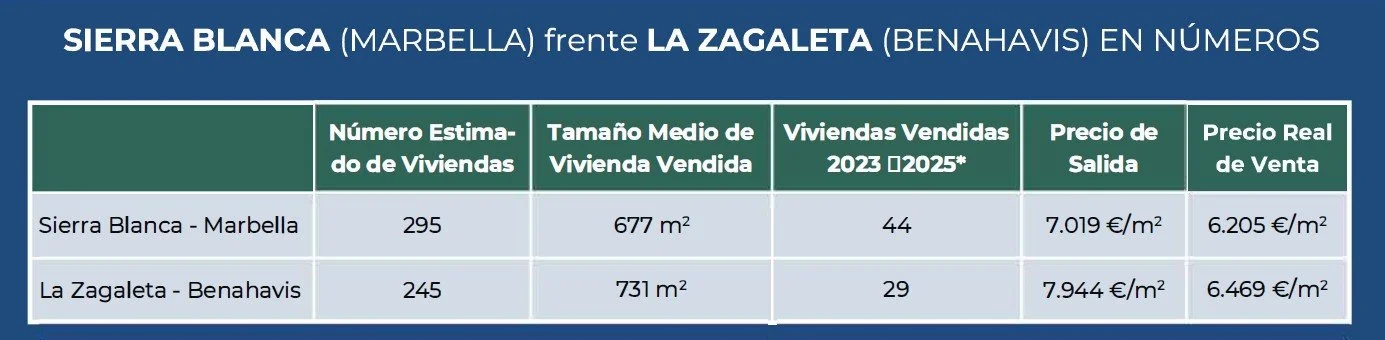
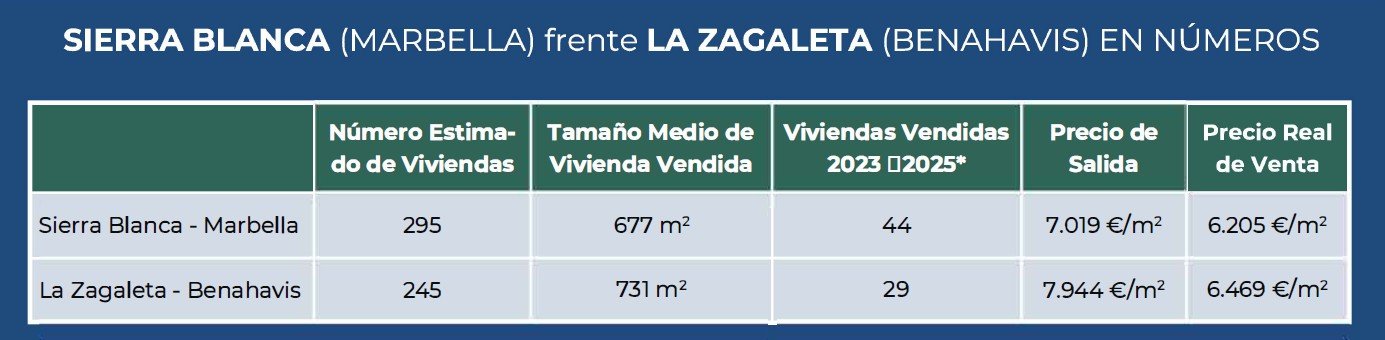
The Market Reality: Sierra Blanca is a more active market, with 44 homes sold between 2023 and 2025, compared to 29 in La Zagaleta. The average sold home here is 677 m2 , reflecting a slightly more compact, urban villa style.

La Zagaleta: The "Retreat" Choice. La Zagaleta, located in Benahavís, feels like a prívate country club. lt is a destina­tion in itself, requiring a drive up the Ronda road, roughly 20 minutes to reach Puerto Banús. In exchange for this distance, you gain unrivaled privacy, security, and space. lt features two prívate golf courses and expansive plots where neighbors are often invisible to one another.

The Market ReaHty: Properties here are grander estates, with an average sold size of 731 m2 and bigger plots. This exclusivity commands a premium: the average sold price currently sits at 6,469 €/m2 , slightly higher than Sierra Blanca's 6,205 €/m2.

The choose, they are similar but different:

While asking prices in both locations average over 7,000 €/ m2, the choice comes down to how you see yourself living:

  • Choose Sierra Blanca if you want easy daily movement between home, school, and Marbella's social scene.

  • Choose La Zagaleta if you seek a secluded, estate-style

    sanctuary and are comfortable driving for amenities.

For most buyers, a personal visit is the deciding factor as the distinct atmosphere of each location will naturally align with their lifestyle.

COSTA DEL SOL MARKET SHIFT? THE TRUTH ABOUT SALES DROPS IN MARSELLA & BENAHAVÍS

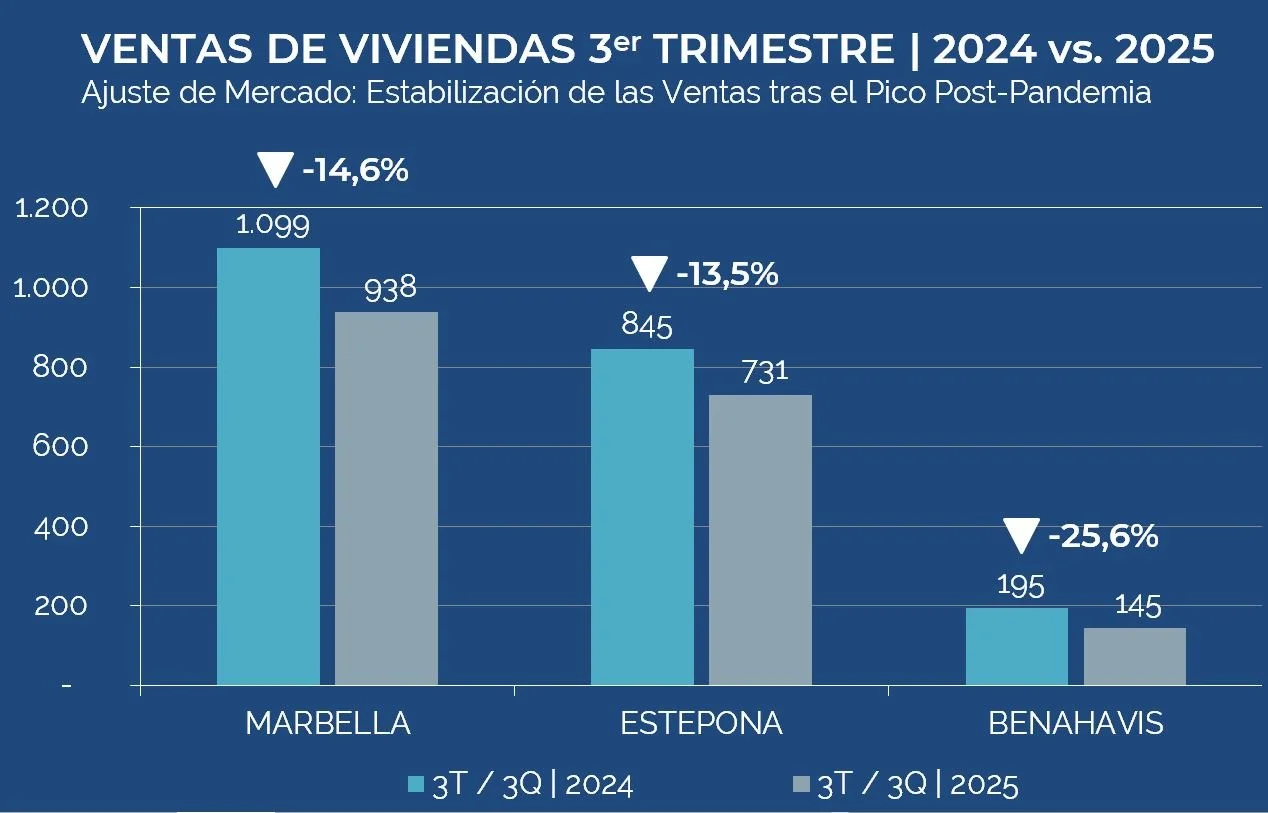
The real estate landscape of the western Costa del Sol is changing. The latest data from the third quarter of 2025 provides an answer to the question on every investor's mind: Is the market crashing? The answer is a resounding no. lnstead, we are seeing a healthy, necessary recalibration. The number of sales in Marbella, Estepona, and Benahavís are finding their natural equilibrium, marking a transition from urgency to sustainability.

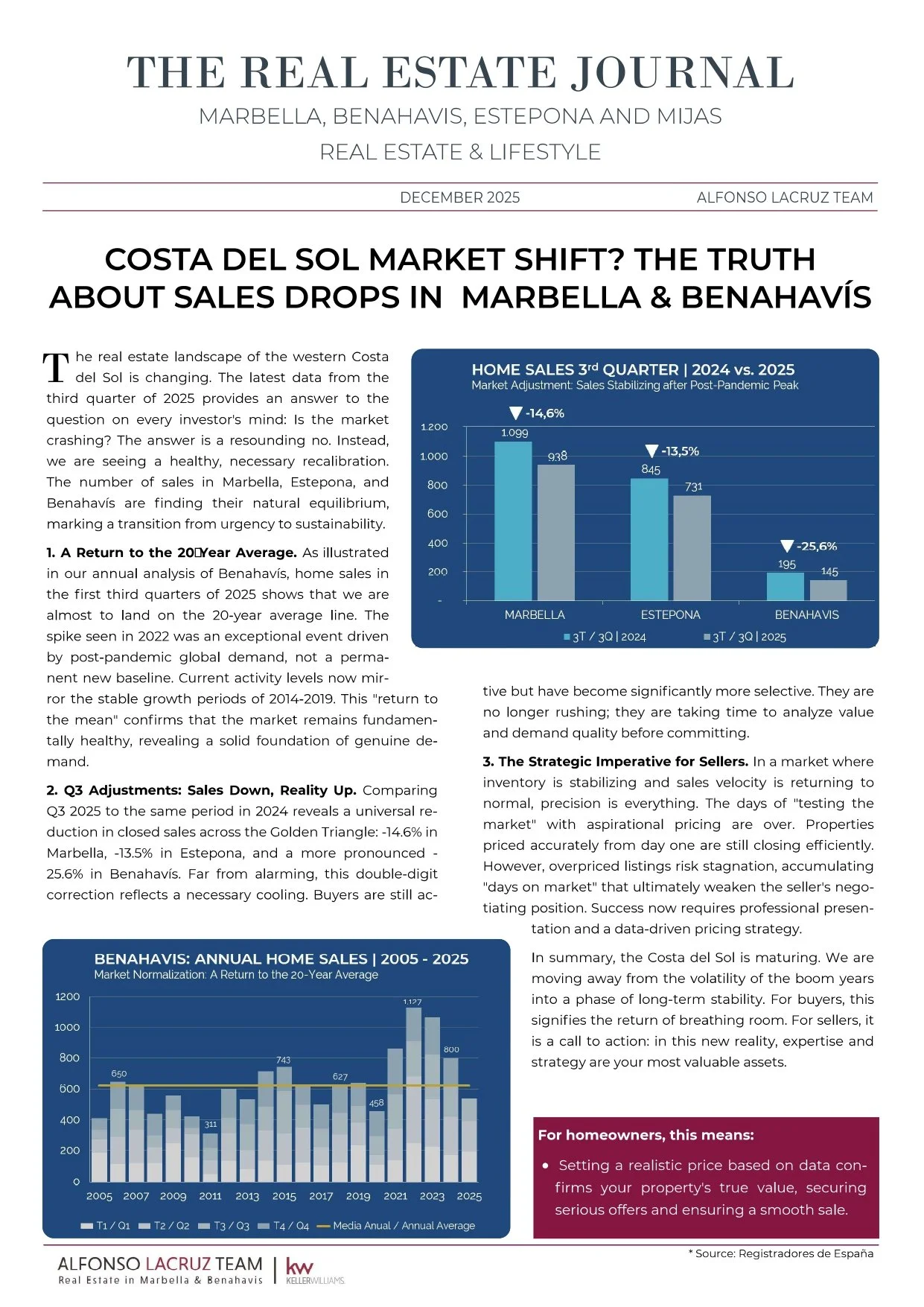
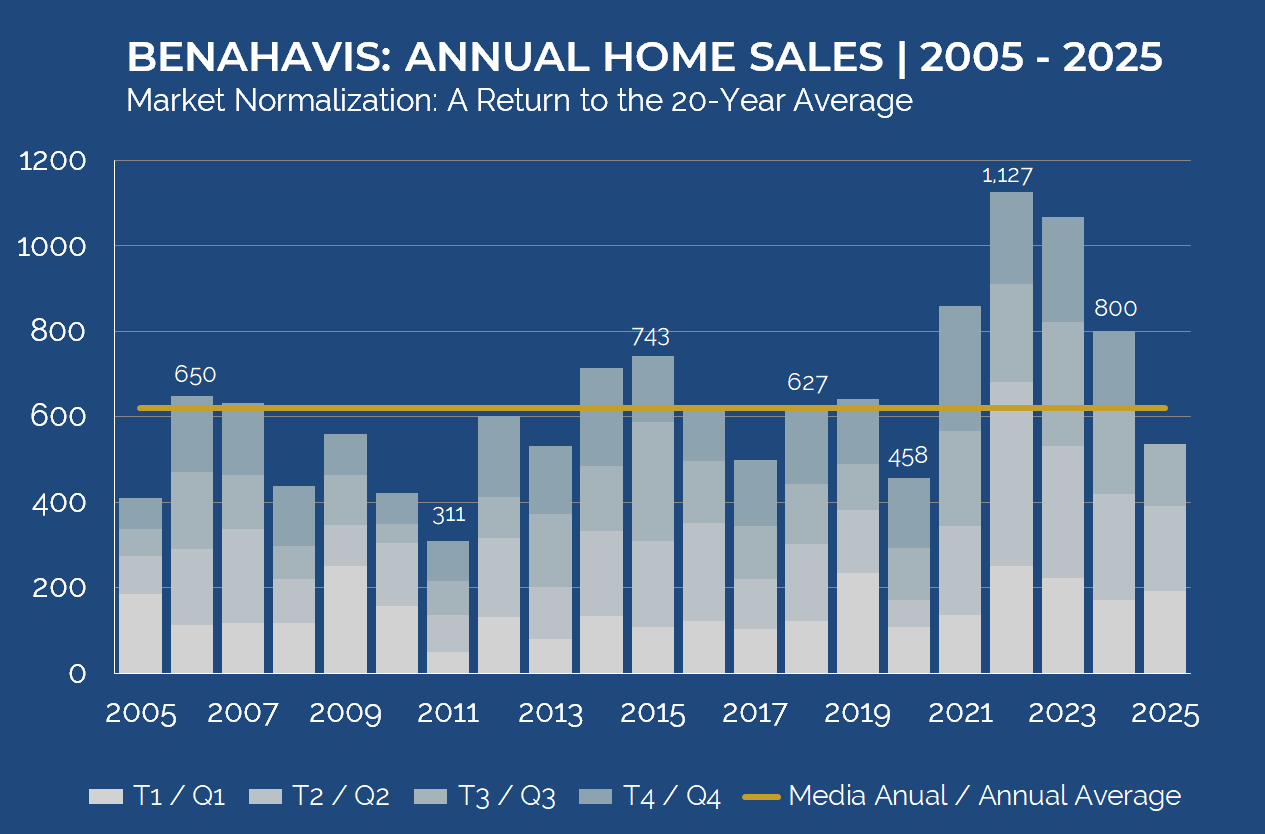
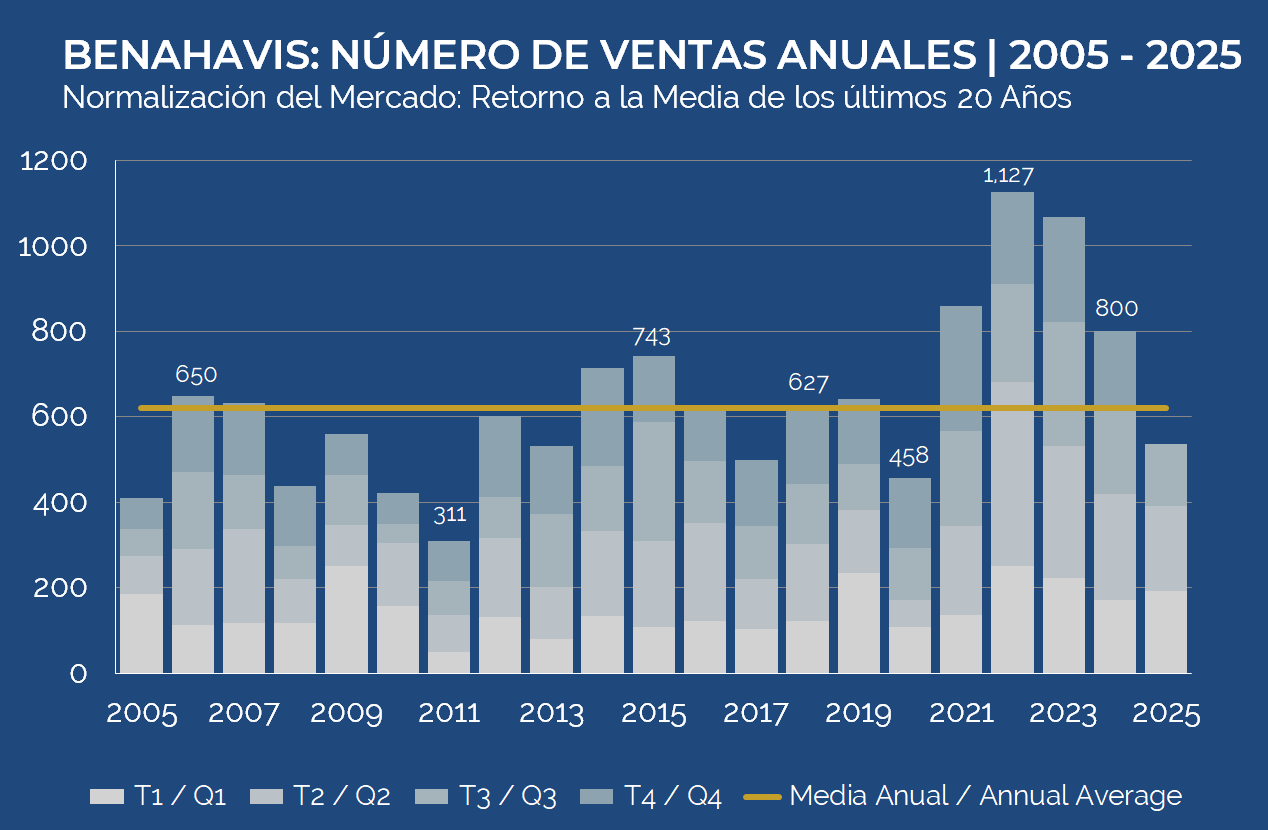
1. A Return to the 20 -Year Average. As illustrated in our annual analysis of Benahavís, home sales in the first third quarters of 2025 shows that we are almo land on the 20-year average line. The spike seen in 2022 was an exceptional event driven by post-pandemic global demand, not a perma­nent new baseline. Current activity levels now mirror the stable growth periods of 2014-2019. This "return to the mean" confirms that the market remains fundamen­tally healthy, revealing a sol id foundation of genuine de­mand.

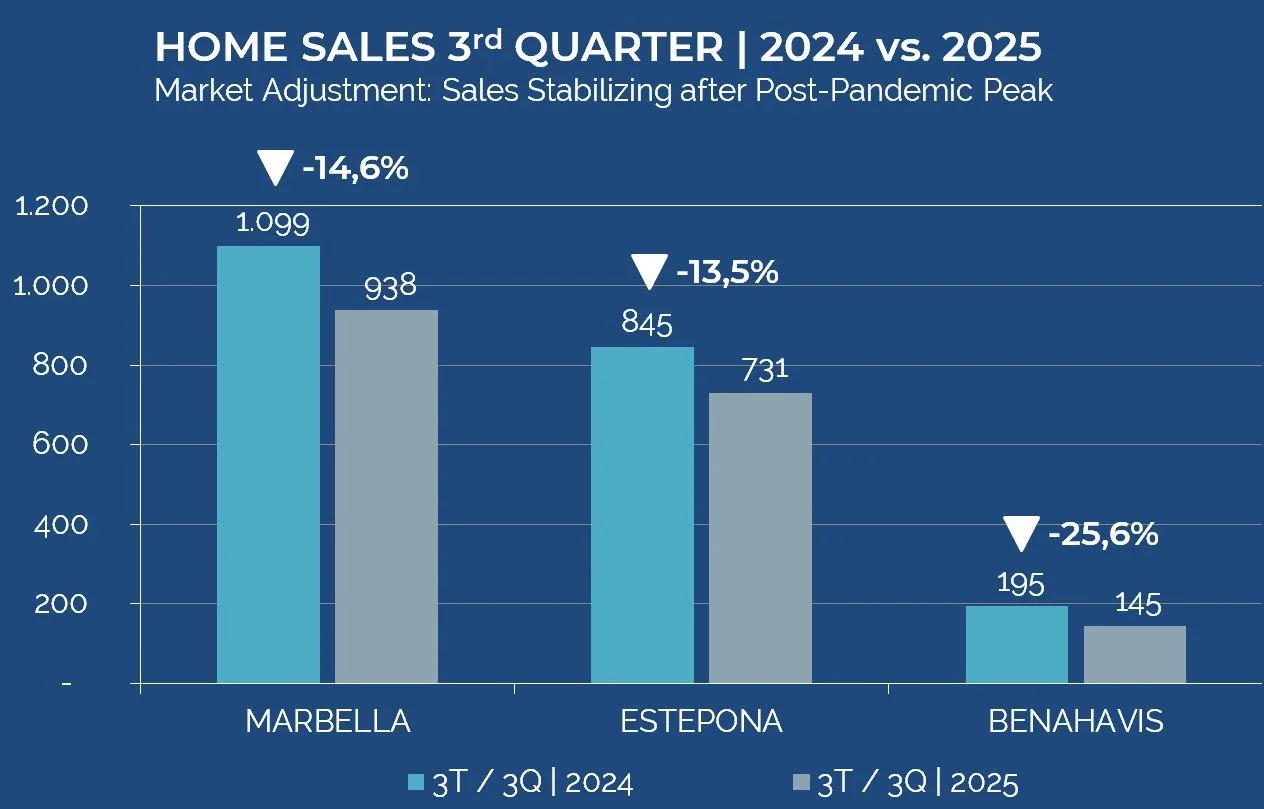
2. Q3 Adjustments: Sales Down, Reality Up. Comparing Q3 2025 to the same period in 2024 revea Is a universal re­duction in closed sales across the Golden Triangle: -14.6% in Marbella, -13.5% in Estepona, and a more pronounced -25.6% in Benahaví­s. Far from alarming, this double-digit correction reflects a necessary cooling. Buyers are still active but have become significantly more selective. They are no longer rushing; they are taking time to analyze value and demand quality before committing.

3. The Strategic lmperative for Sellers. In a market where inventory is stabilizing and sales velocity is returning to normal, precision is everything. The days of "testing the market" with aspirational pricing are over. Properties priced accurately from day one are still closing efficiently. However, overpriced listings risk stagnation, accumulating "days on market" that ultimately weaken the seller's nego­tiating position. Success now requires professional presentation and a data-driven pricing strategy.

In summary, the Costa del Sol is maturing. We are moving away from the volatility of the boom years into a phase of long-term stability. For buyers, this signifies the return of breathing room. For sellers, it is a call to action: in this new reality, expertise and strategy are your most valuable assets.

VIVIR EN SIERRA BLANCA VS. LA ZAGALETA: LUJO URBANO O REFUGIO PRIVADO

Cuando se habla del máximo nivel en complejos de lujo en Marbella y Benahavís, siempre surgen dos nombres: Sierra Blanca y La Zagaleta. La pregunta no es cuál es "mejor", sino cuál se adapta mejor a su día a día. Son dos experiencias distintas: una urbana y conectada, la otra pri­vada y aislada.

Sierra Blanca: La opción urbana. Situada sobre la Milla de Oro, su gran ventaja es la cercanía. Aquí se vive a pocos minutos de los colegios internacionales, Puerto Banús y el centro de la ciudad. Se siente como un barrio residencial tranquilo y prestigioso, con buenas vistas al mar, pero to­talmente integrado en el ritmo diario de Marbella.

La realidad del mercado: Es una zona muy dinámica, con 44 casas vendidas entre 2023 y 2025 (frente a las 29 de La Zagaleta). Las parcelas, en general, más pequeñas, con viviendas algo más compactas con una media de 677 m2 construidos.

La Zagaleta: El refugio. Situada en Benahavís, La Zagaleta funciona como un club de campo privado. Es un destino en sí mismo: hay que subir por la carretera de Ronda (unos 20 minutos hasta la costa), pero a cambio se gana seguridad total, silencio y espacio. Con sus propios campos de golf y parcelas enormes, muchas veces ni siquiera se ve la casa del vecino.

La realidad del mercado: Aquí se encuentran mayores par­celas con un tamaño medio vendido es de 731 m2• Esa ex­clusividad se paga: el precio real de venta ronda los 6.469 €/m2, un poco por encima de los 6.205 €/m2 de Sierra Blanca.

¿Qué decidir siendo similares pero diferentes?

Aunque los precios de salida en ambas zonas suelen su­perar los 7.000 €/m2, la elección depende de cómo se ima­gine viviendo aquí:

  • La elección será Sierra Blanca si quiere ir y venir fácil­mente entre casa, el colegio y la vida social de Marbella.

  • La elección será La Zagaleta si prefiere desconectar en una gran propiedad privada y no le importa coger el coche para todo.

Para la mayoría, la duda se despeja al hacer una visita. La sensación que le transmite cada lugar le dirá claramente cuál es el suyo.

LA BRECHA DE PRECIOS ESTÁ FRENANDO EL RITMO DEL MERCADO INMOBILIARIO DE LA COSTA DEL SOL

El panorama inmobiliario de la Costa del Sol está cambiando de marcha. Los últimos datos del tercer trimestre de 2025 responden con clari­dad a la pregunta que ronda la mente de todo in­versor: ¿Se está hundiendo el mercado? La res­puesta es un rotundo no. Lo que estamos presen­ciando es un ajuste necesario y saludable. El núme­ro de ventas en Marbella, Estepona y Benahavís está encontrando su equilibrio natural, marcando una transición de la urgencia a la sostenibilidad.

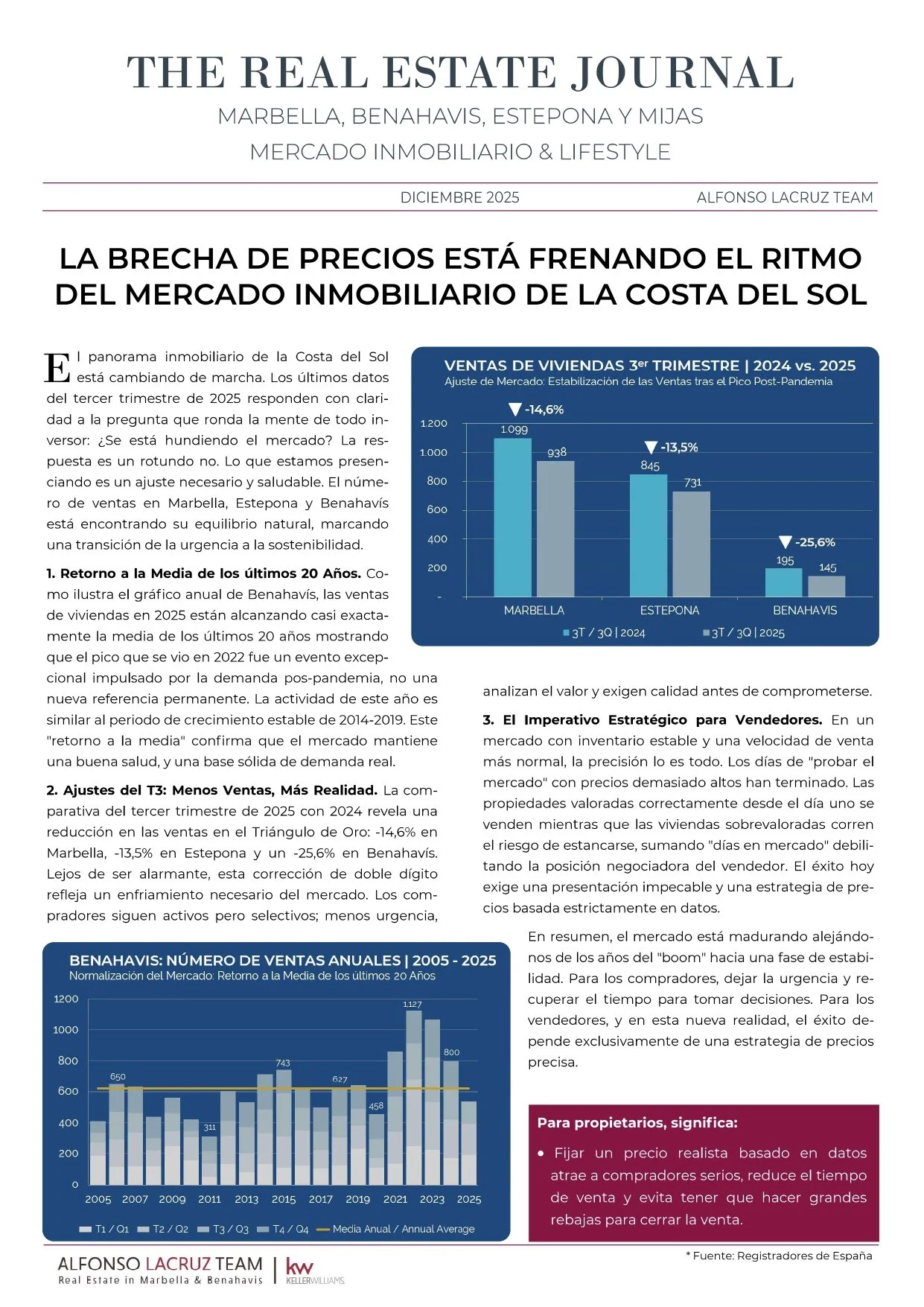
1. Retorno a la Media de los últimos 20 Años. Co­mo ilustra el gráfico anual de Benahavís, las ventas de viviendas en 2025 están alcanzando casi exacta­mente la media de los últimos 20 años mostrando que el pico que se vio en 2022 fue un evento excep­cional impulsado por la demanda pos-pandemia, no una nueva referencia permanente. La actividad de este año es similar al periodo de crecimiento estable de 2014-2019. Este "retorno a la media" confirma que el mercado mantiene una buena salud, y una base sólida de demanda real.

2. Ajustes del T3: Menos Ventas, Más Realidad. La com­parativa del tercer trimestre de 2025 con 2024 revela una reducción en las ventas en el Triángulo de Oro: -14,6% en Marbella, -13,5% en Estepona y un -25,6% en Benahavís. Lejos de ser alarmante, esta corrección de doble dígito refleja un enfriamiento necesario del mercado. Los com­pradores siguen activos pero selectivos; menos urgencia, analizan el valor y exigen calidad antes de comprometerse.

3. El Imperativo Estratégico para Vendedores. En un mercado con inventario estable y una velocidad de venta más normal, la precisión lo es todo. Los días de "probar el mercado" con precios demasiado altos han terminado. Las propiedades valoradas correctamente desde el día uno se venden mientras que las viviendas sobrevaloradas corren el riesgo de estancarse, sumando "días en mercado" debili­tando la posición negociadora del vendedor. El éxito hoy exige una presentación impecable y una estrategia de pre­cios basada estrictamente en datos.