
¿Por qué suben los precios en Marbella, Benahavís y Estepona si se venden menos viviendas?

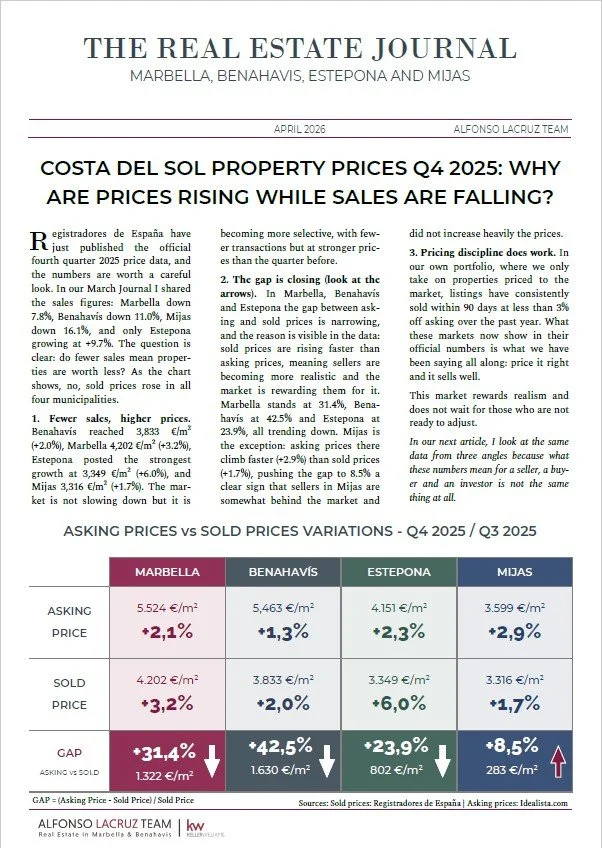
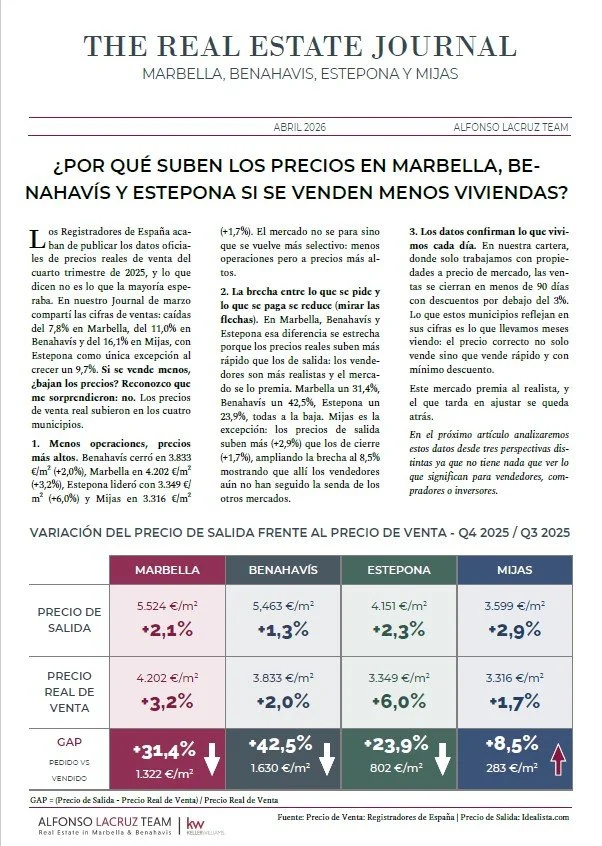
Los Registradores de España acaban de publicar los datos oficiales les de precios reales de venta del cuarto trimestre de 2025, y lo que dicen no es lo que la mayoría esperaba.

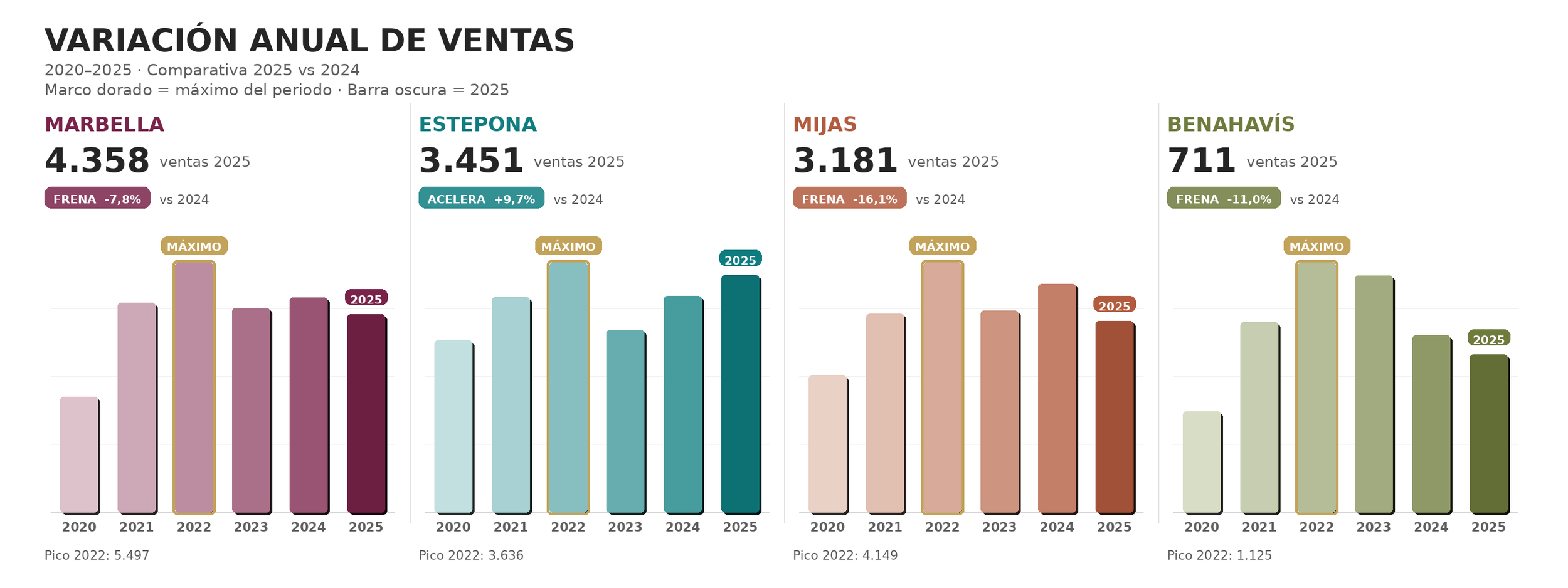
En nuestro Journal de marzo compartí las cifras de ventas: caídas del 7,8% en Marbella, del 11,0% en Benahavís y del 16,1% en Mijas, con Estepona como única excepción al crecer un 9,7%.

Si se vende menos, ¿bajan los precios? Reconozco que me sorprendieron: no. Los precios de venta real subieron en los cuatro municipios.

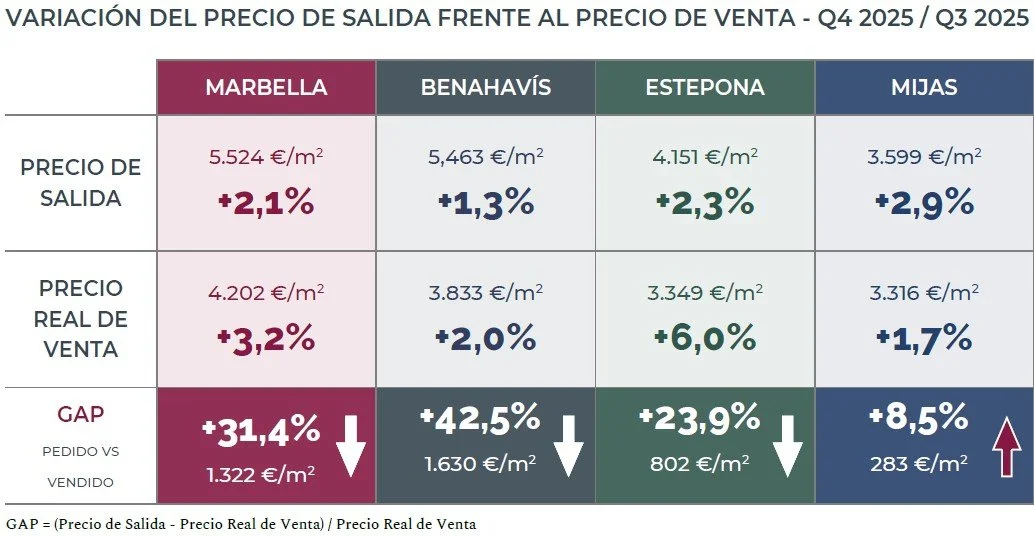
1. Menos operaciones, precios más altos. Benahavís cerró en 3.833€/m² (+2,0%), Marbella en 4.202 €/m² (+3,2%), Estepona lideró con 3.349 €/m² (+6,0%) y Mijas en 3.316 €/m² (+1,7%). El mercado no se para sino que se vuelve más selectivo: menos operaciones pero a precios más altos.

2. La brecha entre lo que se pide y lo que se paga se reduce (mirar las flechas). En Marbella, Benahavís y Estepona esa diferencia se estrecha porque los precios reales suben más rápido que los de salida: los vende-dores son más realistas y el merca-do se lo premia. Marbella un 31,4%, Benahavís un 42,5%, Estepona un 23,9%, todas a la baja. Mijas es la excepción: los precios de salida suben más (+2,9%) que los de cierre (+1,7%), ampliando la brecha al 8,5%mostrando que allí los vendedores aún no han seguido la senda de los otros mercados.

3. Los datos confirman lo que vivimos cada día. En nuestra cartera, donde solo trabajamos con propie-dades a precio de mercado, las ven-tas se cierran en menos de 90 días con descuentos por debajo del 3%. Lo que estos municipios reflejan en sus cifras es lo que llevamos meses viendo: el precio correcto no solo vende sino que vende rápido y con mínimo descuento.

Este mercado premia al realista, y el que tarda en ajustar se queda atrás.

En el próximo artículo analizaremos estos datos desde tres perspectivas dis-tintas ya que no tiene nada que ver lo que significan para vendedores, com-pradores o inversores.
WHAT HAPPENS WHEN YOU OVERPRICE A PROPERTY: HOW TO LOSE VALUE EVEN IN A RISING MARKET ?

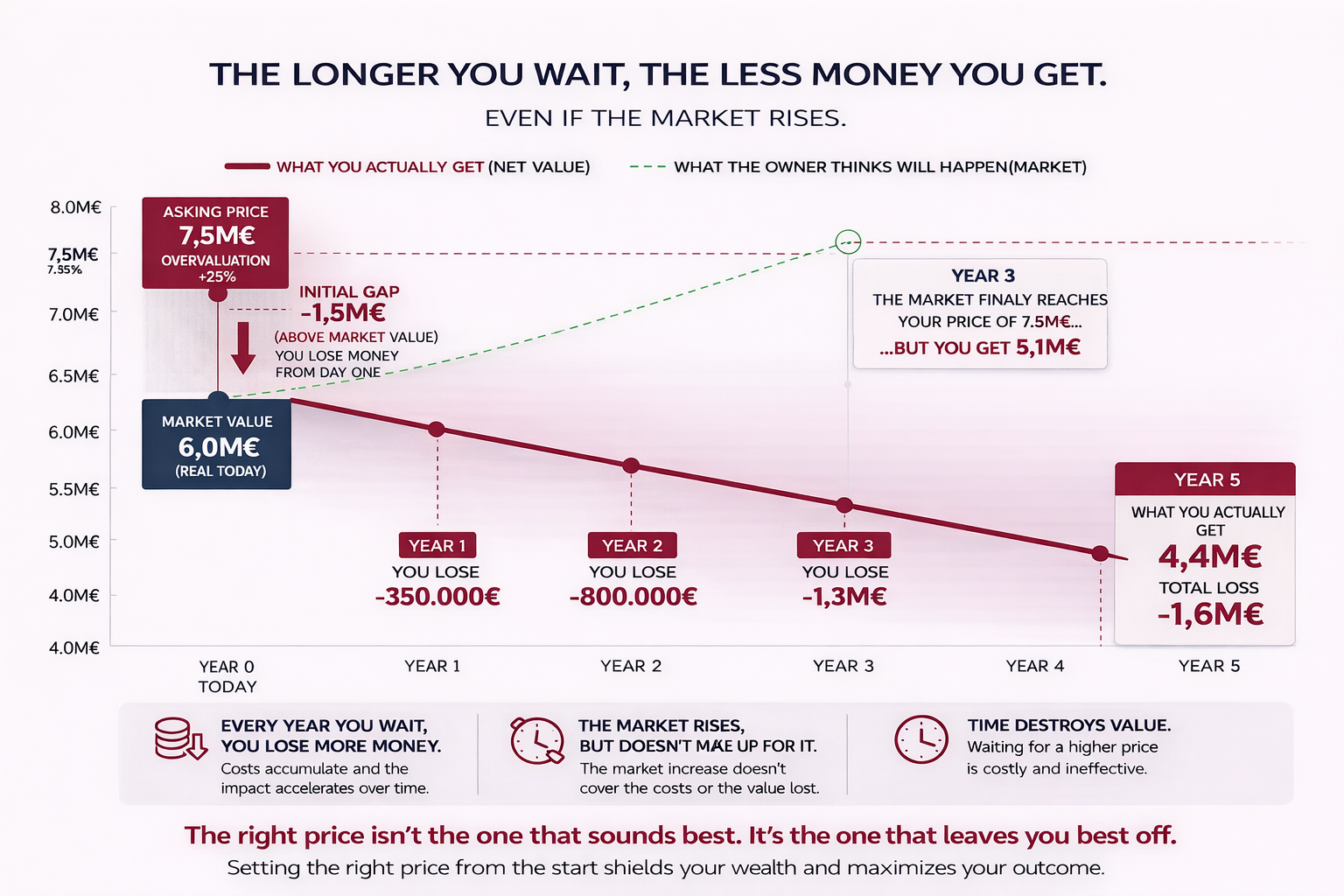
Overpricing a property can reduce what you actually walk away with, even in a rising market. If the property does not generate rental income, waiting is not neutral. In most cases, it quietly works against you. This is especially relevant in markets like Marbella and Benahavís, where many owners assume future price growth will compensate for an ambitious asking price. The reality is different.

Why overpricing a property can cost sellers money?

When a property is launched above its true market val-ue, five factors start working in parallel:

1. Market growth. Yes, prices may increase over time. This is often the reason behind overpricing. But it is on-ly one variable and not the most decisive one.

2.Holding costs. Owning a property comes with ongoing expenses, whether it is sold or not. Community fees, insurance, maintenance and upkeep continue every month. A realistic assumption is around 1.5% per year.

3. Inflation. Even if you achieve a higher price in the future, the real value of that money may be lower. Infla-tion reduces purchasing power over time, often as-sumed at around 2% annually.

4. Opportunity cost. The capital tied up in the property could be working elsewhere. Even a conservative return of 4% per year compounds over time, increasing the cost of waiting.

5. Property ageing. Properties lose relative appeal over time. Design trends evolve, competition improves, and even well-maintained homes can feel outdated. A rea-sonable estimate is around 1% per year.

While the market may rise, these factors ac-cumulate. The result is simple: overpricing does not protect value, it often reduces it. The right asking price is not the highest number a property could reach. It is the price that protects what you actually receive.

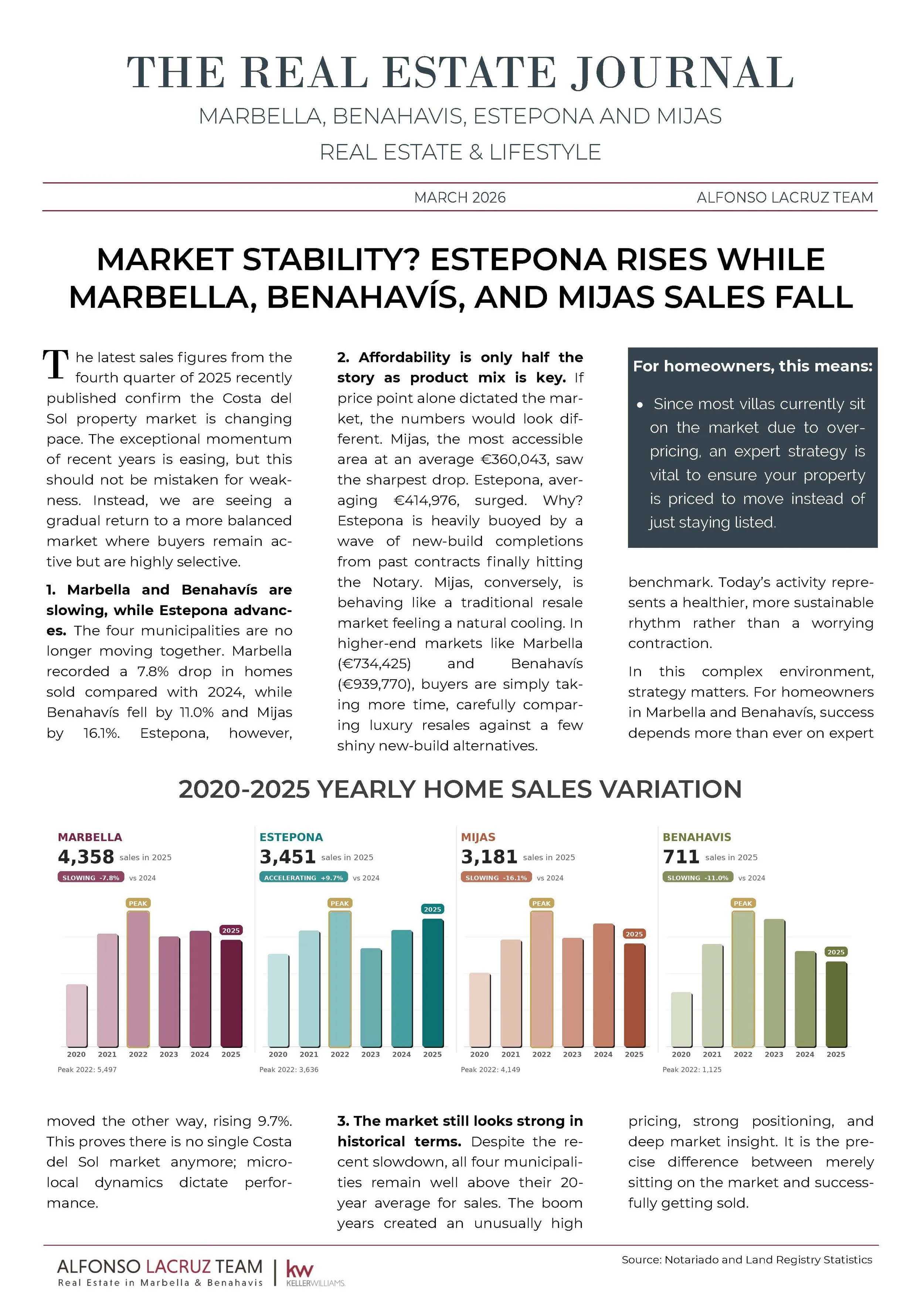
MARKET STABILITY? ESTEPONA RISES WHILE MARBELLA, BENAHAVÍS, AND MIJAS SALES FALL

The latest sales figures from the fourth quarter of 2025 recently published confirm the Costa del Sol property market is changing pace. The exceptional momentum of recent years is easing, but this should not be mistaken for weak-ness. Instead, we are seeing a gradual return to a more balanced market where buyers remain ac-tive but are highly selective.

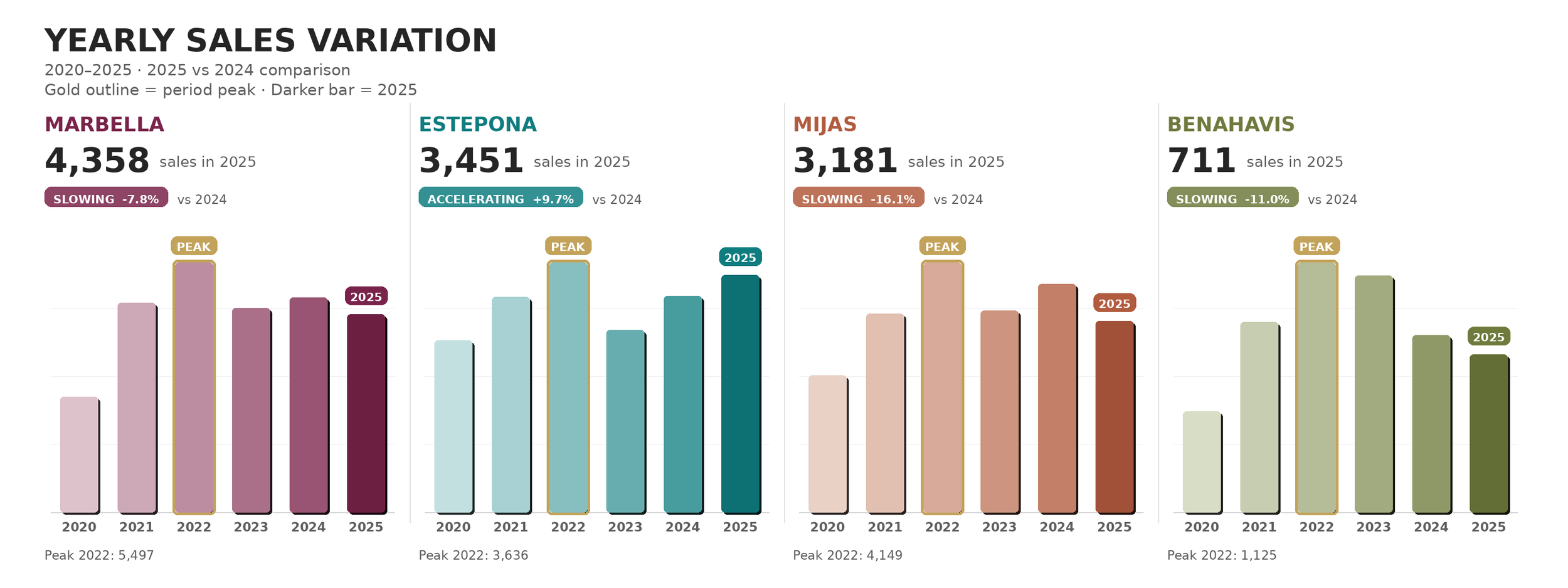
1. Marbella and Benahavís are slowing, while Estepona advances. The four municipalities are no longer moving together. Marbella recorded a 7.8% drop in homes sold compared with 2024, while Benahavís fell by 11.0% and Mijas by 16.1%. Estepona, however, moved the other way, rising 9.7%. This proves there is no single Costa del Sol market anymore; micro-local dynamics dictate performance.

2. Affordability is only half the story as product mix is key. If price point alone dictated the market, the numbers would look diferent. Mijas, the most accessible area at an average €360,043, saw the sharpest drop. Estepona, averaging €414,976, surged. Why?Estepona is heavily buoyed by a wave of new-build completions from past contracts finally hitting the Notary. Mijas, conversely, is behaving like a traditional resale market feeling a natural cooling. In higher-end markets like Marbella €734,425) and Benahavís (€939,770), buyers are simply taking more time, carefully comparing luxury resales against a few shiny new-build alternatives.

3. The market still looks strong in historical terms. Despite the recent slowdown, all four municipalities remain well above their 20-year average for sales. The boom years created an unusually high benchmark. Today’s activity repre-sents a healthier, more sustainable rhythm rather than a worrying contraction.

In this complex environment, strategy matters. For homeowners in Marbella and Benahavís, success depends more than ever on expert pricing, strong positioning, and deep market insight. It is the pre-cise difference between merely sitting on the market and success-fully getting sold.

¿QUÉ PASA CUANDO SE SOBREVALORA UNA PROPIEDAD? CÓMO PERDER VALOR AUNQUE EL MERCADO SUBA

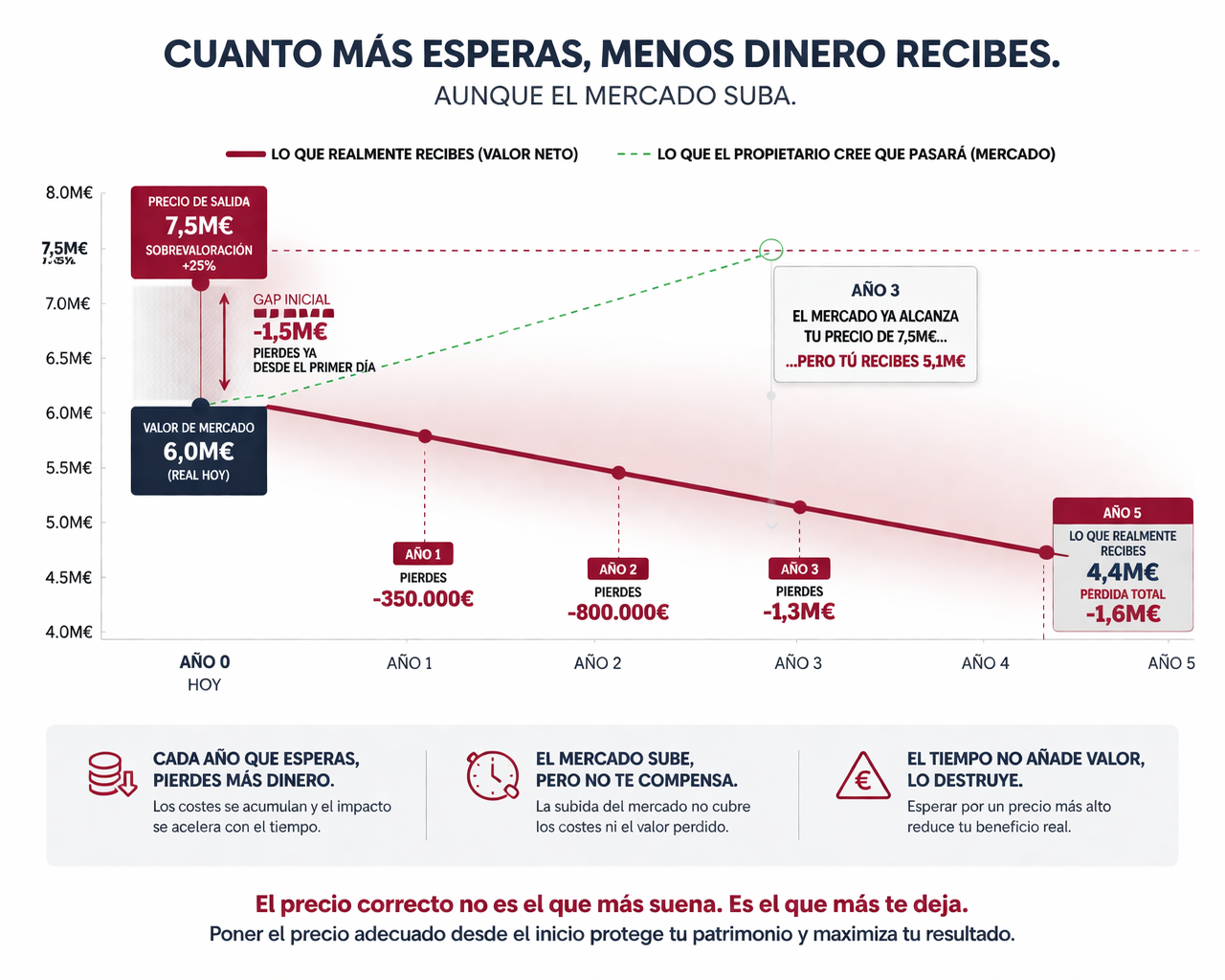
Si la vivienda no genera ingresos por alquiler, esperar no es una decisión sin consecuencias. En la mayoría de los casos, juega en contra. Esto es especialmente relevante en mercados como Marbella y Benahavís, donde muchos propietarios asumen que la subida fu-tura de precios compensará un precio de salida dema-siado alto. La realidad es bien distinta.

¿Por qué sobrevalorar una propiedad puede hacerte perder dinero?

Cuando una propiedad sale al mercado por encima de su valor real, cinco factores actúan al mismo tiempo:

1. Subida del mercado. Sí, los precios suelen subir con el tiempo. Este suele ser el argumento para sobrevalo-rar pero es solo una variable, y no la más determinante.

2. Costes de mantenimiento. Tener una propiedad implica gastos constantes, se venda o no. Comunidad, seguros y pequeñas reparaciones continúan mes a mes. Una estimación podría estar en torno al 1,5% anual.

3. Inflación. Aunque se consiga un precio mayor en el futuro, el valor real de ese dinero puede ser menor. La inflación reduce el poder adquisitivo con el tiempo, pa-ra los cálculos se estima un 2% anual.

4. Envejecimiento de la propiedad. Las viviendas pier-den atractivo con el paso del tiempo. Cambian las ten-dencias, aparecen productos más nuevos y, aunque estén bien mantenidas, pueden quedar desactualizadas. Una referencia razonable es alre-dedor de un 1% anual.

Mientras el mercado puede subir, estos cuatro factores también afectan. El resultado es claro: sobrevalorar no pro-tege el valor, normalmente lo reduce. El precio correcto no es el más alto que se puede imaginar sino el que protege lo que realmente se lleva.

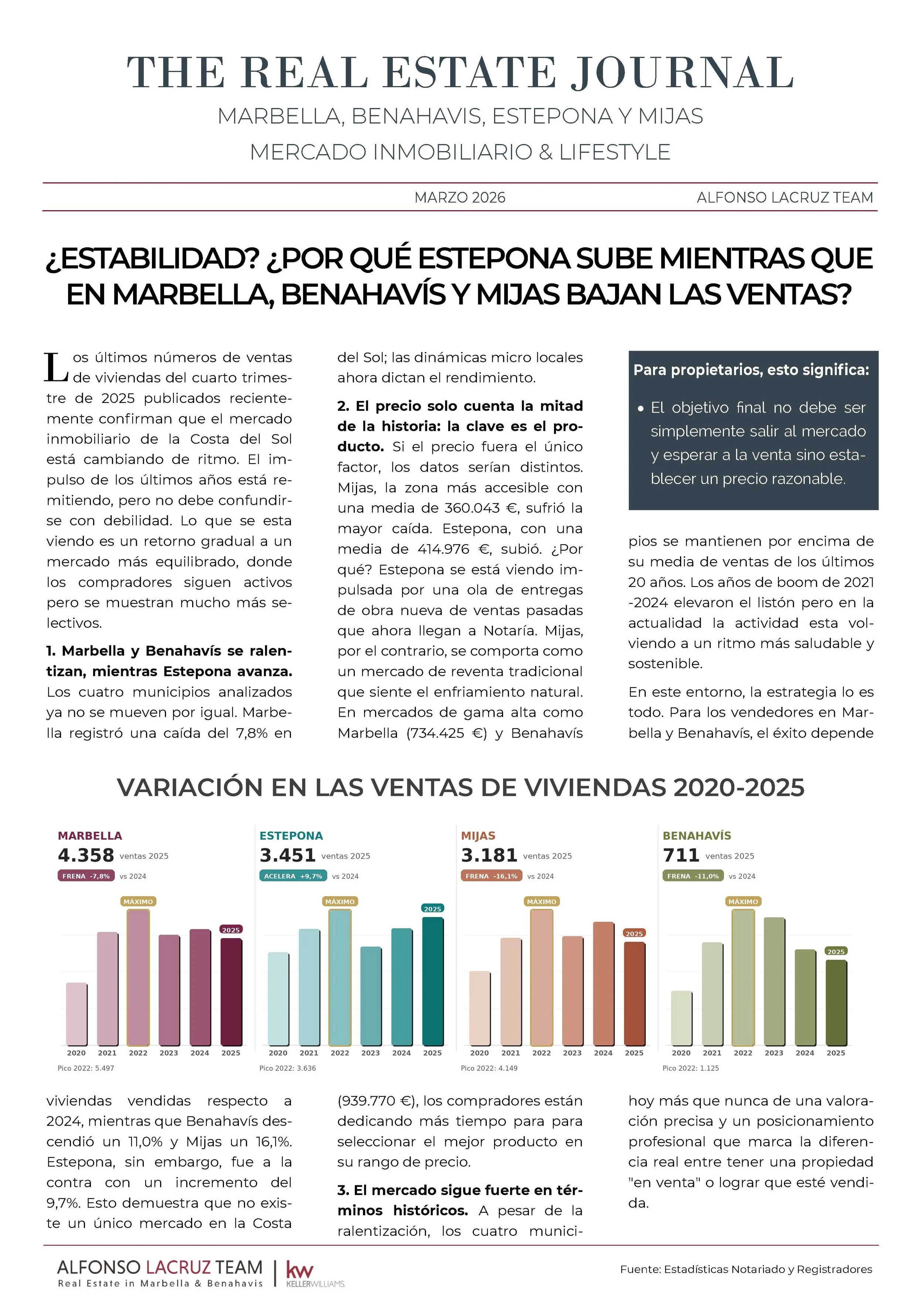
¿ESTABILIDAD? ¿POR QUÉ ESTEPONA SUBE MIENTRAS QUE EN MARBELLA, BENAHAVÍS Y MIJAS BAJAN LAS VENTAS?

Los últimos números de ventas de viviendas del cuarto trimestre de 2025 publicados reciente-mente confirman que el mercado inmobiliario de la Costa del Sol está cambiando de ritmo. El im-pulso de los últimos años está re-mitiendo, pero no debe confundir-se con debilidad. Lo que se esta viendo es un retorno gradual a un mercado más equilibrado, donde los compradores siguen activos pero se muestran mucho más selectivos.

1. Marbella y Benahavís se ralen-tizan, mientras Estepona avanza. Los cuatro municipios analizados ya no se mueven por igual. Marbe-lla registró una caída del 7,8% en viviendas vendidas respecto a 2024, mientras que Benahavís des-cendió un 11,0% y Mijas un 16,1%. Estepona, sin embargo, fue a la contra con un incremento del 9,7%. Esto demuestra que no exis-te un único mercado en la Costa del Sol; las dinámicas micro locales ahora dictan el rendimiento.

2. El precio solo cuenta la mitad de la historia: la clave es el producto. Si el precio fuera el único factor, los datos serían distintos. Mijas, la zona más accesible con una media de 360.043 €, sufrió la mayor caída. Estepona, con una media de 414.976 €, subió. ¿Por qué? Estepona se está viendo im-pulsada por una ola de entregas de obra nueva de ventas pasadas que ahora llegan a Notaría. Mijas, por el contrario, se comporta como un mercado de reventa tradicional que siente el enfriamiento natural. En mercados de gama alta como Marbella (734.425 €) y Benahavís (939.770 €), los compradores están dedicando más tiempo para para seleccionar el mejor producto en su rango de precio.

3. El mercado sigue fuerte en términos históricos. A pesar de la ralentización, los cuatro municipios se mantienen por encima de su media de ventas de los últimos 20 años. Los años de boom de 2021 -2024 elevaron el listón pero en la actualidad la actividad esta vol-viendo a un ritmo más saludable y sostenible.

En este entorno, la estrategia lo es todo. Para los vendedores en Mar-bella y Benahavís, el éxito depende hoy más que nunca de una valora-ción precisa y un posicionamiento profesional que marca la diferen-cia real entre tener una propiedad "en venta" o lograr que esté vendida.

MARBELLA AND BENAHAVIS BETWEEN 500K€ AND 2M€: WHAT KIND OF LIFE CAN YOU HAVE HERE?

As we live every day in this real estate world, we talk a lot about market statistics and prices, but for most of our clients the real question is much simpler: What kind of life can I have here with my budget?

In these ranges, when you know the area and are clear about what you want, the answer is not same for any budget and the article explains what kind of life each level from 500 k€ to 2 M€ euros allows on the Costa.

At the lower range of this bracket, around 500 k€ to 800 k€, buyers are usually choosing between a good apartment or townhouse in a well located community and a more basic villa that may need updating. You can be close to services, in a pleasant urbanization, perhaps with a shared pool and some sea or garden views. Daily life is convenient: schools, supermarkets, sports and restaurants are all within a short drive. What you may compromise on is plot size, absolute privacy or the “wow” view.

As you move towards 1 M€ and even a little higher, the conversation changes. In many areas you can find a solid detached villa with its own garden and pool, often with better orientation, more light and clearer views. The difference is not only in meters, but in how the property feels when you arrive: more space around you, more flexible layouts, room for guests and family to visit comfortably. For many buyers in this range, that is when the property begins to feel like a long-term home rather than just a holiday base.

Between 1,5 M€ and 2 M€, quality and micro-location become more visible. You are closer to the better streets within a given area, with easier access, quieter surroundings and more established neighbors. You may not be in the most famous gated communities, but you are often one or two steps below them in price, with a similar sense of calm and security.

The point is that the same budget can buy very differ-ent lives, depending on where you focus: closer to the beach or in the hills, more square meters or a better street, something ready to live in or a home with poten-tial. The most useful first step is not to chase the largest house on paper, but to be honest about how you want to live day to day. Once that is clear, it becomes much easier to see which areas and which homes truly match your life not just your budget.

Not every location is for everyone but we have many locations and lives to choose from and that is the beauty of our Costa del Sol.

THE MARKET REALITY IN MARBELLA & BENAHAVÍS: WHY SOME HOMES SELL AND OTHERS SIT

Double-click to edit...

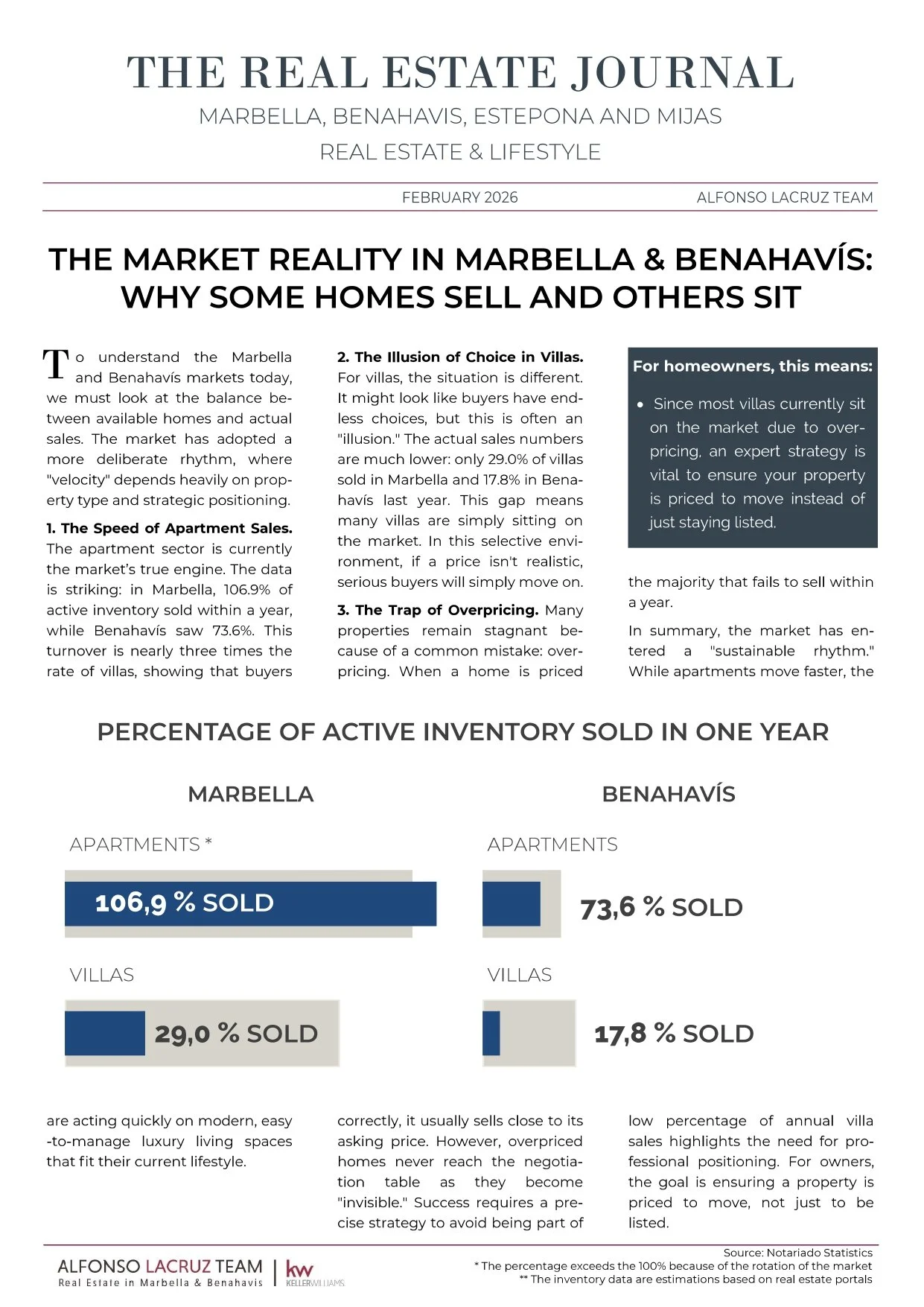
To understand the Marbella and Benahavís markets today, we must look at the balance be-tween available homes and actual sales. The market has adopted a more deliberate rhythm, where "velocity" depends heavily on prop-erty type and strategic positioning.

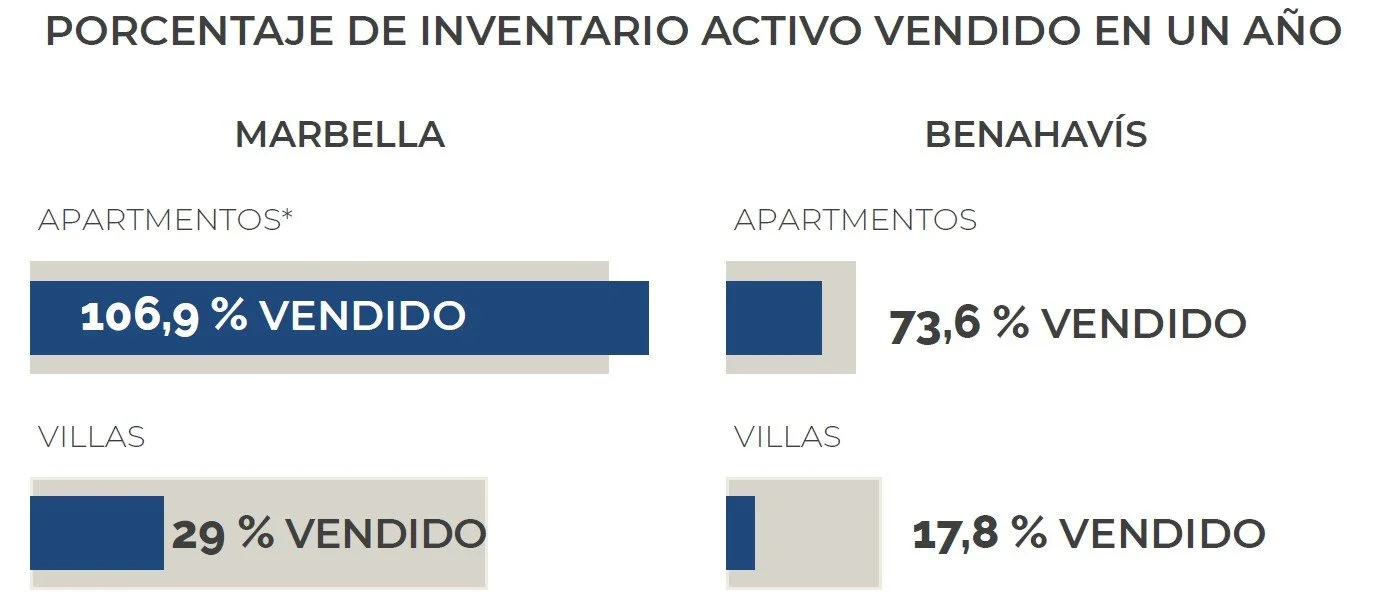
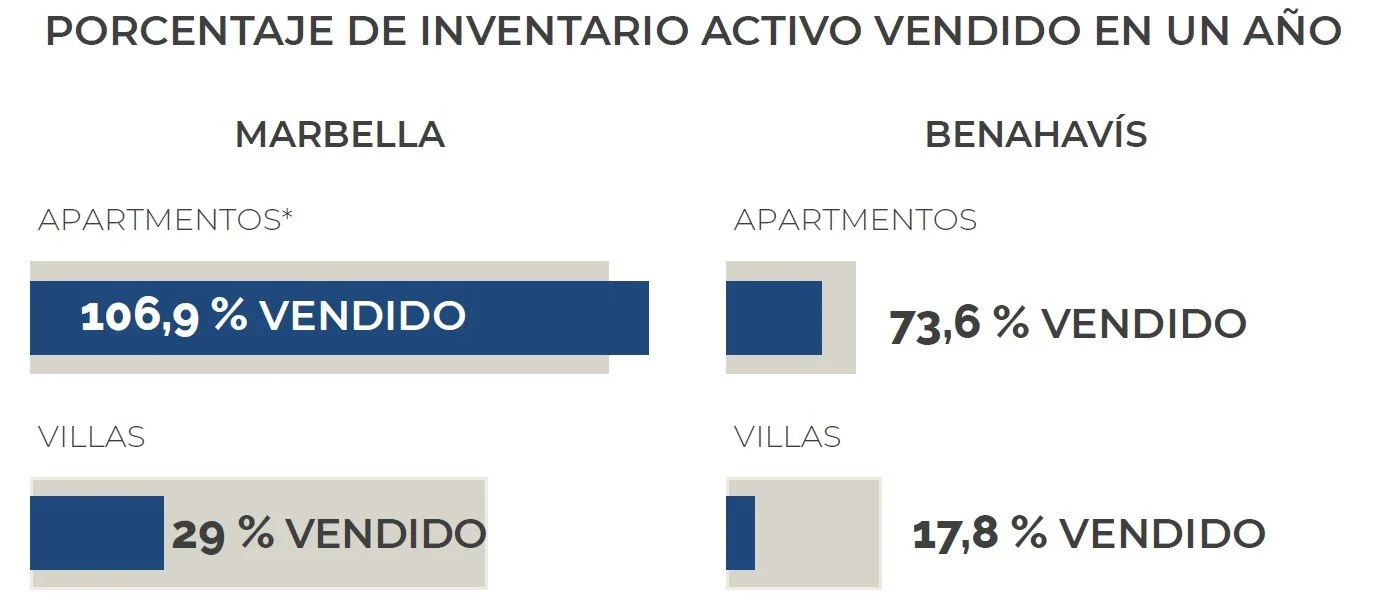
1. The Speed of Apartment Sales. The apartment sector is currently the market’s true engine. The data is striking: in Marbella, 106.9% of active inventory sold within a year, while Benahavís saw 73.6%. This turnover is nearly three times the rate of villas, showing that buyers are acting quickly on modern, easy -to-manage luxury living spaces that fit their current lifestyle.

2. The Illusion of Choice in Villas. For villas, the situation is different. It might look like buyers have end-less choices, but this is often an "illusion." The actual sales numbers are much lower: only 29.0% of villas sold in Marbella and 17.8% in Benahavís last year. This gap means many villas are simply sitting on the market. In this selective envi-ronment, if a price isn't realistic, serious buyers will simply move on.

3. The Trap of Overpricing. Many properties remain stagnant be-cause of a common mistake: over-pricing. When a home is priced correctly, it usually sells close to its asking price. However, overpriced homes never reach the negotiation table as they become "invisible." Success requires a precise strategy to avoid being part of the majority that fails to sell within a year.

In summary, the market has en-tered a "sustainable rhythm." While apartments move faster, the low percentage of annual villa sales highlights the need for pro-fessional positioning. For owners, the goal is ensuring a property is priced to move, not just to be listed.

MARBELLA Y BENAHAVÍS ENTRE 500.000 € Y 2.000.000 €: ¿QUÉ TIPO DE VIDA PUEDES TENER AQUÍ?

En el día a día hablamos mucho de estadísticas y precios, pero para la mayoría de nuestros clientes la pregunta de fondo es mucho más sencilla: “Con mi presupuesto, ¿qué tipo de vida puedo tener aquí?”

En estos rangos de precio, conociendo bien la zona y teniendo claro lo que se busca, la respuesta no es única: cambia según el presupuesto y en este artículo resumo de forma sencilla qué tipo de vida suele corresponder a cada tramo entre 500 k€ y 2 M€ en la Costa del Sol.

En la parte baja de este rango, entre 500 k€ y 800 k€, los compradores suelen buscar entre un buen piso o adosado bien situados o una villa más básica que quizá necesite alguna mejora. Se puede conseguir estar cerca de servicios, en una buena comunidad con piscina co-mún y, en algunos casos, algo de vistas al mar o al jardín. El día a día es cómodo: colegios, supermercados, y servicios están a pocos minutos en coche. Lo que nor-malmente se sacrifica es tamaño de parcela, privacidad o ese efecto “wow” en las vistas y acabados.

A medida que nos acercamos al entorno de 1 M€ y algo más arriba, la conversación cambia. En muchas zonas ya es posible encontrar una buena villa independiente con su propio jardín y piscina, a menudo con mejor orientación, más luz y vistas más despejadas. La diferencia no está solo en los metros, sino en cómo se siente la casa cuando llegas: más espacio, distribución más cómoda y espacio para que amigos y familia pue-dan disfrutar sin agobios. Para muchos compradores en este tramo es cuando la casa empieza a sentirse co-mo un hogar y no solo como una base de vacaciones.

Entre 1,5 M € y 2 M € la calidad y la micro-localización se notan aún más: mejor calle dentro de cada zona, con accesos más fáciles, entornos más tranquilos y consolidados. Puede que no se este en la ubicación más “top”, pero sí muy cerca en sensaciones, algún escalón por debajo en precio y con un nivel de tranquilidad similar.

Al final, con el mismo presupuesto se pueden vivir vidas muy distintas según dónde se ponga el foco: más cerca de la playa o en el golf, más metros o una mejor calle, algo listo para entrar a vivir o una casa con potencial. El primer paso no es simplemente elegir una casa más grande sobre el papel sino ser sinceros sobre cómo se quiere vivir el día a día. Cuando eso está claro, es mu-cho más fácil ver qué zonas y qué viviendas encajan de verdad con ese estilo de vida y no solo con el presu-puesto.

No todas las ubicaciones son para todo el mundo, pero en nuestra Costa del Sol hay muchas formas de vivirla y ese es, precisamente, su encanto.

¿DÓNDE VA EL MERCADO?: LA REALIDAD DEL INVENTARIO Y LA BRECHA DE PRECIOS EN COSTA DEL SOL

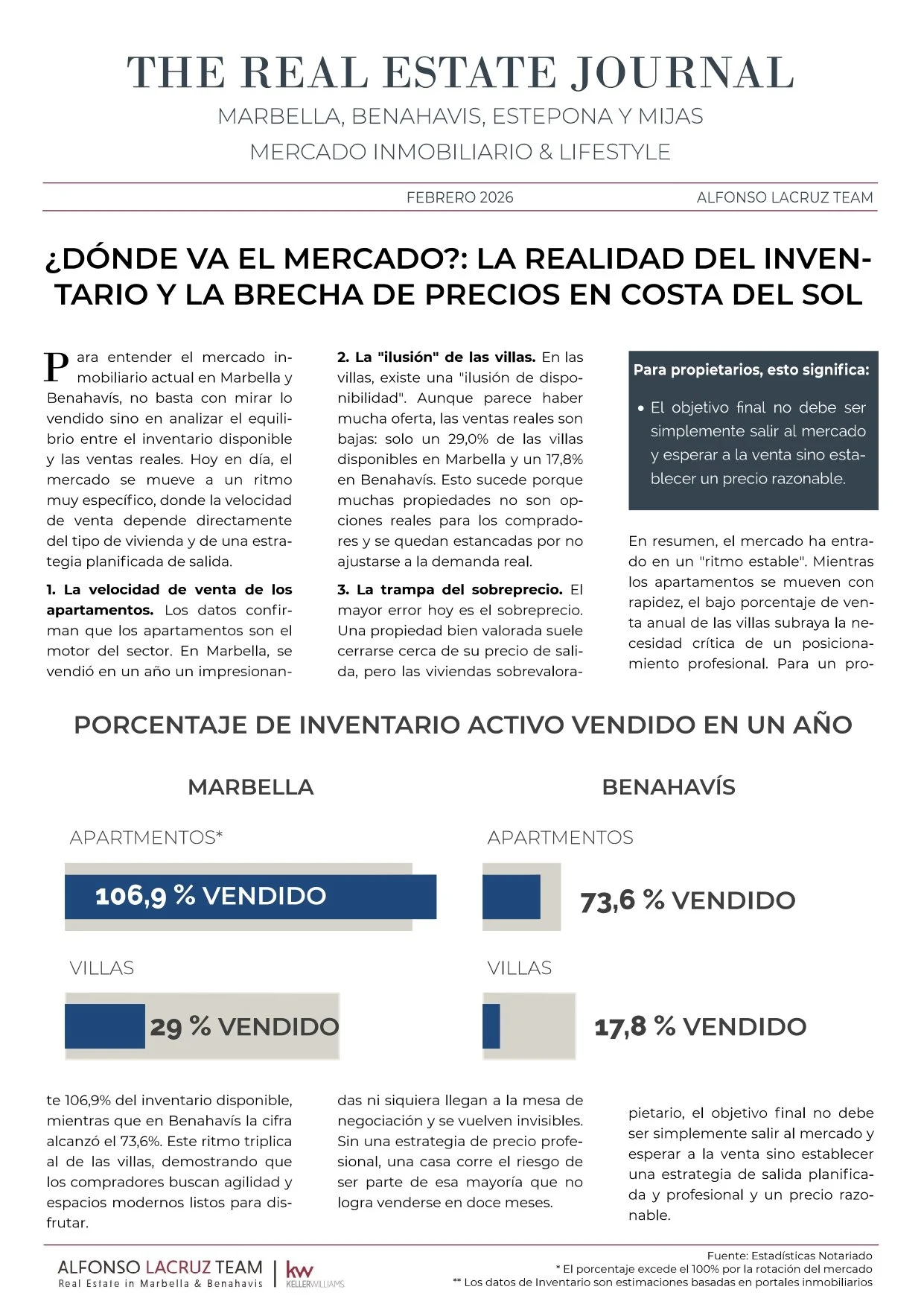
Para entender el mercado in-mobiliario actual en Marbella y Benahavís, no basta con mirar lo vendido sino en analizar el equili-brio entre el inventario disponible y las ventas reales. Hoy en día, el mercado se mueve a un ritmo muy específico, donde la velocidad de venta depende directamente del tipo de vivienda y de una estra-tegia planificada de salida.

1. La velocidad de venta de los apartamentos. Los datos confir-man que los apartamentos son el motor del sector. En Marbella, se vendió en un año un impresionante 106,9% del inventario disponible, mientras que en Benahavís la cifra alcanzó el 73,6%. Este ritmo triplica al de las villas, demostrando que los compradores buscan agilidad y espacios modernos listos para dis-frutar.

2. La "ilusión" de las villas. En las villas, existe una "ilusión de dispo-nibilidad". Aunque parece haber mucha oferta, las ventas reales son bajas: solo un 29,0% de las villas disponibles en Marbella y un 17,8%en Benahavís. Esto sucede porque muchas propiedades no son op-ciones reales para los comprado-res y se quedan estancadas por no ajustarse a la demanda real.

3. La trampa del sobreprecio. El mayor error hoy es el sobreprecio. Una propiedad bien valorada suele cerrarse cerca de su precio de sali-da, pero las viviendas sobrevaloradas ni siquiera llegan a la mesa de negociación y se vuelven invisibles. Sin una estrategia de precio profe-sional, una casa corre el riesgo de ser parte de esa mayoría que no logra venderse en doce meses.

En resumen, el mercado ha entra-do en un "ritmo estable". Mientras los apartamentos se mueven con rapidez, el bajo porcentaje de ven-ta anual de las villas subraya la ne-cesidad crítica de un posiciona-miento profesional. Para un propietario, el objetivo final no debe ser simplemente salir al mercado y esperar a la venta sino establecer una estrategia de salida planifica-da y profesional y un precio razo-nable.

WHAT REALLY DETERMINES THE VALUE OF A VILLA IN MARBELLA AND BENAHAVIS ON THE RANGE 5OOK€-2M€

In the 500k€- 2M€‚ bracket, villa values are about more than size alone. Two homes with the same square meters can end up with very different price tags because buyers are not only comparing "what it is", but also "how it lives" and "what it might cost them later". When you break it down, pricing in Marbella and Bena­havís usually comes back to four key points: location, the property itself, competition, and the wider market.

  • Location (and micro-location). "Location, location, location" is true, but here micro-location moves the needle. There is not one Marbella or one Benahavís. Even within Nueva Andalucía, La Campana, Centro Pla­za, La Cerquilla and Aloha are all "Nueva Andalucía", yet pricing differs. Access, nearby amenities, the quality of the surrounding homes, and the profile of neighbors ali influence demand. So does "friction": road noise, steep approaches, narrow streets, difficult turning, limited

  • The Property (quality + livability). Condition and maintenance shape perception immediately. A kitchen is a kitchen, but it is not the same a Gaggenau kitchen as a basic Bosch set-up-sometimes it is not the real cost difference, but the buyer's perception of value. The same applies to windows, bathrooms, insulation, drain­age, and overall build quality. Then comes liveability: orientation and natural light, layout, room sizes, privacy, the number of stairs in and out, and how usable the plot really is. Views add value, but the premium is higher when the view corridor is likely to remain.

  • Competition (your direct rivals). lf there are many similar villas for sale, price pressure increases. This is why we analyze two sets of comparables. "For sale" comparables show who you compete against today: the alterna­tives buyers will view next, and therefore who you must beat on presentation, features and, if needed, price. "Sold" comparables are the strongest reference for market value be­cause they show what buyers actually paid once negotiations were finished.

  • The Market (demand vs supply). When demand is strong, prices rise. When demand is weaker, sellers compete and price be­comes the lever. This links to what I ex­plained in my November's Journal about the gap between asking and closing prices: por­tals show asking, but the market is defined by sold.

    In summary: correct pricing is not guesswork. lt re­quires a professional review of location, property, com­petition and market grounded in sold evidence, not optimistic listings.

WHERE IS THE MARKET HEADING? THE REALITY OF INVENTORY AND THE PRICE GAP IN COSTA DEL SOL

Double-click to edit...

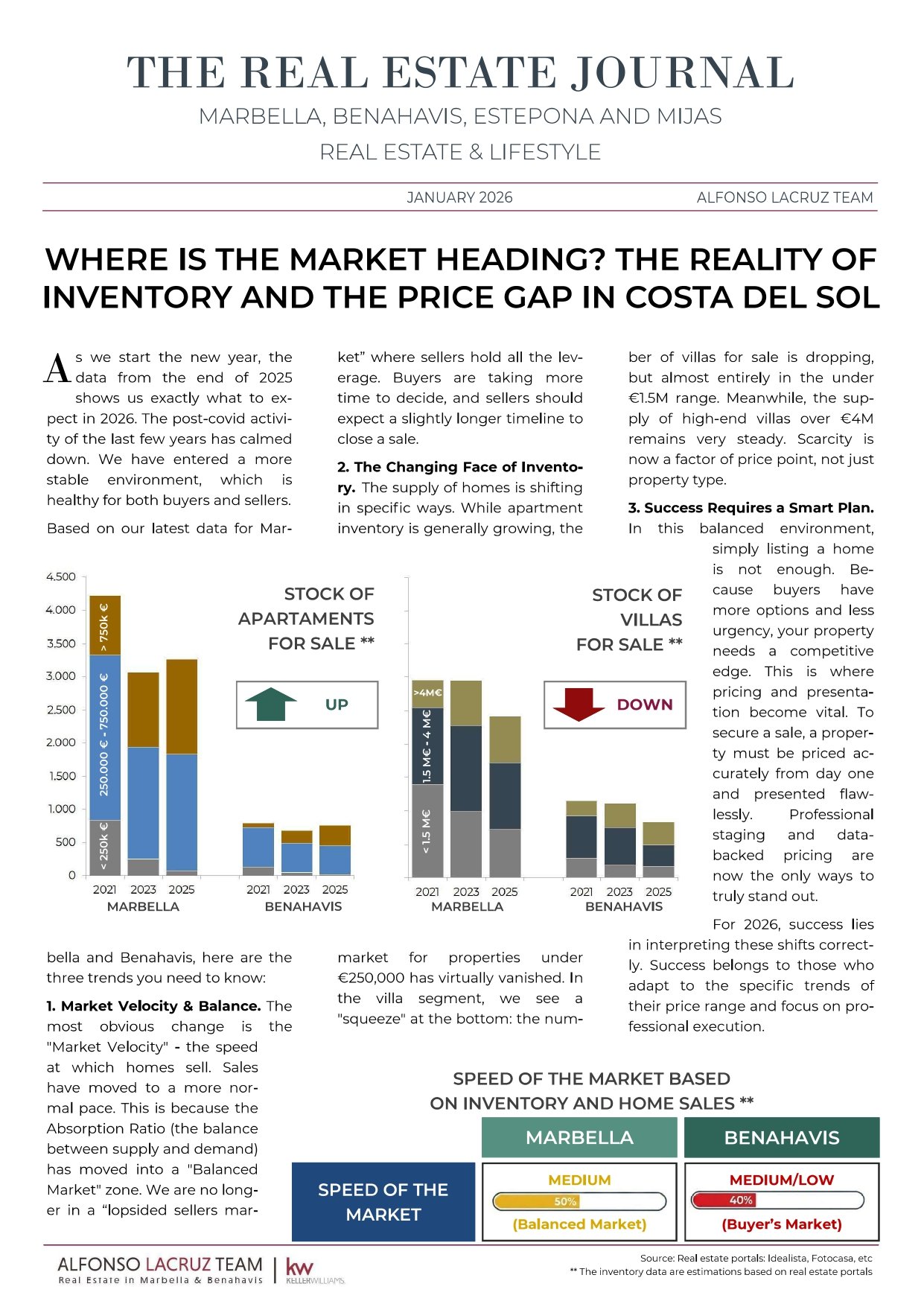
As we start the new year, the data from the end of 2025 shows us exactly what to expect in 2026. The post-covid activi­ty of the last few years has calmed down. We have entered a more stable environment, which is healthy for both buyers and sellers.

Based on our latest data for Marbella and Benahavis, here are the three trends you need to know:

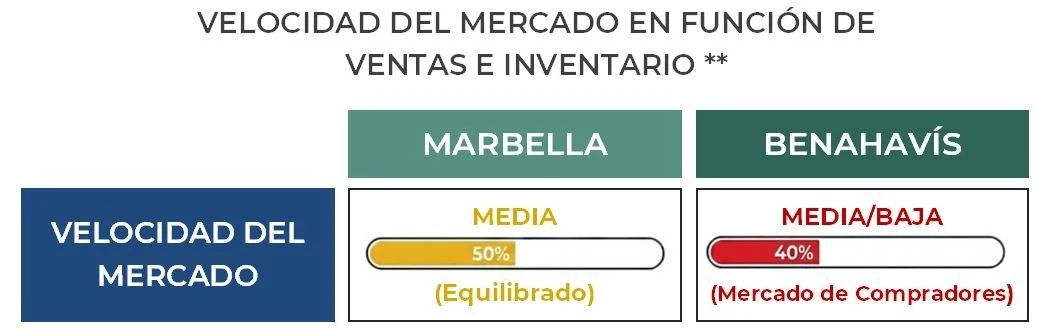
1. Market Velocity & Balance. The most obvious change is the "Market Velocity" - the speed at which homes sell. Sales have moved to a more nor- mal pace. This is because the Absorption Ratio (the balance between supply and demand) has moved into a "Balanced Market" zone. We are no long- er in a "lopsided sellers market" where sellers hold all the lev­erage. Buyers are taking more time to decide, and sellers should expect a slightly longer timeline to close a sale.

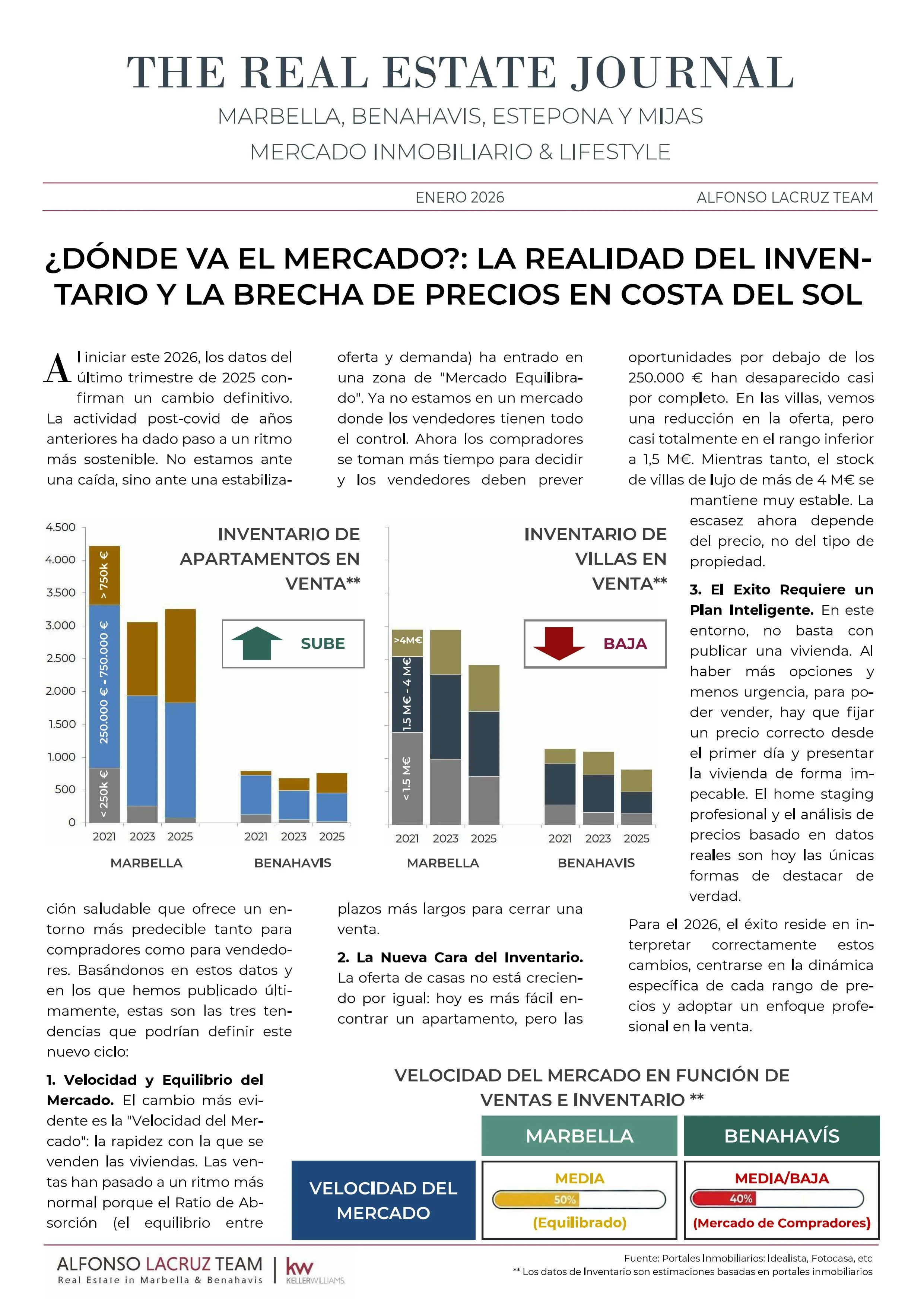
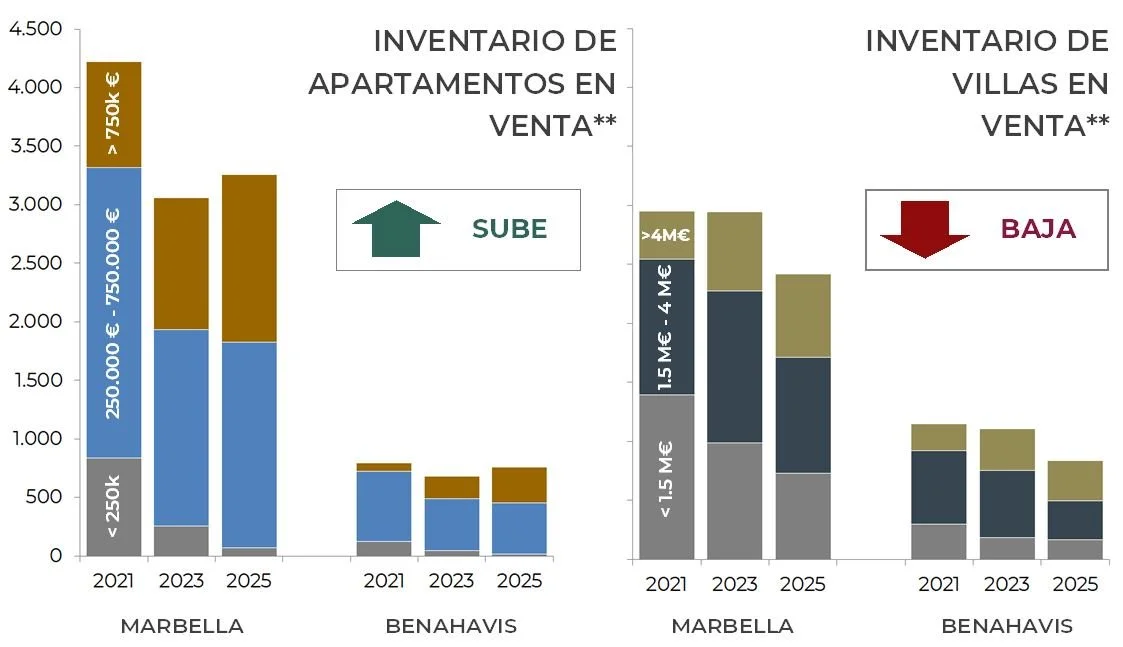
2. The Changing Face of lnvento­ry. The supply of homes is shifting in specific ways. While apartment inventory is generally growing, the market for properties under €250,000 has virtually vanished. In the villa segment, we see a "squeeze" at the bottom: the number of villas for sale is dropping, but almost entirely in the under €1.5M range. Meanwhile, the sup­ply of high-end villas over €4M remains very steady. Scarcity is now a factor of price point, not just property type.

3. Success Requires a Smart Plan. In this balanced environment, simply lísting a home is not enough. Be­cause buyers have more options and less urgency, your property needs a competitive edge. This is where pricing and presenta­tion become vital. To secure a sale, a proper­ty must be priced ac­curately from day one and presented flawessly. Professional staging data- backed pricing are now the only ways to truly stand out. For 2026, success lies in interpreting these shifts correct­ly. Success belongs to those who adapt to the specific trends of their price range and focus on pro-fessional execution.

QUÉ DETERMINA REALMENTE EL VALOR DE UNA VILLA EN MARSELLA Y BENAHAVÍS ENTRE 5OOK€ Y 2.M€

En el rango de entre 500.000 € a 2.000.000 €, el va­lor de una villa no lo dictan solo los metros cuadrados. Dos viviendas similares pueden tener precios muy distintos porque el comprador compara no solo tama-ños sino también "cómo se vive en esa zona y casa" y "qué le puede costar después una casa con esas carac­terísticas". En cualquier caso y en la práctica, el precio de mercado se apoya en cuatro pilares, dos sobre la villa y dos sobre el mercado: ubicación, la propiedad, competencia y mercado.

  • Ubicación (y micro-ubicación). "Ubicación, ubica­ción, ubicación" es cierto, pero aquí la micro-ubicación manda. No hay una sola Marbella ni un solo Benahavís. Incluso dentro de Nueva Andalucía, La Campana, Cen­tro Plaza, La Cerquilla o Aloha se valoran diferente. Pe­san el acceso, los servicios y la calidad del entorno. Tam­bién cuenta la "fricción": el ruido, las pendientes, calles estrechas o poco aparcamiento.

  • La propiedad (calidad y habitabilidad). El estado y el mantenimiento cambian la percepción en segundos. Una cocina es una cocina, pero no es lo mismo una Gaggenau que un conjunto más básico de Bosch: real­mente no es el coste real, sino la percepción de valor del comprador. Lo mismo con ventanas, baños y demás calidades. Independientemente de la calidad están las sensaciones de habitabilidad: orientación y luz, distribución, tamaños de habitaciones, privacidad, las escaleras y la parcela utilizable. Las vistas suman, pero valen más si no se pueden per­der en el futuro.

  • Competencia (tus rivales). Si hay muchas villas similares en venta, aumenta la presión de precio. Por eso analizamos dos compara­bles: i) Los "en venta" nos dicen contra quién compite hoy: qué opciones verá el compra­dor y qué debes superar en presentación, prestaciones y, si hace falta, precio. ii) Los "vendidos" son la referencia más sólida por­que reflejan el precio real tras la negociación.

  • Mercado (oferta y demanda). Cuando la demanda es fuerte, los precios suben; cuan­do es débil, el precio se convierte en palanca. Esto enlaza con mi Journal de Noviembre sobre la brecha entre precio de salida y precio de cierre: los portales muestran la expectativa del vendedor, pero el mercado real lo definen los vendidos.

    En resumen: fijar un precio de mercado requiere anali­zar profesionalmente estos cuatro pilares con datos de ventas cerradas y no solo anuncios online.